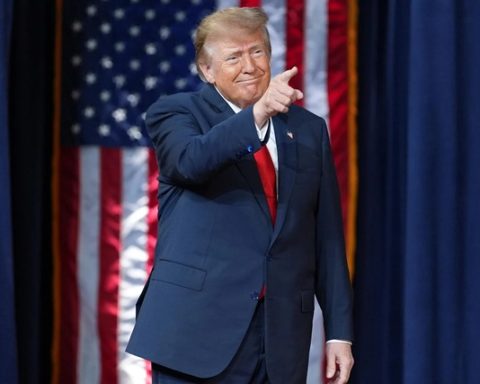

Just as monstrous and mutant algae invade the lagoon of Venice, so our television screens are populated, saturated, by ‘degenerate’ images and statements. In the field of social ecology, men like Donald Trump are permitted to proliferate freely, like another species of algae, taking over entire districts of New York and Atlantic City; he ‘redevelops’ by raising rents, thereby driving out tens of thousands of poor families, most of whom are condemned to homelessness becoming the equivalent of the dead fish of environmental ecology. (Félix Guattari, The Three Ecologies)
“I am the last Cassandra of the human history. . . . I prophesied and nobody believed, and this time it’s not only Troy that will burn, but Sparta and Ithaca and all the Achaeans too.” (Salman Rushdie, Quichotte)
The Trump Revolution in Two Moves
Do you remember what Joe Biden said a few months ago about the possibility Trump’s election victory?
He said, more or less, that Trump’s victory would destroy American democracy. He wasn’t wrong; assuming that American democracy ever existed (which I don’t believe), the advent of the Trump-Bannon-Musk gang represents its full-blown liquidation.
Technically speaking, the advent of Trump aims to be a revolution, albeit a reactionary one. The Trumpist revolution will happen in two moves: the first move is announced by Stephen Bannon, the diabolical strategist, the most lucid of that band.
In a talk at New York University at the time of Tthe Donald’s first triumph, he declared: “I am a Leninist.”
To the astonished academic who hosted his talk and asked for explanations, he replied that “Lenin wanted to destroy the state and that’s my goal too.” Actually the appointment of freaks to the highest positions in the administration goes in the direction of making state institutions a carnival joke so as to destroy the public sphere.
However, if for Lenin destroying the state was the premise for building the proletarian dictatorship in the name of a future justice that never arrived, for Bannon destroying the state means allowing the profound dynamics of American society to be unleashed.
Here comes the second move, whose proponent would be Elon Musk: unleashing the animal spirits of American society, starting from a reactivation of the wild dynamics of this society, born from a genocide and enriched by deportation and slavery.
The Musk’s project is the creation of a high-tech slave system, the abolition of residual social protections, the systematic use of terror against minorities and migrant persons. The implementation of this programmatic framework can be glimpsed in declarations and in the first steps of the DOGE project.
Pretending that the US is a democracy (if the word means something) implies a state of systematic denial, a stubborn removal (in the Freudian sense of Verdrängung) of the psychogenesis of the American unconscious.
Before dying, just a few months ago, Paul Auster wrote Bloodbath Nation (2023), which tries to come to terms with the reality (and the unconscious) of the American entity.
Auster remarks that in Berlin there is a monument dedicated to the memory of the Holocaust. In Washington there is nothing dedicated to centuries of slavery. Racism is the core of the American unconscious. This is why Trump is the soul of America.
Better said: Trump is the psychotic eruption of the senescent white unconscious, unable to deal with the amount of violence that haunts the collective self-perception, and unable to deal with decline (demographic decline, mental decline, political decline).
Trump is he aggressive extroversion of the unbearable self-despise of white culture. Twenty-five years ago, Michael Hardt and Antonio Negri wrote in Empire (2000) that:
“Empire is the . . . sovereign power that governs the world. . . . Empire is emerging today as the center that supports the globalization of productive networks and casts its widely inclusive net to try to envelop all power relations within its world order. . . . We should understand the society of control . . . as the society . . . in which mechanisms of command become ever more “democratic,” ever more immanent to the social field, distributed throughout the brains and bodies of the citizens.” (pp. xi-23)
Dazzled by the light of the Clinton era, Hardt and Negri were missing the nihilistic substance of the global power of the United States and the destructive nature of the new technologies, dependent on the neoliberal model. That book proposed to view the postmodern Empire as the equivalent of the progressive trend implicit in the utopia of networked revolution.
“The imperial project, a global project of network power, defines the fourth phase or regime of U.S. constitutional history.” (p. 179)
Hardt and Negri were expecting peace and prosperity based on the peer-to-peer principle as they failed to see the duplicity of that principle and also because they did not grasp the irredeemable abyss of the American unconscious. A year later, Salman Rushdie published his highly prophetic Fury. Let’s read some lines:
“This Metropolis built in Kryptonite in which no Superman dared set foot, where wealth was mistaken for riches and the joy of possession for happiness, where people lived such polished lives that the great rough truths of raw existence had been rubbed and buffed away, and in which human souls had wandered so separately for so long that they barely remembered how to touch; this city whose fabled electricity powered the electric fences that were being erected between men and men, and men and women too?” (pp. 86-87)
The tension that ran beneath the surface of globalism at the beginning of the century is not perceived by the authors of Empire, who wrote instead:
“Empire can only be conceived as a universal republic, a network of powers and counterpowers structured in a boundless and inclusive architecture. This imperial expansion has nothing to do with imperialism, nor with those state organisms designed for conquest, pillage, genocide, colonization, and slavery. Against such imperialisms, Empire extends and consolidates the model of network power.”(pp. 166-67)
A few months after the publication of Empire, the new economy based on the digital technology collapsed worldwide. Eventually, in the year 2001, Al-Qa’ida put in motion the war that unfolded in the terrorist wave of Daesh and in the counter-terrorist wars of Iran Afghanistan and so on.
This evolution totally escapes to the theoretical schema outlined in Empire:
“An idea of peace is at the basis of the development and expansion of Empire. This is an immanent idea of peace that is dramatically opposed to the transcendent idea of peace, that is, the peace that only the transcendent sovereign can impose on a society whose nature is defined by war. Here, on the contrary, nature is peace.” (p. 167)
In the same page of the book, Hardt and Negri quote Virgil: “’The final age that the oracle foretold has arrived; / The great order of the centuries is born again ‘” (p. 167). Shortly after the publication of this book, the history of the world took a totally different direction. The 9/11 coup de scene provoked a reversal of the prevailing sentiment of invincibility of the Western hegemony.
The never ending peaceful expansion of democracy gave way to the breakdown of the global hegemony of the United States. After a decade of inconclusive wars, of social decline, and of growing resentment, the emergence of Donald Trump marked the beginning of a sort of chaotic civil war in the very center of the Empire.
Now, twenty-five years later the civil war in the US is provisionally over, and it’s easy to understand who is the (provisional) winner. The winner is not Augustus, the glorious and peace loving emperor glorified by Virgil but an interesting mix of Caligula and Nero.
The problem with Hard and Negri, the reason why their book failed to grasp the impending process, lies in their indifference to the anthropological dimension in which American politics is deployed. Only by gauging the abyss of the American unconscious, can we decipher the roots of the social ferocity that now is in full display.
Unthinkable
Much more interesting than Hardt and Negri’s Empire is Congressman Jamie Raskin’s Unthinkable: Trauma, Truth, and the Trials of American Democracy.
Published in 2022, on the first anniversary of the farcical insurrection that brought thousands of Trump’s followers into the political heart of the US, the book takes on new meaning today, after the comeback of the leader of that subversive demonstration.
Jamie Raskin is also a professor of constitutional law, a self-proclaimed liberal, and a father of three. One of his children, Tommy – a political activist, a supporter of progressive causes, a compassionate, empathic young man – died on the last day of 2020.
To be more precise, Tommy committed suicide because of a long lasting depression and also (it goes without saying) because of the long moral humiliation of his humanitarian values during the years of the first Trump incumbency.
This book has been important for me because it contains a radical reflection on the entrenched racism of the American democracy (a detail that totally escaped to the authors of the book of the self appointed Marxists who authored Empire).
For Raskin, Tommy’s final decision is not only an affective catastrophe but the trigger of a radical meditation on the depth of the crisis that is tearing apart liberal democracy. I read the book just after its publication, and I’m reading the book again now that the comeback buries forever the credibility of the country’s democracy and questions the very credibility of the concept of democracy itself.
Raskin writes that he has always considered himself as “an optimist, and I am radically optimistic about how the Constitution of the nation itself can uplift our social, political, and intellectual condition.”
After the death of his son, however, his self-perception has changed. He writes that his constitutional optimism is shattered by the prevailing of brutal force upon the force of reason,and by the spread of depression.
“Suddenly, this constitutional optimism shames and embarrasses me. . . . I fear that my sunny political optimism, what many of my friends have treasured in me most, has become a trap for massive self-delusion, a weakness to be exploited by our enemies. Yet I am also terrified to think about what it would mean to live without this buoyancy—and also without my beloved, irreplaceable son. The two always went hand-in-hand, and now I may be alive on earth without either of them” (p. 11)
The political optimism of this generous law professor is shaken by the sudden realization that liberal democracy rests on a fragile foundation. In fact, he writes: “Seven of our first ten presidents were slaveholders. These facts are not contingent or random but arose from the deep architecture of our political institutions” (p. 117).
Slavery is part of the cultural heritage of the American nation, just as genocide was of the early inhabitants of the territory. How can this nation claim to be seen as an example to something else?
How can we avoid thinking that this nation is a danger to the survival of humanity?
Now it’s getting impossible to persist in the state of denial: the American memory is so loaded with horror that no political evolution can erase this elementary truth from the collective unconscious of a country whose manifest destiny is the destruction of the whole human kind.
In the speech that Biden gave on 6 January 2022, one year after the insurrection, speaking of the need to reject violence, he said: “We must decide what kind of nation we are going to be.”
Can America decide to rule out violence, if American history is based on violence, slavery, and genocide?
The irredeemability of that past is a source of systemic depression for the West and therefore a systemic source of violence. But now, if we look at the geopolitical landscape, if we look at the inner landscape of the Western culture, disintegration seems irreversible.
Will the decline and disintegration of the Western world trigger the final destruction of what we used to call civilization?
Disintegration
Disintegration is the trend emerging throughout the Western world.
In every European country, as in the United States, not to mention Israel, the population is irreconcilably divided by the alternative between liberal democracy and authoritarian tyranny. As liberal democracy has always been fake also the alternative is false, but disintegration is real.
In my humble opinion, Trump’s election will accelerate the Western disintegration. I don’t think there will be a civil war as was the case during the Spanish Civil War, with armed multitudes clashing along a more or less defined front. No, this is not how the civil war of a demented population unfolds. We’ll have a multiplication of racist shootings, of massacres, we will simply have what is already there, but increasingly widespread, harsh, violent.
The mass deportation that has been has promised by the winners will rather result into a restaging of the Ku Klux Klan in many areas of the country than in an actual operation of impossible repatriation of undocumented immigrants. Violence, fear, aggressiveness will eventually persuade migrants to go away, but the process will hardly be peaceful. Despair will be the driving force of the American disintegration.
In Deaths of Despair and the Future of Capitalism (2020), Anne Case and Angus Deaton describe despair in statistical terms: increased mortality, particularly among whites aged 45 to 54 years old – alcoholism, suicide, use of firearms, obesity and addiction to opioids (such as fentanyl). Overall decline in life expectancy (unique among advanced countries): from 78.8 years in 2014 to 76.3 years in 2021. All this in the presence of the highest healthcare spending in the world (equal to 18.8 percent of GDP).
Nonetheless, we cannot expect a peaceful disintegration of American power. Just as Polyphemus, blinded by Ulysses, slashes those who approach him, so the colossus is destined to react with reckless fury.
In “After Trump’s Victory: From MAGA to MEGA,” Slavoj Žižek relativizes the Trumpian triumph and tries to see it in perspective. The MAGA formula could be described in an inverted way: after decades of military defeats, the superpower recognizes that it cannot continue the policy of global hegemony and must withdraw by accepting, without admitting it, a position of local power that must compete on an equal footing with other local powers, Russia, China, India.
Žižek’s opinion is well founded, but my question is: Will the stronghold of white supremacy accept its decline without a reaction that might be no less than apocalyptic?
Furthermore Zizek thinks that Europe could emerge strengthened from the downsizing of the American geopolitical role, hidden behind the promise of “making America great again.” Europe, according to Žižek, will no longer be the “little sister” of the giant.
Here too I have some doubts. The Žižek’s hypothesis would only be true if the EU really existed. But the Ukrainian war has pushed the European Union into a position of irrelevance, weakness, and rapid disintegration.
The French government is breaking down, the German government I breaking down, while economic recession is looming. The strategic defeat in the war against Putin’s Russia (the legacy of Biden) pushes the union towards disintegration, while the allies of Putin, election after election, are winning the majority of the continent’s parliaments.
To conclude my short essay I will quote Rushdie’s Quichotte again: “I can’t look up. Up there, what is that. Like a colossus with a huge blaster blew a hole in the air. You look at it, you want to die. This can’t be fixed. I don’t believe there’s anyone in DC or Canaveral who knows what the fuck to do about this.”