


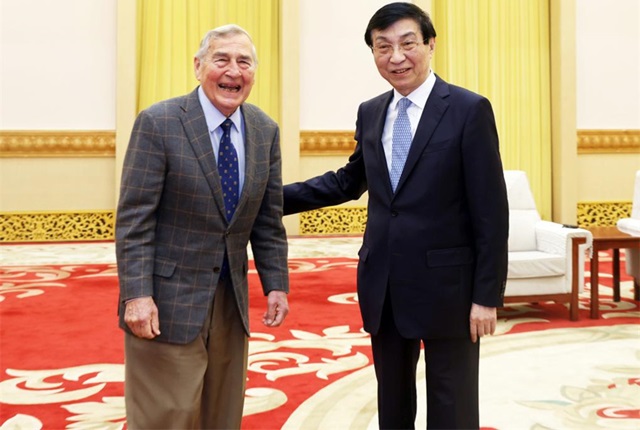
On a significant Thursday in Beijing, a momentous meeting took place between Wang Huning, the chairman of the National Committee of the Chinese People’s Political Consultative Conference, and Graham Allison, the Harvard academic celebrated for his articulation of the “Thucydides Trap.” This intellectual rendezvous underscored an enduring theme: the intricate interplay of global superpowers. Wang’s reaffirmation of Xi Jinping’s four “red lines”—principles delineating China’s sovereignty and ideological non-negotiables—was a calculated reminder of China’s rise within a framework of modernization defined on its terms. This very encounter resonates with the prescient critique Wang penned in 1991’s America Against America.
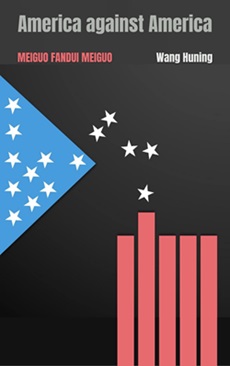
In America Against America, Wang unveils an incisive analysis of the United States, a nation he deconstructs through the lens of contradictions: prosperity shadowed by inequality, democracy impeded by economic disparity, and innovation fettered by the ghosts of tradition. Through the book, Wang challenges not only the grandiosity of the American experiment but its applicability as a model for China or any other nation. His methodology, a blend of empirical observation and sociopolitical critique, foreshadows his later ascent as a key ideologue shaping China’s 21st-century governance.
A Nation of Contradictions
Wang’s journey through America—chronicled in his preface—takes him from bustling metropolises to forgotten rural enclaves. “America is a rich country,” he admits, but he counters this perception by painting vivid scenes of urban homelessness: “At Berkeley’s People’s Park,” he notes, “a tent city sprawls with destitute individuals, their plight symbolizing the underside of prosperity.” This paradox—wealth alongside abject poverty—is foundational to his thesis.
Furthermore, Wang’s reflections on American democracy evoke unease. He critiques its superficial egalitarianism, observing, “The Constitution is revered, but economic disparities ensure that political power remains concentrated among elites.” Quoting American scholar Sydney Hook, Wang underscores the limitations of a democracy tethered to capitalism: “A democracy cannot function where economic power subverts the political process.” In this analysis, Wang’s implicit query is whether China’s central governance model can sidestep these pitfalls while fostering equitable progress.
The “Four Cs” of American Hegemony
Wang identifies four elements he deems emblematic of American society: Cars, Calls, Computers, and Cards. Each “C”, while signifying progress, embodies the fractures within the societal framework.
- Cars: Symbols of mobility and modernity, yet Wang observes the environmental and social costs: “Pollution, traffic fatalities, and urban sprawl are the shadows cast by the automotive revolution.”
- Calls: A society interconnected through telephony, but plagued by “invasion of privacy and unending noise.”
- Computers: Tools of efficiency, but vulnerable to “systemic fragility”—a cautionary tale as “digital monopolies tighten their grip.”
- Cards: Representing convenience in economic transactions, yet their proliferation facilitates “crime, forgery, and financial exclusion.”
Wang’s exploration of these four facets elucidates the paradox of technological progress—its potential for liberation curtailed by its commodification and the inequities it perpetuates.
Commodification: Blessing or Blight?
The commodification of American society forms another cornerstone of Wang’s critique. He marvels at the ubiquity of consumer goods but notes the existential costs: “Even human flesh, sex, knowledge, and power become commodities in this marketplace.” This commodification, Wang argues, has eroded societal cohesion and undermined the moral fabric. Yet he acknowledges its efficacy in reducing the government’s role in everyday affairs: “By allowing housing, food, and employment to self-regulate via market mechanisms, commodification lightens the administrative burden.”
Here, Wang strikes a controversial tone, oscillating between admiration and disdain. Commodification, he implies, is both the genius and the Achilles’ heel of the capitalist model—a lesson for China as it balances market reforms with centralized governance.
American Democracy: Ideal or Illusion?
Wang’s dissection of American democracy is particularly biting. He juxtaposes the ideals of freedom and equality against the systemic disenfranchisement borne of economic stratification. Elections, he argues, are “dominated by powerful lobbying groups, rendering the common citizen a spectator rather than a participant.” This insight mirrors Xi Jinping’s emphasis on “whole-process people’s democracy”—a governance model purportedly free from such contradictions.
Quoting Alexis de Tocqueville’s observation that “America is great because she is good,” Wang delivers a devastating counterpoint: “America’s greatness is now sustained by illusions, its goodness compromised by systemic inequities.”
Lessons for China
Perhaps the most provocative element of America Against America is Wang’s implicit roadmap for China. He warns against wholesale adoption of Western models, emphasizing the unique historical, cultural, and social conditions that shape each nation’s path. As he writes, “What works in America cannot simply be transplanted to another society.”
Wang’s critique of American inequality and commodification underscores the importance of safeguarding social equity within China’s modernization drive. His analysis of democratic shortcomings cautions against excessive decentralization, while his admiration for technological advancement advocates a tempered embrace of innovation, ensuring it serves collective well-being rather than individual profit.
Controversy and Resonance
America Against America is a masterclass in intellectual provocation. Wang’s unflinching critique of the United States invites discomfort, not merely for Americans but for any reader inclined to lionize or vilify a nation in binary terms. By exploring the contradictions within the American ethos, Wang challenges us to question our assumptions about modernity, democracy, and governance.
For China, Wang’s work resonates as a manifesto of caution and aspiration. It reflects the ideological groundwork underpinning Xi Jinping’s policies, from the Belt and Road Initiative to “common prosperity.” For the West, it is an uncomfortable mirror, reflecting the gaps between its ideals and its realities.
America Against Itself
Wang’s titular paradox—America Against America—captures the essence of his critique. America’s greatest strengths are also its deepest vulnerabilities. Its wealth is shadowed by inequality; its democracy, marred by systemic disenfranchisement; its innovation, tempered by tradition.
As Wang closes his preface, he leaves readers with a profound observation: “The United States is not a simple homogeneous whole. To understand it, one must grasp its contradictions.” This insight, at once an indictment and an invitation, makes America Against America an indispensable text for anyone seeking to understand not just America but the modern world. In an era where superpowers vie for global influence, Wang’s work is both a warning and a guide, urging us to learn from history’s most intricate lessons—lest we repeat them.










