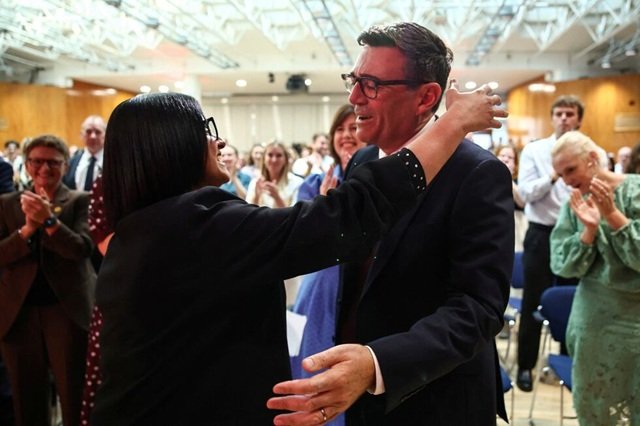
Andy Burnham will arrive at 10 Downing Street on Monday as the United Kingdom’s new prime minister, becoming the seventh person to hold the office in the decade since the Brexit referendum transformed British politics. His appointment follows a rapid and unexpected change in Labour Party leadership that ended Keir Starmer’s tenure after little more than a year in government and reflected growing concerns within the party over its electoral prospects.
The transition will follow one of Britain’s oldest constitutional traditions. Before entering Downing Street, Burnham is scheduled to travel in an official vehicle provided by Buckingham Palace to meet King Charles III, who will formally invite him to form a new government. The ceremony, repeated for centuries with successive prime ministers, now unfolds against the backdrop of an unusually turbulent political period marked by frequent leadership changes and shifting electoral fortunes.
Burnham’s rise to the country’s highest political office comes after Labour replaced Starmer with the former mayor of Manchester in an effort to reverse increasingly unfavorable opinion polls that predicted declining support for the governing party alongside continued gains for Nigel Farage’s right-wing movement. The leadership contest concluded only weeks after Labour’s disappointing performance in England’s local elections on May 7, a result that accelerated calls within the party for a change at the top.
Burnham’s advisers have sought to temper expectations ahead of his first day in office. Rather than presenting his premiership as the beginning of a triumphant new chapter, they have indicated that his opening remarks will emphasize honesty, reflection, and a commitment to giving British citizens what they describe as “some room to breathe” after years of political and economic strain.
Earlier on Monday, Starmer will deliver his farewell statement outside Downing Street before departing office. Elected in July 2024 after leading Labour back to government following 14 years of Conservative rule, Starmer secured a commanding parliamentary majority and frequently argued in his final days as prime minister that he was leaving the country in a stronger position than he had inherited. Despite that assessment, Labour lawmakers concluded that retaining him as leader risked losing the next general election, choosing instead to pursue a rapid change in leadership.
Burnham formally became Labour leader last week, using his acceptance speech to promise what he described as the most significant political transformation Britain has seen in four decades. His diagnosis of the country’s challenges centers on the political and economic model introduced during Margaret Thatcher’s governments in the 1980s, a period that, in his view, concentrated political authority while transferring increasing economic power into private hands.
By framing his political agenda in those terms, Burnham also implicitly distances himself from successive Labour governments led by Tony Blair, Gordon Brown, and Starmer, arguing that the need for structural reform extends across decades rather than focusing solely on recent administrations. His proposed direction emphasizes devolving greater authority to local governments while placing household finances and everyday economic security at the center of government decision-making.
Lucy Powell, Labour’s deputy leader since October 2025 and one of Burnham’s closest political allies, described those objectives in an interview with the BBC by highlighting practical concerns facing many families. She said the new administration intends to improve job security, expand opportunities for home ownership, strengthen local communities, and create conditions that offer future generations greater prospects.
Although Burnham has outlined broad priorities, he has disclosed relatively few details about the composition of his cabinet or the government’s immediate policy agenda. The limited information has fueled days of speculation across British media regarding ministerial appointments and the direction of the new administration. Burnham has said only that he was finalizing those decisions and intended to announce his cabinet after formally taking office.
One appointment has already been confirmed. James Purnell, a longtime political ally who shared parliamentary offices with Burnham during the 1990s, will become his chief of staff and one of his closest advisers inside Downing Street.
Attention has largely focused on the position of Chancellor, traditionally regarded as the second most powerful office in the British government. British media have widely reported that Home Secretary Shabana Mahmood is expected to assume the role, a possibility that surprised many observers who anticipated former Labour leader Ed Miliband would receive the appointment instead.
Mahmood has built a political profile through a tougher approach to immigration, earning support from Labour’s right wing. However, questions surrounding her economic experience have prompted uncertainty among sections of Britain’s business community. At the same time, reports suggesting Miliband will not become Chancellor have been welcomed by some business leaders, who viewed his commitment to ambitious climate policies as potentially conflicting with Burnham’s emphasis on economic pragmatism.
Energy policy is expected to feature prominently during the government’s opening weeks. Burnham has indicated that his administration intends to relax restrictions affecting existing oil production in the North Sea. While his team has ruled out issuing new exploration licenses, it has suggested that measures will be introduced to increase output from existing fields as part of efforts to reduce energy costs for households facing years of elevated utility bills.
The incoming prime minister has also reaffirmed support for greater public involvement in essential services. Drawing on policies introduced during his tenure as mayor of Manchester, where he oversaw the public control of the city’s transport network, Burnham plans to place Thames Water, the utility serving more than 16 million customers and currently facing financial collapse, under a special public administration regime. His government also intends to reduce and cap fares on urban bus services.
Beyond those immediate initiatives, Burnham has identified long-term reforms that he says will require sustained implementation. Among them are plans to overhaul Britain’s social care system for elderly and vulnerable people, an area that has experienced significant strain over the past decade. Housing is expected to become another central priority, with proposals to accelerate the construction of thousands of social homes in response to shortages affecting communities across the country.
The new government has also signaled an early shift in immigration policy by announcing its intention to abandon plans for a national identity card system. The proposal, developed under Starmer’s administration as part of broader efforts to address irregular migration, had long faced public opposition and recalled similar debates during Tony Blair’s premiership.
Burnham’s arrival in Downing Street marks another chapter in the period of political volatility that has characterized Britain since the Brexit referendum. His government begins with ambitious promises of institutional reform, economic relief, and a different governing style from his predecessor. As the initial transition gives way to the practical demands of governing, attention will increasingly turn to how those commitments are translated into policy and how quickly the new administration can deliver measurable results for a public that has witnessed repeated changes in leadership over the past decade.