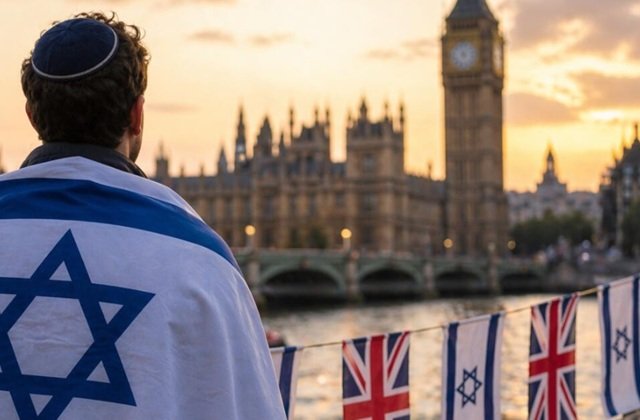
On April 29, 2026, two Jewish men, Shilome Rand (34) and Moshe Shine (76), were stabbed in broad daylight on Highfield Avenue, which runs off Golders Green Road, north London, Britain, a neighbourhood known for its Jewish settlement. The attacker, a 45-year-old man, a British national born in Somalia (identity not yet revealed), was Tasered by Police before being arrested on suspicion of attempted murder and remains in custody. Later, the head of Counter Terrorism Policing, Assistant Commissioner Laurence Taylor, formally declared the attack a terrorist incident. Additionally, Police are treating the incident as terrorism, with the suspect described as having been hunting for anyone “visibly Jewish” to attack. Prime Minister, Keir Starmer commented: “The antisemitic attack in Golders Green is utterly appalling. Attacks on our Jewish community are attacks on Britain.”
Chief Rabbi Sir Ephraim Mirvis, who represents Britain’s largest Jewish community, stated: “I’m sad to say that today’s event proves that if you are visibly Jewish, you’re not safe and far more needs to be done… It’s a sustained effort to terrorise the Jewish community, which will not succeed, because we’re a strong and resilient community. We face these kinds of attacks and these incidents with great fortitude. However, this cannot be allowed to continue.”
This stabbing is not an isolated event but part of a wider surge in antisemitic incidents across London in recent months, including the incident on October 2, 2025, in which two Jewish persons were killed, and three were left in serious condition after a car rammed them, followed by a stabbing attack, outside a synagogue in Manchester. Several incidents have occurred in March 2026, including on March 23, 2026, when four Jewish charity-owned ambulances were set on fire in the car park of a synagogue in Golders Green, followed by the April 15, 2026, incident, when a brick and two bottles thought to contain petrol were thrown at the Finchley Reform Synagogue in north London. Again, on April 17, 2026, suspicious items, later found to be non-hazardous, were found near the Israeli Embassy in London. On April 18, 2026, a bottle containing an accelerant was thrown through the window of Kenton United Synagogue in north-west London. On April 27, 2026, a suspected arson attack was carried out at a memorial wall in Golders Green, which contained tributes to people killed by the Iranian regime during anti-government protests, as well as a section to those killed in the 2023 Hamas attack on Israel. A clear pattern of a sharp rise in antisemitic attacks is being observed in Britain since the war in Gaza.
A notable incident had occurred on November 23, 2025, when anti-Zionist activist groups staged a protest led by Jewish Anti-Zionist Action (JAZA) and Palestine Pulse, rallying outside the St. John’s Wood United Synagogue in London against a World Zionist Organization (WZO) Aliyah Day commemoration. The protestors asserted that the WZO the event was facilitating the genocide of Palestinians and colonisation of their land. Activists projected “Jews for Palestine” and “Stolen lands sold here” onto the synagogue facade, according to JAZA. Later, on February 25, 2026, the European Legal Support Centre (ELSC) stated that it had verified 964 cases of “anti-Palestinian repression” in UK between January 2019 and August 2025, including students being investigated over their solidarity, activists being arrested, employees facing disciplinary procedures, and artists having their events cancelled. Apart from public sentiment, there have been political debates and conferences reflecting an anti-Zionist stance, such as the March 28, 2026, spring conference of the UK’s Green Party failed to vote on a controversial motion to define Zionism as racism, after proceedings were derailed by internal disputes, multiple no-confidence motions against the chair, and technical failures. As part of the proceedings, the party, led by Jewish non-Zionist Zack Polanski, was expected to vote on a “Zionism is Racism” motion that called for the abolishment of the Jewish state of Israel and the establishment of a “single democratic Palestinian State in all of historic Palestine with Jerusalem as its capital.” The motion would also have formally rejected the definition of antisemitism as set by the International Holocaust Remembrance Alliance (IHRA), claiming that it has been “weaponized to silence legitimate criticism of the state of Israel.” This perception of repression, combined with war imagery around Gaza, has contributed to a charged atmosphere in which grievances are easily radicalised. The convergence of these issues, the West Asian conflict, and ideological polarisation, has contributed to an environment that may justify or inspire violence against Jewish targets.
British counter-terrorism officials are currently studying a claim of responsibility for the April 29 stabbings by a group linked to Iran known as Harakat Ashab al-Yamin al-Islamia (HAYI), which has previously claimed responsibility for a string of attacks across Europe since March 2026, mainly targeting Jewish communities. This incident garnered attention from national leaders, including the Leader of the Conservative Party Kemi Badenoch, who said there was now “an epidemic of violence against Jewish people” that had become “a national emergency”. Additionally, Israel’s Foreign Ministry stated, regarding the incident, “Prime Minister Keir Starmer’s statements are no substitute for confronting the roots of antisemitism festering across the United Kingdom… British Jews should not need security patrols and emergency volunteers to live openly as Jews.” The broader pattern of incidents, reactions and investigative angles suggests that this is not merely a domestic law-and-order issue but part of a transnational trend of targeted religious intimidation.
The Golders Green stabbing marks a serious escalation in antisemitic violence in Britain, moving from property damage to direct, targeted physical attacks on individuals. If the current trajectory of incidents continues, the challenge for British authorities will not only be preventing further incidents but also rebuilding trust and security in a community that increasingly feels threatened.