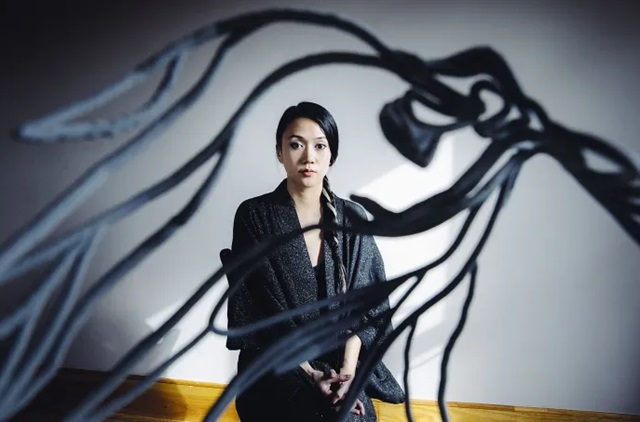
In an era where artificial intelligence is often seen as a threat to artistic creativity, Canadian-Chinese artist Sougwen Chung embraces AI as a tool for collaboration and exploration. Through their work, Chung challenges traditional notions of artistic creation, demonstrating that technology can be more than a mere instrument—it can be a partner in the creative process.
Chung’s art is deeply intertwined with technology, often performed live and evolving in real time. Audiences witness an extraordinary synergy as the artist works alongside robots, drawing simultaneously with AI-driven mechanical arms. This innovative approach pushes the boundaries of art in an age of rapidly advancing artificial intelligence and robotics.
“I consistently question the idea of technology as just a utilitarian instrument,” says Chung. Their approach diverges from the conventional generative AI movement, which often focuses on creating static digital images. Instead, Chung’s work emphasizes performance, spontaneity, and the unpredictability of human-machine collaboration.
One of their most recent works, Spectral, was showcased at the World Economic Forum in Davos in January 2025. This performative installation featured robotic arms guided by AI, drawing based on Chung’s real-time brain activity captured through an electroencephalogram (EEG). “My alpha state drives the robot’s behavior, translating an internal experience into tangible, spatial gestures,” they explain. By integrating AI and robotics, Spectral exemplifies how technology can serve as more than just an artistic tool—it can become a collaborator in creation.
Chung’s journey into AI and robotics has been marked by a deep curiosity about the intersection of traditional art and cutting-edge technology. Born to a father who was an opera singer and a mother who worked as a computer programmer, they grew up surrounded by both artistic and technological influences. Their early works featured sprawling ink drawings, but over time, they transitioned into performance-based art, embracing robotics and AI to expand the possibilities of their practice.
Their first major exploration into AI-assisted art began in 2015 when they developed the Drawing Operations Unit: Generation 1 (DOUG 1). Using an open-source robotic arm, computer vision, and a real-time feedback system, the robot was initially designed to mimic Chung’s drawing movements. However, instead of perfect replication, DOUG 1 introduced small, unpredictable variations, turning errors into an essential part of the artistic process. “One of the most transformative lessons I’ve learned is to ‘poeticize error,’” Chung reflects.
Subsequent iterations of DOUG continued to evolve, incorporating machine learning and real-time data inputs. DOUG 2, trained on Chung’s previous works, generated new drawings during live performances, eventually earning a place in the Victoria and Albert Museum in London. DOUG 3 and DOUG 4 expanded on this concept, integrating external data sources such as urban surveillance feeds and EEG signals to influence their artistic output.
Chung’s groundbreaking work has gained recognition from leading institutions, including the MIT Technology Review, which highlights how their approach redefines the relationship between humans and AI. Rather than seeing AI as a replacement for human creativity, Chung’s work exemplifies a model of co-production—where human intention and machine autonomy merge to create something new and unexpected.
The rise of powerful generative AI models has sparked widespread debate about the future of creativity. Many artists fear that AI, trained on existing artworks, may erode originality and displace human creators. Artist and scholar Sofian Audry acknowledges these concerns, warning that “if people get their work stolen by the system and get nothing out of it, why would they go and do it in the first place?”
While Chung supports the protection of artists’ rights, they also see AI as a means to expand creative possibilities. “Training your own models and exploring how your own data work within the feedback loop of an AI system can offer a creative catalyst for art-making,” they say.
Architect Zihao Zhang, who studies human-machine interactions, believes that Chung’s work provides an alternative narrative to the common AI-versus-human debate. “We’re still kind of trapped in this idea of AI versus human, and which one’s better,” Zhang explains. However, Chung’s work challenges this binary thinking, demonstrating how AI can serve as a co-creator rather than a competitor.
Ultimately, Chung believes that AI remains inherently human—shaped by human data, biases, and experiences. “These technologies don’t emerge in a vacuum—there’s real human effort and material extraction behind them,” they say. “For me, art remains a space to explore and affirm human agency.”
As AI continues to evolve, artists like Chung provide a compelling vision for the future of human-machine collaboration. Their work not only redefines what it means to create art in the digital age but also invites audiences to rethink the role of technology in shaping artistic expression.