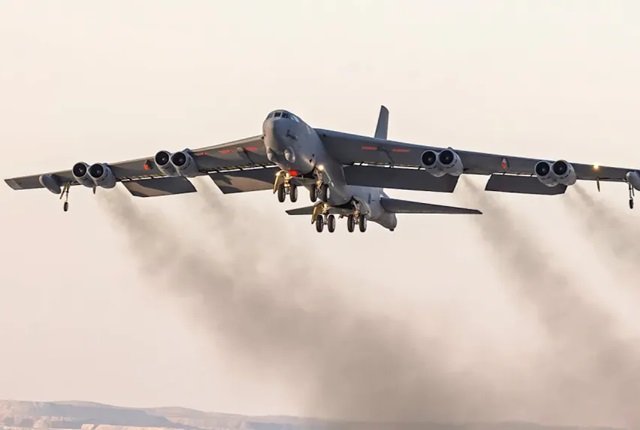
A United States Air Force B-52 Stratofortress crashed shortly after takeoff at Edwards Air Force Base in California on Tuesday morning, erupting into a massive fire and sending a towering column of black smoke into the sky above the main runway area as emergency crews rushed to the scene and the installation moved into immediate response operations.
The crash occurred at approximately 11:20 a.m. on the Edwards airfield, according to an official statement posted by the base on its social media channels. The Air Force confirmed that the aircraft went down shortly after takeoff and that emergency personnel responded immediately. At the time of the initial announcement, officials said the situation remained active and that further information would be released as it became available.
Visuals emerging from the base showed a large blaze along or near the main runway, with dense black smoke visible from miles away. Still images and video circulating shortly after the incident depicted a widespread fire zone, suggesting a high-impact crash and significant post-impact burning in the immediate area of the airfield. Later footage shared by Fox News reportedly showed a heavily scorched stretch of ground adjacent to the runway, with no clearly identifiable wreckage visible in the immediate aftermath.
Early unconfirmed reports circulating online suggested the aircraft may have been tail number 061, though this has not been verified by officials. The aircraft type involved was confirmed as a B-52 Stratofortress, a long-range strategic bomber that has undergone ongoing modernization efforts in recent years. Among those upgrades is the integration of the AN/APQ-188 active electronically scanned array (AESA) radar, part of a broader program aimed at updating the fleet’s capabilities. It remains unclear whether the aircraft involved in Tuesday’s crash was directly connected to that specific modernization configuration.
Details about the crew and their condition were not immediately released following the crash. Initial uncertainty included how many individuals were on board at the time and whether any had been able to eject. The B-52’s crew escape system includes downward-firing ejection seats, a configuration that can present significant complications depending on altitude and timing during an emergency shortly after takeoff.
Prior to the incident, the U.S. Air Force maintained a fleet of 76 B-52 aircraft in service. The bomber involved in Tuesday’s crash was reported to have been on a routine test mission when it went down, according to later confirmation from Air Force officials.
The crash at Edwards came against the backdrop of another recent U.S. military aviation incident, though officials emphasized the events were unrelated. Just days earlier, a U.S. Marine Corps F/A-18D Hornet assigned to Marine Fighter Attack Squadron 323, known as VMFA-323, crashed near Mount Rainier in Washington State on June 13. In that incident, both crew members were able to eject safely, though the aircraft impact sparked a wildfire.
As information continued to develop through the afternoon, Edwards Air Force Base issued additional updates confirming operational disruptions across the installation. By early afternoon, the base announced that the airfield had been closed and that all inbound aircraft were being diverted. Non-commercial visitor passes were also suspended until further notice, as personnel focused on emergency response operations and securing the crash site.
Further clarification came in a press release issued by the 412th Test Wing Public Affairs Office, which confirmed that eight people were aboard the B-52 at the time of the crash. The aircraft was described as being engaged in a routine test mission when it went down shortly after takeoff at 11:20 a.m. Pacific Daylight Time. Officials stated that initial indications suggested the crash was not survivable and confirmed that emergency response teams were on scene working to account for all personnel. The statement also confirmed that the crash remains under investigation.
The number of personnel aboard aligns with the maximum capacity of the B-52, which can carry up to eight crew members, including positions in addition to standard flight stations. Officials did not immediately release further details on the identities or roles of those on board. The incident was noted as potentially one of the most significant losses at Edwards in decades, drawing historical comparison to a fatal 1951 crash involving a B-50D bomber near the base in which eight individuals were killed.
Later in the day, Air Force Col. James Hayes, Deputy Commander of the 412th Test Wing at Edwards Air Force Base, provided additional context during a press briefing. He stated that after reviewing available footage of the crash, officials had determined the event to be an unrecoverable and unsurvivable incident, prompting immediate notification procedures to next of kin and relevant authorities.
Col. Hayes confirmed that the B-52 involved was participating in the Radar Modernization Program at the time of the crash. He also stated that the aircraft carried a mixed crew composed of military personnel, government civilians, and government contractors supporting the test mission. At the time of the briefing, officials said there was still no indication of what caused the crash, and that determining the cause could take up to six months as multiple investigations proceed.
The Air Force further noted that operations at Edwards Air Force Base would be paused the following day, with Col. Hayes explaining that the decision was driven in part by the condition of the runway and the need to prioritize recovery and investigative work. Full operations, he said, would resume later once the installation completes its response and review procedures.