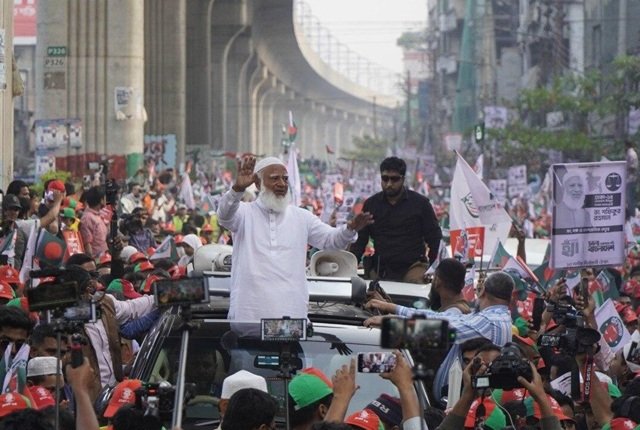
On August 2, 2026, Hizb-ut-Tawhid (HT) Dhaka city unit staged a human chain and protest rally in front of the National Press Club in Dhaka, denouncing open threats, false propaganda, and inflammatory remarks made under the banner of Hefazat-e-Islam (HeI) in Noakhali District. The rally began at 11:00 am, protesting against speeches delivered at HeI’s gathering at Noakhali Zilla School ground on August 1, 2026. Addressing the human chain, Dhaka city HT President Mahbub Alam Mahfuz stated that HeI’s mahfil (gathering) was an extremist and provocative assembly aimed at disturbing Noakhali’s peaceful environment. Mahfuz claimed HeI leaders made baseless allegations against HT and issued direct threats such as burying, evicting, and driving them out of Bangladesh. Mahfuz further accused HeI speakers of inciting violence against a lawful movement by “exploiting religious sentiment through misogynistic and hate-filled rhetoric”.
On July 25, 2026, the Khelafat Majlis withdrew from the 11-party unity program and declared that it will, henceforth, hold programs alone. They are the second party after the Bangladesh Khelafat Andolan to withdraw from the 11-party unity program. The decision was taken at the third general session of the Central Majlis-e-Shura held at the Diploma Engineers Institute auditorium in Kakrail in Dhaka. The announcement stated that some decisions had been taken regarding the 11-party electoral unity in the Khelafat Majlis-e-Shura session, and that the 11-party unity was basically an electoral compromise. With the end of the elections, the effectiveness of this unity ended. After the end of the elections, the Khelafat Majlis participated in some of the 11-party programs. The Khelafat Majlis also stated that efforts would continue to build greater unity if needed for the country, nation and Islam in the future. It added that Khelafat Majlis Members of Parliament would continue to play the role of the Opposition in Parliament.
Staging a protest against HeI and Khelafat Majlis’ decision on July 25, 2026, to withdraw from the 11-party electoral unity, HT declared that it marked a significant crack in Bangladesh’s Islamist political coalition.
These incidents, while they may appear isolated, are not, as a timeline of events this year demonstrates:
- On January 16, 2026, Islami Andolan Bangladesh (IAB) formally withdrew from the alliance just before the parliamentary election over seat-sharing disagreements and decided to contest independently. This happened just a day after the Jamaat-led alliance announced a seat-sharing arrangement on January 15, 2026.
- On June 6, 2026, Bangladesh Khelafat Andolan publicly declared it no longer considered itself part of the 11-party coalition’s activities. Later, after the 11-party alliance’s divisional rally in Chittagong on 13 June, 2026, Khelafat Majlis formally requested that the alliance stop using its name and those of its leaders on banners and other promotional materials for any future events.
- On July 25, 2026, the Khelafat Majlis withdrew from 11-party unity.
The formation of the Jamaat-e-Islami (JeI)-led electoral alliance was formally announced on October 19, 2025, with seven like-minded political parties joining JeI in the venture, producing a group of eight: JeI, Islami Andolan Bangladesh, Khelafat Majlis, Bangladesh Khelafat Majlis, Bangladesh Nezam-e-Islam Party, Bangladesh Khelafat Andolan, Jatiya Ganatantrik Party (JAGPA), and Bangladesh Development Party (BDP). On December 28, 2025, the alliance expanded to 10 parties as the Liberal Democratic Party (LDP) led by Oli Ahmed, and the National Citizen Party (NCP) led by Nahid Islam, joined. A day later, on December 29, 2025, the Amar Bangladesh Party (AB Party) also joined the coalition, transforming it into an 11-party electoral alliance.
The alliance experienced its first rupture on January 16, 2026, when IAB withdrew from the coalition over disagreements regarding seat-sharing arrangements and announced that it would contest the parliamentary election independently. On January 24, 2026, the Bangladesh Labour Party formally joined the JeI-led coalition, bringing the 10-party alliance back to its 11-party strength.
The alliance nevertheless began to fragment in the months following the election. The first signs of weakening emerged when Bangladesh Khelafat Andolan distanced itself from alliance activities and requested that its name no longer be used in connection with the coalition; however, the party did not formally announce its withdrawal. The most significant rupture occurred on July 25, 2026, when Khelafat Majlis formally resolved to withdraw from all activities and programmes of the JeI-led alliance, arguing that the electoral coalition had fulfilled its purpose with the completion of the national election. Khelafat Majlis’ exit effectively reduced the alliance to 10 active parties. However, according to JeI, the 11-party alliance remained ‘united’, and Khelafat Majlis continued to be regarded as one of its constituent members.
Hamidur Rahman Azad, Assistant Secretary General of JeI and coordinator of the 11-party alliance, rejected any claims suggesting that the alliance was falling apart. Azad said, “There is no problem within the 11-party alliance. The alliance exists and will continue to exist. Not every party can participate in every programme all the time.” Referring to Khelafat Majlis and Bangladesh Khelafat Andolan, Azad added, “Neither party has said it is leaving the alliance. They have only said they are unable to participate in some programmes for the time being.”
One exit after another or broken associations signal that the alliance, formed primarily to maximise electoral gains ahead of the February 2026 parliamentary elections, is rapidly losing cohesion. On 27 June, 2026, the day of the Mymensingh divisional rally, sharing his sentiments on the arrangement, Khelafat Majlis Rangpur metropolitan President Touhidur Rahman Mondal Raju wrote on Facebook,
Sharing the spoils before entering the battle is part of international war strategy. Jamaat-e-Islami Bangladesh won 68 parliamentary seats, the NCP six, Bangladesh Khelafat Majlis two and Khelafat Majlis one. As far as I know, the other parties involved in the 11-party electoral arrangement failed to win any parliamentary seat. The alliance should have conducted an evaluation after the election… Jamaat has announced its mayoral candidates for all 11 city corporations. Although the alliance is campaigning for the implementation of the July Charter and addressing other national crises, Jamaat is also strategically advancing its own election campaign. The other parties have been reduced to mere spectators.
While Khelafat Majlis, after its exit, has not ruled out future cooperation on issues concerning Islam or national interests, its decision reflects growing dissatisfaction with the alliance’s direction and raises questions about the future of coordinated Islamist politics in Bangladesh.
Significantly, as the three Islamist parties distanced themselves from the 11-party alliance’s activities, the initiative by HeI to unite seven Qawmi-based Islamic parties gained fresh momentum.
On July 16, 2026, a meeting chaired by HeI Chief Allama Muhibbullah Babunagari was held at the Jamia Azizul Uloom Babunagar Madrasah at Fatikchhari, Chittagong, where seven Islamic parties of the Qawmi stream agreed in principle to work together in the future. Representatives from Jamiat Ulema-e-Islam Bangladesh, Khelafat Majlis, Bangladesh Khelafat Majlis, Bangladesh Nizam-e-Islam Party, Islami Oikya Jote, Bangladesh Khelafat Andolan, and Islami Andolan Bangladesh attended the meeting. Out of these, four Qawmi-oriented political parties – Bangladesh Khelafat Majlis, led by Maulana Mamunul Haque; Khelafat Majlis, led by Abdul Basit Azad; Nezam-e-Islam Party; and Bangladesh Khelafat Andolan, led by Habibullah Miazi – contested the 13th parliamentary election as part of the 11-party alliance led by JeI. However, the situation gets more complicated as HeI has given some opinions against JeI as an Islamist religious group. Earlier, on February 5, 2026, HeI Chief Babunagari declared,
Tell all Muslims that voting for them (Jamaat) will not be permissible. It is haram… We are waging jihad with Maududi’s Jamaat by keeping him in front. I don’t understand the election. This is jihad. If Jamaat comes to power, the roots of Islam will be cut off. The roots of faith will be cut off.
At that time, Babunagari also referred to JeI as a ‘blood-splitting group’.
One of the immediate consequences of the split is the weakening of JeI’s claim to leadership of a unified Islamist bloc. The 11-party alliance was created to consolidate Islamist forces, minimise electoral fragmentation, mobilise support and reduce competition. With multiple parties distancing themselves, the coalition no longer reflects a broad consensus within Bangladesh’s Islamist political spectrum. Although the parliamentary elections have concluded, future local government polls and national campaigns could see renewed competition between Islamist parties, rather than coordinated mobilisation.
This fragmentation is further shaped by the influence of the qawmi madrasa (Islamic seminaries) network, particularly under HeI control. While JeI remains the country’s strongest electoral Islamist party with an extensive organisational structure, HeI, though not a political party, derives its influence from its vast network of qawmi madrasas and religious scholars, enabling it to shape religious discourse and mobilise supporters outside the political arena. The long-standing ideological conflict between JeI, which follows Syed Abul A’la Maududi, and HeI’s emphasis on the traditional Islam of Madinah, has continued to complicate efforts to sustain Islamist unity in Bangladesh.
The recent confrontation between HT and HeI further suggests that competition is expanding beyond electoral politics into contests over religious legitimacy. As a result, Bangladesh’s Islamist politics is increasingly characterised by multiple competing centres of influence, rather than any single dominant authority, which the JeI-led alliance envisioned.