


Shares of Warren Buffett’s Berkshire Hathaway have underperformed the broader market by one of the widest margins in decades, triggering unease among investors as the 94-year-old billionaire prepares to step down as chief executive.
According to Financial Times analysis, Berkshire’s class A shares have fallen 14% since May 2—the trading day before Buffett announced that vice-chairman Greg Abel would assume leadership of the conglomerate. In stark contrast, the S&P 500 has rallied 11% over the same period, including dividends, underscoring a divergence not seen since the early days of the pandemic.
Buffett, who has led Berkshire Hathaway since 1965, transformed it from a failing textile manufacturer into a global financial empire spanning insurance, utilities, railroads, and energy. His legendary buy-and-hold, value-focused strategy has delivered returns that beat the S&P 500 by over 5 million percentage points since his tenure began.
But the so-called “Buffett premium”—a valuation cushion attributed to investor faith in his leadership—may be fading, according to CFRA analyst Cathy Seifert. She notes that this premium might not immediately transfer to Abel, despite Buffett’s endorsement.
The underperformance in recent months is among the worst Berkshire has experienced over any three-month window since 1990, with the Financial Times noting that only the COVID-19 market crash in early 2020 saw a steeper gap versus the benchmark index. That period was particularly painful for financial and insurance stocks—core holdings for Berkshire.
It remains unclear who has been selling the A shares, which were trading at a record $812,855 each in May. Historically, these high-vote shares have been tightly held by longtime investors and passed down across generations. Large institutional disclosures will not be available until later this month.
Despite investor jitters, Berkshire’s underlying business remains strong. In its most recent quarterly report, core divisions—including BNSF Railway, utilities, and retail—posted profit growth, with operating earnings (adjusted for currency swings) rising 8% year-over-year.
Still, the stock has pulled back sharply after surging nearly 19% in the months leading up to Berkshire’s annual meeting in May. That rally had been driven in part by investor nervousness over global trade tensions, which prompted a rotation into perceived safe-haven stocks like Berkshire.
Bill Stone, chief investment officer of Glenview Trust, a Berkshire shareholder, said the company had benefited from concerns over U.S. tariffs, but added that more recent momentum has been driven by a renewed tech rally—an area Buffett has traditionally avoided.
“What is really moving in this market is technology, and we know that’s not really his thing,” Stone told Financial Times. He also described Berkshire’s $344 billion cash and Treasury portfolio as “Fort Knox,” reflecting Buffett’s caution in overheated markets.
Indeed, the rally in Berkshire shares earlier this year pushed its price-to-book ratio—an indicator of market value relative to net assets—to 1.8x, the highest since October 2008. That valuation surge coincided with the cessation of Berkshire’s share repurchase program in May. Buffett has long repurchased shares only when he believes they trade below intrinsic value.
“The stock was overvalued,” said Christopher Bloomstran, president of Semper Augustus Investments, another Berkshire investor. However, Bloomstran suggested that the recent decline may prompt Buffett to restart buybacks soon.
In addition to halting buybacks, Buffett has also been steadily trimming the company’s equity exposure. Berkshire has now been a net seller of stocks for 11 consecutive quarters, and last year sold down a significant portion of its stake in Apple. As of the end of June, cash and Treasury holdings had reached 30% of total assets.
This cautious approach echoes Buffett’s stance during previous market bubbles, most notably the dot-com boom of the late 1990s. Though Berkshire lagged the market then as well, the subsequent crash vindicated Buffett’s conservative strategy.
Berkshire Hathaway declined to comment on the stock’s recent performance when contacted by Financial Times.
With Buffett’s formal retirement now looming, questions remain over how smoothly investor confidence will transfer to Greg Abel, and whether the firm’s culture—and valuation premium—can endure without the “Oracle of Omaha” at the helm.


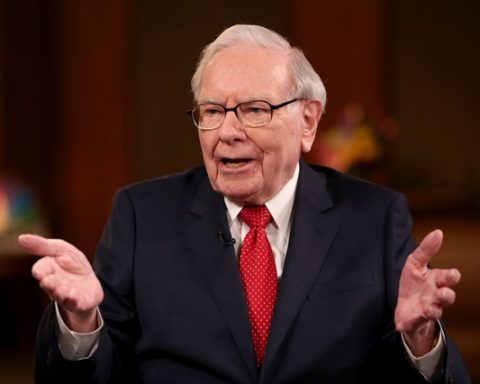










Warren Buffett began buying shares in the 1960s and took control by the late 1960s. He shifted its focus from textiles to investments and diversified businesses.