In a historic escalation of the Middle East conflict, the United States has launched direct military strikes on Iran’s key nuclear facilities, targeting sites in Fordow, Natanz, and Isfahan. The move, reportedly coordinated with Israel, marks a turning point in U.S. involvement in the long-standing standoff over Iran’s nuclear ambitions. Despite the scale and impact of the attack, however, analysts caution that the Ayatollah regime may not be as vulnerable as hoped.
According to a detailed report by Haaretz, U.S. President Donald Trump authorized the deployment of heavy bombers carrying bunker-buster bombs in a precision strike intended to cripple Iran’s uranium enrichment infrastructure. The attack has reignited tensions across the Middle East, with ripple effects already being felt from Beirut to Baghdad.
The immediate aftermath was met with contrasting reactions: celebration in parts of Israel and cautious alarm throughout the region. While Iran’s strategic assets have suffered a major blow, the question now dominating diplomatic and military circles is whether the regime in Tehran will buckle under pressure—or harden its defiance.
A Regime Built to Withstand Crisis
Despite the damage inflicted, Iran’s ruling clerics have survived decades of hardship. From the brutal Iran-Iraq War of the 1980s to economic suffocation under Western sanctions and repeated internal unrest, the regime has adapted and endured. As Haaretz noted, its survival tactics include the creation of a complex security apparatus—featuring the Islamic Revolutionary Guard Corps (IRGC) alongside regular military forces—and an expansive network of proxy militias in Lebanon, Iraq, Syria, and Yemen.
Even now, with its nuclear program under direct attack, Iran shows no signs of imploding. Hezbollah and Iraqi militias—usually considered Tehran’s regional enforcers—have not mobilized. Only the Houthis in Yemen have formally broken off their cease-fire with the U.S., and even they have yet to act militarily.
An Uncertain Nuclear Future
One of the most pressing concerns emerging from the strike is the unknown fate of Iran’s uranium stockpile. Prior to the attack, reports indicated that Iran had moved an estimated half-ton of enriched uranium out of Fordow, a move that could allow the regime to preserve its nuclear capabilities despite the assault.
Iran had already begun enriching uranium to 60 percent purity in 2024—dangerously close to the 90 percent required for a nuclear weapon—especially after the collapse of Hezbollah and the Assad regime in Syria heightened its sense of strategic isolation.
As Haaretz emphasized, this leaves open the ominous possibility of a “North Korea scenario”—in which Iran, cornered and desperate, rushes to build a nuclear bomb to guarantee its regime’s survival.
Diplomacy or Detonation?
The Trump administration appears to have calculated that a decisive show of force would compel Iran to return to the negotiating table. However, Tehran’s historical skepticism—particularly since the U.S. withdrawal from the 2015 JCPOA nuclear agreement—means such hopes may be misplaced.
So far, both Russia and China have condemned the U.S. strike but offered little in terms of material support for Iran. Gulf Arab states remain nervous, caught in a triangle of hostility between the U.S., Israel, and Iran, and fearing potential retaliation that could shut down the vital Strait of Hormuz and imperil global oil supplies.
Strategic Blow, But No Knockout
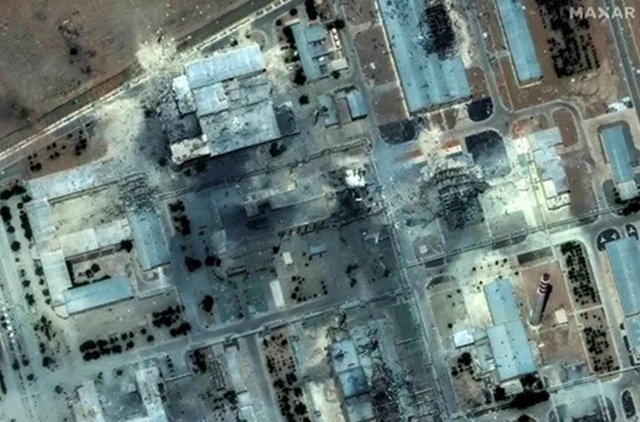
Satellite imagery published by Maxar Technologies and cited by Haaretz confirms significant damage at the Isfahan facility. Yet, there’s a growing consensus that this military action, while stunning in scale, has not dismantled the ideological or operational backbone of the Iranian regime.
Protests erupted in Tehran following the attack, with demonstrators waving Iranian flags and chanting against U.S. intervention, reinforcing the government’s narrative of resistance. Analysts suggest that far from toppling the regime, the bombing may reinforce its siege mentality and justify continued militarization and nuclear advancement.
Conclusion: A Familiar Impasse
While Washington may hope that the massive airstrike will spark a new round of diplomacy, history suggests Tehran is likely to dig in its heels. As Haaretz pointed out, the Iranian leadership views survival not as a luxury, but a duty rooted in ideology and history. The scars of past wars, sanctions, and betrayals have made Iran’s rulers expert survivors.
The Middle East now waits in tense uncertainty: Will Iran escalate? Will the U.S. act again? Or is this the beginning of a new, colder phase of confrontation where the nuclear threat remains very much alive, just beneath the rubble?