In a bid to overcome its looming debt crisis, the Maldives has announced plans to invest $8.8 billion into a blockchain and digital assets financial hub, a bold move aimed at diversifying its economy beyond tourism and fisheries. The development of this hub, backed by the Dubai-based family office MBS Global Investments, is seen as a strategic attempt to tackle the island nation’s mounting financial pressures.
The proposed investment, which is expected to unfold over five years, far exceeds the Maldives’ annual GDP of around $7 billion. However, Finance Minister Moosa Zameer told Financial Times that the country had no choice but to “take the leap” to create new sources of revenue. “Debt coming due in the next two years is the biggest challenge that we have,” Zameer explained. “This is something we see as a potential contributor to bring us out of certain difficulties that we are in.”
MBS Global Investments, the family office of wealthy Qatari Sheikh Nayef bin Eid Al Thani, has pledged to fund the Maldives project through a combination of equity and debt. The firm, which manages assets worth approximately $14 billion, has already secured firm commitments “north of” $4-5 billion for the initiative. Nadeem Hussain, CEO of MBS, emphasized the scale of the investment, noting, “We appreciated right from the offset what was involved in terms of funding and we’ve made the necessary alliances and brought in the necessary partners to ensure we have that.”
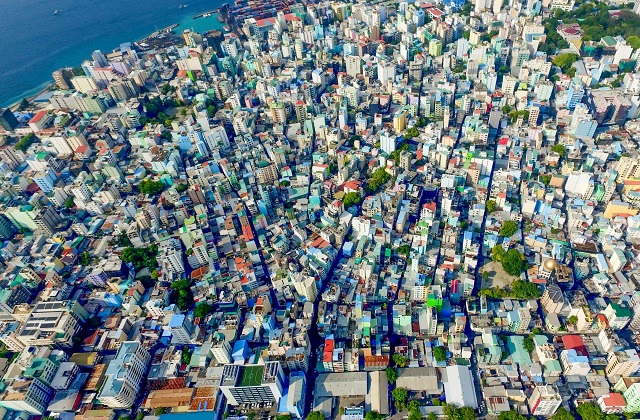
The project will establish the Maldives International Financial Centre, an 830,000 square meter hub in the capital, Malé, designed to host 6,500 people and provide employment for 16,000 individuals. It will serve as a global “financial freezone” focused on blockchain and digital assets. According to the project’s masterplan, the centre aims to triple the country’s GDP within four years and generate revenue in excess of $1 billion by the fifth year.
This announcement comes just months after India extended a $760 million bailout to the Maldives to help prevent a potential sovereign default. The country is facing significant external liquidity pressures, with substantial debt obligations coming due in the near future. In December, Moody’s warned that the Maldives’ “external liquidity pressures remain heightened,” noting that the country has approximately $600-700 million in debt due this year and around $1 billion due by 2026, including a $500 million sukuk bond.
Zameer acknowledged the contributions of India and China as development partners but emphasized that this new financial centre model would offer the Maldives an alternative to traditional borrowing mechanisms. “With MBS, we are getting into business—it’s going to be a business which is totally different from the traditional models of borrowings that we do,” he said.
The Maldives’ political stability, strong connectivity, and proximity to major markets like India and the Gulf countries make it an attractive location for such a project. However, some industry experts remain skeptical about the feasibility of turning Malé into a regional financial hub. One senior Indian businessperson noted, “It won’t be easy,” especially given the stiff competition from well-established financial centres like Dubai and Mauritius.
Despite these challenges, the Maldives is hopeful that the blockchain hub will generate the necessary economic momentum to stabilize its finances and secure its future growth. The ambitious plan represents the country’s latest attempt to navigate a difficult financial landscape and move beyond its reliance on tourism and fisheries for economic stability. As the nation takes these bold steps to reinvent itself, the world will be watching to see if the Maldives can successfully establish itself as a new player in the global financial arena.