The recent migration crisis in the Spanish enclave of Ceuta has prompted renewed discussion over the European Union’s approach to border management, migration, and humanitarian responsibility. While governments have concentrated on security measures and immediate policy responses, the events have also inspired broader reflections on Europe’s identity and its treatment of migrants. In an opinion essay published by the German weekly Die Zeit, the crisis is examined through the lens of Christopher Nolan’s adaptation of The Odyssey, with the newspaper using the film to explore the tensions between security, hospitality, and the moral responsibilities of modern societies.
According to Die Zeit, Nolan’s adaptation places these themes at the centre of its narrative from the opening scenes. The newspaper notes that the film introduces “people from the sea”, figures who are portrayed as a source of anxiety for Ithaca’s ruling class, which fears an invasion threatening what it regards as the pinnacle of Greek civilisation. At the same time, Die Zeit highlights the film’s emphasis on Zeus’ law of hospitality, known as Xenia, under which strangers are to be welcomed and offered food and shelter because any traveller, regardless of appearance or wealth, could be a disguised god.
The newspaper argues that this contrast between fear and hospitality provides a striking parallel with present-day Europe. According to Die Zeit, while the fictional society of Ithaca oscillates between military defence and welcoming strangers, contemporary Europe increasingly applies different standards to different categories of migrants. Rather than simply opening or closing borders, the newspaper contends that European migration policy has evolved into a system of selective access.
To develop this argument, Die Zeit draws on the work of sociologist Steffen Mau and his 2021 description of borders as “sorting machines”. The newspaper argues that borders now function as mechanisms that determine who may enter and who must remain outside. It notes that affluent tourists, privileged expatriates, highly sought-after skilled workers, and seasonal labourers needed to address labour shortages continue to enjoy mobility, while those who do not fit these categories face increasingly restrictive barriers.
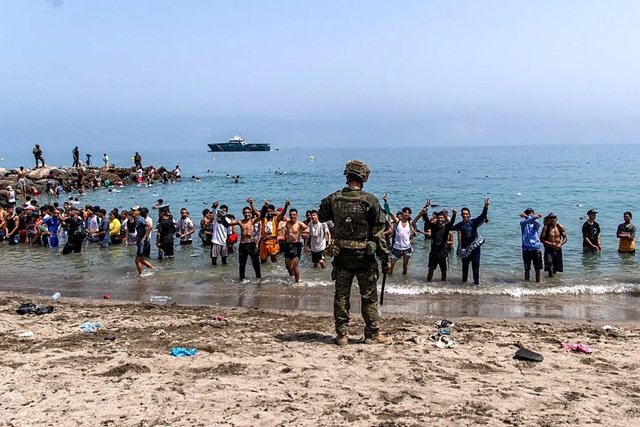
As an example, Die Zeit refers to Germany’s so-called “asparagus airlift” in 2020, when thousands of Romanian agricultural workers were flown into Germany despite COVID-19 lockdown restrictions. The newspaper contrasts that episode with the recent events in Ceuta, where approximately 50,000 migrants—many described as young Moroccans—attempted to enter the Spanish enclave after reportedly being influenced by false information circulating on social media suggesting they could continue onwards to mainland Spain.
The opinion essay also examines the political reaction within Europe. According to Die Zeit, Spain received little visible solidarity from fellow European Union member states during the crisis. The newspaper further notes that 22 EU heads of government, including German Chancellor Friedrich Merz, signed an open letter attributing at least part of the responsibility for the crisis to Spain’s highest court. That court had recently ruled that migrants reaching Ceuta and Melilla by sea should not be subjected to immediate pushbacks but instead should be given access to asylum procedures.
Using Steffen Mau’s concepts of “opening globalisation” and “closing globalisation”, Die Zeit argues that the European Union’s internal freedom of movement is closely connected to the fortification of its external borders. According to the newspaper, the ability of people to move freely within the Schengen Area depends upon stronger controls at Europe’s external frontiers, creating a system in which internal mobility and external restrictions reinforce one another.
Beyond border policy, Die Zeit argues that efforts to combat irregular migration have become one of the defining political priorities for governments across Europe. The newspaper observes that even critics of the existing border regime rarely advocate a comprehensive alternative. In support of this argument, it cites British historian Perry Anderson, who reportedly argued in April 2025 that Europe’s political left struggles to present a politically consistent and coherent position on migration, limiting its ability to challenge conservative approaches.
The newspaper identifies Spanish Prime Minister Pedro Sánchez as an illustration of this broader political reality. According to Die Zeit, Sánchez has continued strengthening Spain’s external borders while cooperating closely with Morocco and Algeria on migration policy. Following the events in Ceuta, he travelled to the enclave to make clear that Moroccan migrants should not expect onward travel to mainland Spain. At the same time, Spanish authorities were reported to be installing additional barriers in the water to reduce the likelihood of similar crossings. The newspaper also notes that most migrants had already returned to Morocco, partly because they found neither food nor drinking water after reaching Ceuta.
While Die Zeit acknowledges what it describes as a broad European political consensus in favour of stricter border controls, it argues that the official response to the deaths recorded during the crisis deserves closer examination. Referring to official reports identifying 72 fatalities, with police expecting additional bodies to be recovered, the newspaper observes that these deaths were not mentioned in the open letter signed by European leaders. It also notes that when European Commission President Ursula von der Leyen referred to the “unacceptable images” from Ceuta, her remarks did not explicitly refer to those who had drowned.
To interpret this response, Die Zeit invokes the work of the late sociologist Zygmunt Bauman and his concept of the “adiaphorisation of migration”. According to the newspaper, Bauman used the term to describe situations in which migrants cease to be viewed primarily through moral considerations. Die Zeit argues that this concept provides a framework for understanding why, in its view, those who died during the Ceuta crisis received relatively little public acknowledgement in official political discourse.
The newspaper further compares European communication surrounding migration with that of the administration of former US President Donald Trump. According to Die Zeit, while the Trump administration openly projected a hard-line approach to immigration through public messaging and social media, European governments have generally responded with greater restraint when fatalities occur at external borders such as Ceuta, Lesbos, and Lampedusa. The newspaper argues that the principal distinction lies in political communication rather than necessarily in the underlying objective of border control, presenting this as its interpretation of current migration policy.
In its concluding reflections, Die Zeit returns to Christopher Nolan’s adaptation of The Odyssey and draws upon interpretations of Odysseus presented by philosophers Theodor W. Adorno and Max Horkheimer in Dialectic of Enlightenment. The newspaper notes that Nolan’s film ultimately depicts Odysseus acknowledging that he and his companions themselves have become the feared “people from the sea”. According to Die Zeit, this ending suggests that the capacity for brutality exists not only beyond the borders of civilisation but also within it. Framed as an opinion essay rather than a news report, the article uses the events in Ceuta to encourage reflection on how Europe reconciles border security, humanitarian responsibility, and the values it seeks to uphold in an increasingly polarised migration debate.