For Souleymane Griene, Europe began not with opportunity but with survival. After escaping death in the waters separating Morocco from the Spanish enclave of Ceuta, the 20-year-old climbed into an Islamic cemetery to rest among white gravestones, sleeping beneath the open sky with only a towel for warmth. Cuts from the jagged shoreline marked his legs, while two friends who had crossed with him remained missing. Yet despite everything he had witnessed, his hopes remained fixed on the continent just beyond the horizon.
“I had less fear of the sea than of a life without a future,” Griene said.
His account forms part of a wider reconstruction by Der Spiegel, which interviewed more than two dozen migrants on both sides of the Morocco-Spain border following one of the most extraordinary episodes in the recent history of European migration.
Ceuta, a Spanish city on the African continent and European Union territory since the seventeenth century, has long represented both proximity and impossibility. For many Moroccans, it is the visible edge of another world. Across only a narrow stretch of sea lie cleaner streets, economic opportunity and the promise of a different future. While sophisticated fences, surveillance systems and substantial European funding have fortified the land border, the sea had largely remained an assumed natural barrier—until rumours spread that the route was suddenly open.
Many migrants traced their decision to social media. Videos circulating on platforms including TikTok, alongside footage published by the Moroccan news outlet Hespress, appeared to suggest that access to Ceuta had become possible. For Griene and his school friends from Ksar al-Kebir, all of whom had completed vocational training but remained unemployed, the decision was almost immediate. Pooling the equivalent of around €20 each, they travelled to the border town of Fnideq, wrapped their mobile phones in plastic and entered the sea.
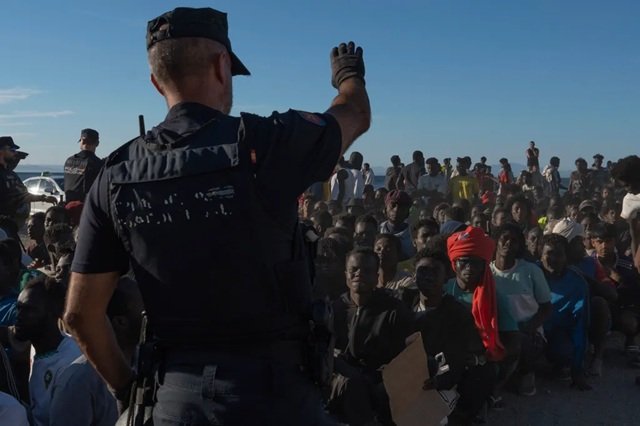
What followed became an unprecedented movement of people. At least 50,000 migrants reached Ceuta within days, with some reports placing the number even higher. Women, children, teenagers and young adults swam alongside one another, many clinging to tyres or improvised flotation devices. Panic spread in the water as swimmers struggled against waves and exhaustion, while many witnessed bodies floating beside them. According to available figures, at least 141 people died.
The sudden arrival overwhelmed the enclave of approximately 84,000 residents and triggered political shockwaves across Europe. Although most arrivals returned to Morocco within hours or days because of hunger, lack of shelter and the impossibility of continuing to mainland Spain without valid documents, the images of mass arrivals revived memories of Europe’s migration crisis and raised urgent questions about how such an event had unfolded.
Der Spiegel’s interviews reveal remarkably consistent testimony from migrants who alleged that Moroccan security forces directed or pressured them towards Spain. Several described being beaten with sticks or physically pushed towards the sea. “They beat us so we would continue towards Spain,” one young Moroccan told the magazine. Griene similarly alleged that security personnel struck and forced groups towards the water. Morocco has denied any involvement.
Responsibility for the crisis remains heavily contested. Spanish newspaper El País reconstructed how anonymous TikTok accounts had promoted claims that the border was open before both the videos and accounts disappeared. Rabat argues that a ruling by Spain’s Supreme Court concerning sea arrivals, combined with online rumours, created the momentum, while insisting it had warned Madrid in advance that its security forces could not contain such vast numbers. Spain rejects that account, with Prime Minister Pedro Sánchez describing the episode as an attack on the country’s territorial integrity and blaming people smugglers. The opposition has demanded an investigation.
The political consequences extended well beyond the border itself. The European Union quickly descended into public disagreement before rallying behind Spain’s crisis management. Yet the central question of responsibility remained unresolved, while Morocco’s strategic importance meant its role was not formally singled out. As Der Spiegel’s reporting illustrates, both Brussels and Rabat understand the leverage that accompanies control of Europe’s external frontier.
For Ceuta’s residents, the crisis transformed daily life almost overnight. Shops shuttered across the city, cafés closed their doors and military vehicles appeared on normally peaceful streets. Soldiers patrolled alongside police, hotels filled with security personnel and residents spoke of remaining indoors out of fear. At demonstrations outside government buildings, protesters waved Spanish flags while demanding stronger border controls and greater security, as figures from across Spain’s political spectrum travelled to the enclave.
Yet the city itself defies many simplistic narratives. More than 40 per cent of Ceuta’s population is Muslim, mixed families are common and many residents initially attempted to help those arriving by offering food before the sheer scale of the influx overwhelmed available resources.
Among those stranded were hundreds of unaccompanied minors. Der Spiegel documented cases in which children were escorted towards the border before observers reminded security personnel that minors could not legally be deported without individual assessment. Hundreds remained in emergency accommodation, including girls who described gathering together because they felt unsafe elsewhere.
The migrants themselves reflected a broad cross-section of aspiration and desperation. Baye Gana Pouye, a 27-year-old from Senegal, had travelled north since December 2024. He recalled phoning his mother to tell her, “Mama, the border is open. I am going to Europe!” Instead, he encountered violence, lost nearly everything he owned and crossed a shoreline scattered with bodies. Yet even after reaching Ceuta, Europe remained out of reach.
Back in Morocco, the determination persisted. Sixteen-year-old Samir, who had travelled around 1,000 kilometres from Zagora after searching unsuccessfully for work, insisted he would try again. “Europe is only a matter of time,” he said. Youssef, who returned after nearly starving in Ceuta, reflected bitterly: “It was a game, and we are ordinary people—we fell for it.”
For many young Moroccans, Europe continues to symbolise possibility despite repeated disappointment. More than one-third of Moroccans aged between 15 and 24 are unemployed and not in education or training, while many others have abandoned the search for work altogether. Social media has only intensified comparisons between lives separated by a short stretch of sea but divided by vastly different opportunities.
Spain’s most visible response has been the installation of a 500-metre floating barrier at the Tarajal breakwater, accompanied by increased maritime patrols. The measures are designed to make future crossings more difficult, yet the final scenes documented by Der Spiegel suggest that the deeper forces driving migration remain unchanged.
Only days after returning from Ceuta because of hunger rather than fear, three young friends from Agadir were already planning another attempt—this time towards Melilla. They spoke of opening barber shops, building businesses and finding dignity in Europe. Having survived one of the deadliest crossings, they remained convinced that the journey was still worth making.
“Europe is our future, whatever the cost,” one of them said.