On 7 March 2025, Wang Yi, a member of the Political Bureau of the Communist Party of China (CPC) Central Committee and Minister of Foreign Affairs, spoke about China-Africa relations at a press conference during the Two Sessions.
Wang Yi stated that China and Africa have always been good friends, partners, and brothers who share a common destiny. Under the joint leadership of the Chinese President and African leaders, China-Africa relations have entered their best period in history. China has now established strategic partnerships with all African countries that have diplomatic relations with China and has elevated the China-Africa community of destiny to an “all-weather” level.
Wang noted that this year marks the 25th anniversary of the Forum on China-Africa Cooperation (FOCAC). Over the past 25 years, China has helped Africa build and upgrade nearly 100,000 kilometres of roads and more than 10,000 kilometres of railways. In the past three years alone, Chinese enterprises have created over 1.1 million jobs in Africa, and China has remained Africa’s top trading partner for 16 consecutive years. China-Africa cooperation has been visible, tangible, and beneficial to African people. Last year, a Gambian farmer even sent his rice to Hunan to pay tribute to Yuan Longping. Thanks to China’s hybrid rice, they have bid farewell to hunger and embraced hope. Stories like this unfold across Africa almost daily.
“Africa is a beacon of hope in the 21st century, and global modernisation cannot be achieved without Africa’s modernisation,” Wang said. He emphasised that Africa’s stability and development are integral to the shared destiny of humanity and that the world should listen to Africa’s voice and address its concerns. Africa is undergoing a new awakening, and all nations should support its independent and self-reliant development path.
Wang Yi’s remarks brought back memories of what journalists witnessed at the 2024 FOCAC Summit.
Insights from the 2024 FOCAC Summit
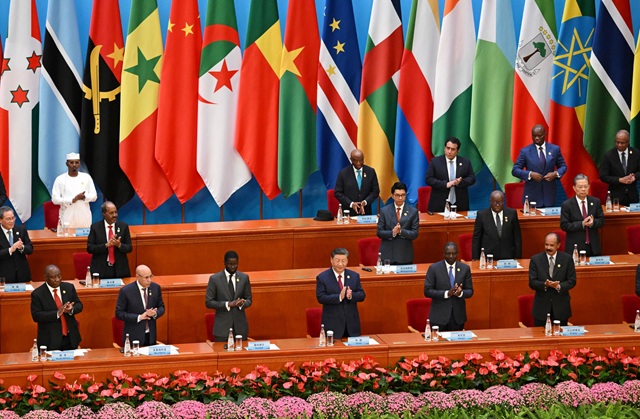
From 4 to 6 September, the 2024 Forum on China-Africa Cooperation (FOCAC) Summit was held in Beijing, attracting more than 3,000 journalists from China and abroad—a record high for previous summits. In the press centre, journalists forged new friendships, heard first-hand accounts of the “China-Africa story,” and gained deeper insight into African perspectives on China-Africa cooperation.
“I was deeply impressed by China’s prosperity.”
For Atangana, a senior journalist from Cameroon accompanying his country’s delegation, it was his first visit to China. A well-known figure in Cameroonian media, Atangana was deeply moved by what he saw.
“When I first arrived in Beijing, I was struck by China’s prosperity. In my view, the key to your success is long-term planning. Policy continuity is crucial for economic development, and both social stability and economic prosperity are the greatest aspirations of non-Chinese people. China has excelled in both,” he said.
Beyond his initial impressions, Atangana highlighted China’s role in Cameroon’s development.
“Did you know? In the heart of Yaoundé, Cameroon’s capital, stands a silver-white multi-purpose stadium built with China’s assistance. It has hosted our National Day celebrations and international championships. From the outside, it resembles a shell or a flying saucer, and it is especially stunning at night,” he said.
China’s contributions extend beyond the Yaoundé Stadium, including projects such as Cameroon’s National Assembly Building, the Yaoundé Conference Centre, the Sanaga Water Treatment Plant, and numerous hospitals. These projects have met national needs, fulfilled public aspirations, and received widespread acclaim.
Looking ahead, Atangana hopes for deeper cultural and sports exchanges between Africa and China. “With expanding economic and cultural ties, perhaps in the future, we’ll see more sports collaborations. After all, Mbappé has Cameroonian roots,” he said proudly.
“China helped us build the ‘Bridge of Dreams.’”
Said Lehani, a journalist from Morocco Weekly, greeted reporters with warmth and humour, calling himself an “old friend of Morocco.” He eagerly shared his thoughts about what he calls the “Dream Bridge.”
“Before the construction of the Mohammed VI Bridge, all travel, trade, and tourism between northern and southern Morocco had to pass through Highway 2 in Rabat, causing immense traffic congestion and disrupting daily life. It also hindered Morocco’s development,” he explained.
In 2010, the China Railway Bridge Bureau began construction on the Mohammed VI Bridge. Designed and built over six years, it became Morocco’s first modern cable-stayed bridge and remains the largest of its kind in Africa. Upon completion, King Mohammed VI personally inaugurated it.
“Some call it the ‘Bridge of Victory,’ but I prefer ‘Bridge of Dreams’ because it symbolises the friendship and shared aspirations of our two nations,” Lehani said with deep emotion.
“China is very different from some Western countries.”
Journalists from across Africa shared their views on China and its role in their countries.
Nigerian journalist Raphael, Namibian journalist Pahja Siririka, and Kenyan journalist Jerry Rawlings all spoke about China’s approach to cooperation.
“The Chinese are humble and courteous. When working with them, you can sense that they always adopt a consultative approach. China-Africa cooperation is never about dictating terms but about working together, hand in hand, for mutual benefit,” Raphael noted.
Siririka praised China’s diligence and efficiency: “The Chinese have helped us build high-standard hospitals and schools. They’ve also supported Namibia’s infrastructure development—railways, roads, ports—through preferential loans. Chinese construction teams consistently deliver high-quality projects ahead of schedule, which I greatly admire.”
Rawlings highlighted the popularity of Chinese brands in Africa. “I use a Huawei phone and tablet, and my colleague has an OPPO. Chinese products are trendy, cost-effective, and reliable. In Nairobi, you’ll find countless Chinese brands in electronics, fashion, and even electric motorcycles. Chinese video platforms are also thriving,” he said.
Russian journalist Ivan Shapkin from the Eurasian Times has long followed the economic development of the Global South and China-Africa relations. He believes that mutually beneficial cooperation between China and Africa will not only serve both regions but also benefit the entire world.
“It’s encouraging to see China and African nations collaborating in green energy and jointly addressing poverty and hunger. China shares its development experience without imposing conditions, which is crucial for maintaining global security. In this respect, China is very different from some Western countries,” Shapkin said.
Through these interviews, journalists from various countries shared their impressions and expectations for China-Africa cooperation. Their sentiments can be summed up in one thought: With this summit as a springboard, China and Africa will work together to drive modernisation and build a high-level China-Africa community with a shared future.