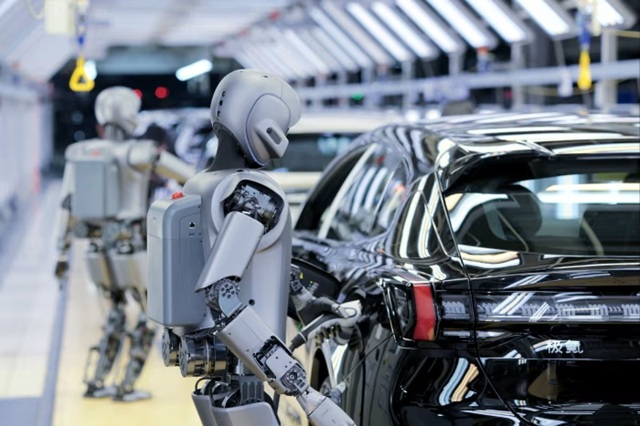
China is emerging as a dominant player in the development of humanoid robots, posing a serious challenge to U.S. companies in this cutting-edge field. With advances driven by cheaper components, fast-paced innovation, and Beijing-backed financing, China is positioning itself to lead the next wave of technological evolution, much like it did with electric vehicles.
Unitree, a Hangzhou-based robotics company, is at the forefront of this movement. Its humanoid robots, including the G1, are designed to demonstrate remarkable dexterity, with capabilities such as performing complex tasks like dancing and even delivering roundhouse kicks. Visitors to Unitree’s headquarters can push and kick the robots to test their balance, showcasing the level of sophistication in China’s robotic hardware. These robots are powered by open-source software, allowing for a wide range of customization in both research and entertainment applications.
Unitree is not alone in this race; a host of other Chinese start-ups, including AgiBot, Engine AI, and UBTech, are rapidly gaining recognition for their innovative demonstrations, often going viral on social media. One particularly striking example of China’s robotic prowess was the synchronised performance of 16 Unitree H1 bots during the country’s Spring Festival Gala, an event broadcast to millions.
China’s competitive edge in humanoid robotics is rooted in its robust electronics and electric vehicle (EV) supply chains, which provide critical components like actuators, batteries, and lidar vision systems, all at significantly lower prices than those offered by U.S. suppliers. As a result, analysts from Bank of America estimate that using Chinese parts in Tesla’s humanoid robots could cut production costs by as much as one-third. In fact, 25 Chinese companies supply components for dexterous robot hands, compared to just seven in the U.S.
This price advantage has opened the floodgates for innovation, enabling experimentation that was once restricted to high-cost research labs. As Bruno Adorno, a robotics expert at the University of Manchester, puts it, “There is a boom in humanoid research underway. It wasn’t possible before Unitree.”
The progress of Chinese humanoid robotics mirrors its earlier triumphs in the electric vehicle market, where China rapidly scaled production and diversified product offerings. According to Bernstein analysts, China’s approach to robotics follows a similar “natural selection” model—focusing on rapid iteration and multiple product models rather than waiting for a singular, perfect solution. This fast-paced approach is pushing China ahead in the race for dominance in the global humanoid robotics market, which Goldman Sachs predicts could reach $205 billion by 2035.
At the same time, U.S. companies like Tesla, Google, Meta, and robotics start-ups such as Boston Dynamics are also competing in the humanoid robot space. However, experts say that while the U.S. maintains an advantage in software and AI, China is outpacing the competition in hardware, an area where the country has significant manufacturing capabilities.
China’s government is also playing an instrumental role in this technological push. Humanoid robots were recently declared a strategic industry, with Beijing pouring significant financial resources into supporting start-ups. Unitree’s founder, Wang Xingxing, has even met with President Xi Jinping to discuss the future of robotics in the country. Additionally, the Chinese government has allocated massive funding for robotics development, with a new Rmb1tn ($137bn) state-backed venture capital fund designed to further propel the sector.
Moreover, local governments across China are introducing subsidies, policy packages, and industrial support to help build up the robotics supply chain. In Hangzhou, government funds are fueling the sector, while Shenzhen is actively courting companies with incentives. Shanghai has taken the initiative with a state-backed training facility designed to help humanoid robots develop the necessary skills to perform industrial tasks, with plans to expand to 1,000 robots by 2027.
Despite these advancements, challenges remain in the commercial viability of humanoid robots. While companies like Unitree have significantly reduced the cost of their robots, which now range around $100,000, the true potential of humanoids is still a work in progress. Some industry experts, like Markus Fischer of Exxeta, argue that the technology is still not ready for mass commercialization. For instance, while humanoid robots can perform tasks like greeting customers in retail environments, more complex tasks like inventory management or even simple actions such as opening doors remain challenging.
China’s humanoid robotics sector is already being used in limited applications, such as law enforcement, retail, and industrial settings. Local police have begun employing robots for neighborhood patrols, while robots are also being tested in factories for specific production tasks. However, large-scale, general-purpose use is still a few years away.
The humanoid robot race is far from over, and as China continues to capitalize on its hardware advantage and receive significant government backing, the future of humanoid robotics looks increasingly set in its favor. According to Shen Zhengchang, a Chinese legislative delegate, “AI-powered robots may not only be the future direction of development for China but possibly the entire world.” With China’s ambition clear, it appears poised to lead the next great tech revolution, just as it did with EVs.