The CIA continues to withhold major portions of its internal history of operations in Mexico, including nearly ten completely redacted pages concerning activities against left-wing student groups in the period leading up to the Tlatelolco massacre of October 2, 1968, according to documents released by the National Security Archive on the 58th anniversary of the killings.
The records, drawn from the JFK Assassination Records Collection, show that the agency conducted extensive covert operations targeting Mexican student organisations, labour and campesino groups, and political networks. They also document close relationships with senior Mexican officials and security forces, including the Federal Security Directorate (DFS), while leaving critical sections of the CIA’s Mexico City station history concealed. The National Security Archive is calling on the CIA to release the remaining material.
The Mexico City station history, a three-volume, 539-page account covering CIA activities from 1947 to June 30, 1969, was requested by the House Select Committee on Assassinations in 1978. The CIA initially refused to provide it but eventually supplied 227 pages. The history subsequently entered the more than six million pages of the JFK Assassination Records Collection. Although most of the collection has been declassified under the President John F. Kennedy Assassination Records Collection Act of 1992 and Executive Order 14176 of 2025, the station history has undergone five additional reviews, in 2017, 2022, 2023 and 2025, without becoming fully public.
The National Security Archive says the latest version, released by the National Archives in January, still contains substantial redactions. After the Archive filed a Freedom of Information Act request, the National Archives’ JFK collection webpage stated that the Office of White House Counsel had informed it that the CIA could continue withholding portions of the station history that did not relate to Kennedy’s assassination under FOIA exemptions.
The surviving material provides extensive evidence of CIA involvement in Mexican political and security operations. The station history was produced under the CIA’s Clandestine Services Historical Program, established in late 1964 to preserve the agency’s institutional memory through historical accounts of intelligence and covert operations. Anne L. Goodpasture, a CIA officer from 1947 to 1973 who had served in Mexico City and worked closely with station chief Winston M. Scott, wrote the Mexico history. She had been involved in LITEMPO, which developed relationships with senior Mexican officials, and in LIENVOY, a joint CIA-Mexican government telephone surveillance operation.
The documents show that the CIA continued cooperating with Mexican security officials despite serious concerns about corruption and abuses. Goodpasture described the DFS as a “hip pocket group” of agents who were “vicious, venal, corrupt extortionists”. One CIA-backed joint intelligence group included eight DFS agents operating under the cryptonym LIVESTOCK-2 to conduct training and operations against the Mexican Communist Party. The DFS official associated with the project, Francisco Luis Velasco, remained on the CIA payroll after serving two years in prison for killing a politician.
The records also detail CIA support for surveillance infrastructure. The LIENVOY telephone operation cost $150,000 to install, equivalent to approximately $1.5 million today, with annual maintenance exceeding $60,000, or about $600,000 today. CIA engineers installed equipment including 40 Ampex tape recorders, 30 dial recorders, 11 Wollensak tape recorders and 11 Revere tape recorders. In 1968, as repression against students and other dissidents intensified, the CIA provided portable telephone-tapping equipment to a Mexican contact identified as LIELEGANT.
Another newly disclosed detail concerns Miguel Nazar Haro, who later became director of the DFS. The 2025 version reveals that the CIA sponsored and subsidised his 1965 training in the United States at the request of DFS director Fernando Gutiérrez Barrios. After returning to Mexico, Nazar Haro commanded about 20 agents assigned to “subversive targets”. Between 1966 and 1969, his group produced around 20 per cent of the station’s “positive intelligence production”, covering communist organisations, Cuban exiles, Trotskyites and Soviet Bloc cultural groups. From 1967 to 1968, it also worked with the CIA on US radical students travelling to Cuba.
The most heavily censored section concerns student operations and the events surrounding Tlatelolco. The station history’s pages 331 to 341 remain substantially redacted. The surviving records show that the CIA had at least five projects involving student politics: LIHUFF, LICOAX, LIMIX, LIAGOG and LINOODLE. A 1965 directive instructed the station to support and guide anti-communist youth and student organisations and develop additional assets at key schools.
The CIA also funded MURO, a radical right-wing student group, at $6,000 a year from 1963. Agency documents described MURO as having “200 shock troops” campaigning against communists and pro-Castro groups at universities. In 1967, CIA official Kenneth Y. Millian warned that supporting MURO would strengthen a group whose activities were counterproductive to other US efforts. He wrote that the long-term negative consequences outweighed the short-term tactical benefits. The available records do not establish when direct CIA support for MURO ended.
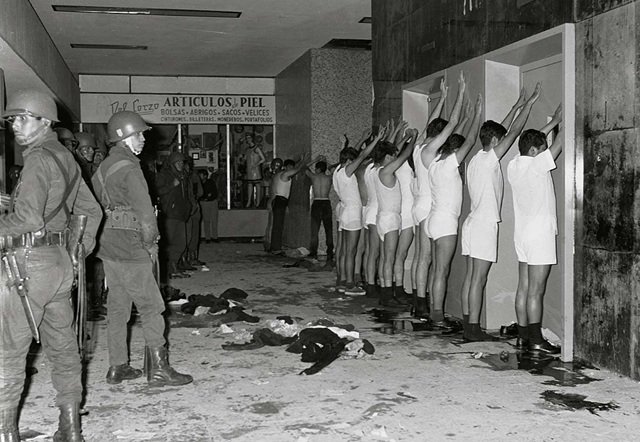
On October 2, 1968, police and army units surrounded demonstrators at the Plaza de las Tres Culturas and opened fire. The station history described the event as a “shooting contest” between “rioting students and the Mexican army”, in which “the students lost”. Hundreds were detained, including a CIA asset reporting on the demonstration. The documents released by the National Security Archive show that US officials largely followed the Mexican government’s account blaming leftist students and communist agitators.
The surviving evidence does not establish the extent of CIA involvement in the violence itself. The National Security Archive argues that the documents show at least an active role in polarising student politics, while stating that the remaining redactions prevent a fuller assessment. It is therefore calling on the CIA to comply with the JFK Records Act and release the still-secret portions of its Mexico City station history.