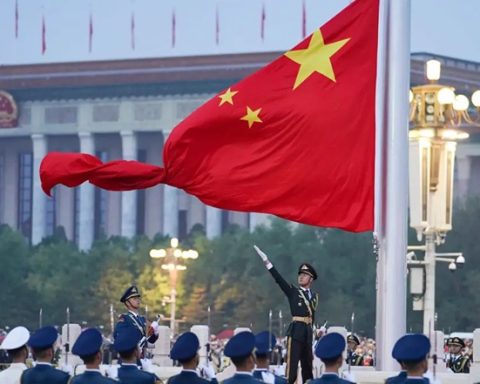
At the heart of Beijing this week, China’s annual Two Sessions convened, bringing together deputies to the National People’s Congress and members of the Chinese People’s Political Consultative Conference (CPPCC). In the shadow of Tiananmen Square, the normally controlled environment provided a rare glimpse into what Chinese lawmakers are thinking about the escalating conflict in the Middle East. According to reporting from El País, members of parliament expressed unease over the attack on Iran, describing it as a disruption to the global order they had known.
“I believe China should continue on its own path and maintain its own growth. It will be a way of indirectly contributing to global stability,” said Yang Debin, a Hong Kong deputy in the National People’s Congress, emphasizing that China’s measured approach could help stabilize a chaotic world. Other lawmakers shared his concerns. Xie Rupeng, representing Guangzhou, noted that although there were no immediate disruptions, the conflict could affect China’s supply chains, exports, and broader economic interests.
The Two Sessions, a tightly scripted and carefully controlled event, allows only fleeting interaction between journalists and delegates. Yet, even within these brief exchanges, the scope of anxiety was clear. Members of the CPPCC, including Hong Kong lawyer He Junyao, likened the situation to “skating on thin ice in spring,” warning that the conflict might interfere with diplomatic initiatives, including a planned visit by former U.S. President Donald Trump to China, which Beijing has yet to confirm.
Delegates expressed moral as well as practical concerns. “An attack on a sovereign country and the assassination of its leaders? I don’t think that’s legal,” said Wei Binjiang, a Hong Kong technology expert and CPPCC member. He added, “This isn’t the world order I grew up with,” reflecting a generational sense of disorientation at the rapid erosion of international norms. The possibility of a wider regional escalation was seen as having global consequences, with China’s leaders and representatives closely monitoring developments.
Despite the tension, some lawmakers voiced cautious optimism about bilateral economic relations. Feng Yidong, from the government’s Economic Commission, emphasized that China and the United States remain interdependent: “Cooperation benefits both sides, and confrontation hurts us; the Americans recognize this as well.” Similarly, Chen Wei, a delegate from Chongqing, highlighted domestic development and open international cooperation as priorities, suggesting that China seeks to balance caution with engagement in global affairs.
The presence of journalists allowed these perspectives to be recorded, though fleetingly. Most delegates, particularly from the People’s Liberation Army, were unwilling to speak, citing ongoing purges and the tightly controlled political environment. Nevertheless, those who did speak underscored a shared concern: the situation in the Middle East is dangerous, unpredictable, and could affect China’s strategic interests.
Beyond immediate economic implications, lawmakers viewed the conflict as a broader geopolitical challenge. Ruan Hongxian, a CPPCC member, summarized the sentiment, saying that China must observe international developments carefully and make independent assessments to guide its decisions. Yao Jianping, an artist and delegate from Suzhou, concluded that China must continue to stand on the side of peace, reflecting the official narrative that stability at home and measured engagement abroad can contribute to global order.
The Two Sessions thus revealed a China carefully watching the Middle East crisis, acknowledging both the risks and responsibilities of its global position. Reporting by El País underscores that while the country projects an image of internal stability and continuity, its political representatives are acutely aware of how conflicts like the U.S.–Israel attack on Iran could ripple across the world, impacting diplomacy, trade, and security. In a tightly controlled political environment, even brief, unfiltered comments from lawmakers reveal the challenge Beijing faces in navigating a world increasingly marked by volatility, uncertainty, and shifting alliances.