China’s intelligent computing power is projected to grow by more than 40 percent in 2025, according to industry forecasts released at the 2025 China Computing Power Conference, which concluded on Sunday. Experts attribute this rapid expansion to the country’s accelerating advancements in artificial intelligence (AI) and the growing demand for high-performance computing across multiple sectors.
Analysts say the country’s computing power industry is entering a new era of high-quality, large-scale development. The projected growth signals significant progress in AI capabilities, which will support innovation across industries and strengthen China’s position in the global technology race.
“Computing power is the unseen engine behind AI transformation,” Zhang Xiaorong, director of the Beijing-based Cutting-Edge Technology Research Institute, told the Global Times. “The surge in scale means AI is no longer confined to labs or city centers; it is rapidly spreading across Chinese society.”
Rapid Growth in Computing Power
Data from the conference indicated that China’s total computing power has been growing at an annual rate of around 30 percent. By June 2025, the country’s total computing power ranked second worldwide, according to Liu Liehong, head of the National Data Administration (NDA).
As of June 2025, China’s intelligent computing power reached 788 EFLOPS—an exponential increase from 90 EFLOPS at the end of 2024. In 2024, intelligent computing accounted for 32 percent of the country’s total computing capacity of 280 EFLOPS.
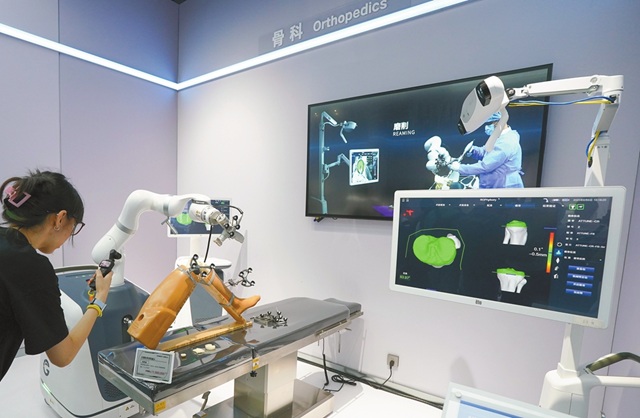
The demand for computing power is being driven by an expanding array of applications, including generative AI, autonomous driving, smart cities, industrial manufacturing, and the low-altitude economy. Over 23,000 innovative computing projects have been collected through national computing power competitions, with widespread adoption in finance, healthcare, and energy, according to CCTV News.
“Intelligent computing is revolutionizing healthcare, education, and agriculture,” said Wang Peng, associate research fellow at the Beijing Academy of Social Sciences. “From AI-driven medical imaging to personalized learning systems and precision farming, robust computing support is critical for these applications.”
Infrastructure and Investment
China’s computing infrastructure is rapidly advancing to meet rising demand. Ten provincial national computing platforms are now integrated, and domestic operators are expected to maintain investment growth of over 20 percent in 2025. Leading internet enterprises plan to invest more than 500 billion yuan ($69.8 billion) in AI over the next three years, creating significant opportunities for the expansion of ICT infrastructure, Xie Junshi, executive vice president of ZTE, told Xinhua News Agency.
The Ministry of Industry and Information Technology (MIIT) is working to optimize intelligent computing infrastructure, strengthen regional resource allocation, and accelerate breakthroughs in key technologies such as GPU chips. “AI applications fuel demand for computing power, which in turn relies on advanced chips. This creates a reinforcing cycle that accelerates innovation across the ecosystem,” Zhang explained.
Next-Generation AI and Computing Models
The conference also highlighted emerging AI models such as DeepSeek’s newly announced DeepSeek-V3.1, which leverages the FP8 precision format to double computing efficiency while reducing bandwidth needs. Experts note that such technological advancements, combined with a booming digital economy, are creating new drivers for economic growth.
“By 2035, AI is projected to contribute over 11 trillion yuan to China’s GDP, accounting for approximately 4-5 percent,” said Rao Shaoyang, director at the China Telecom Research Institute. “This could increase computing power demand by tenfold—or even a hundredfold—underscoring the transformative potential of intelligent computing.”
China’s rapid expansion in computing power signals not only technological progress but also the integration of AI and digital infrastructure into the nation’s broader economic and social development strategy.