by Our Correspondent in Colombo
Wei Huaxiang has arrived in Colombo this morning as China’s new Ambassador Extraordinary and Plenipotentiary to Sri Lanka. His arrival is being presented in the conventional language of diplomatic friendship and bilateral cooperation. But his career deserves closer examination because Wei is not the product of a conventional foreign-service career. His professional trajectory has been overwhelmingly shaped by China’s political system and economic administration before he moved into overseas diplomacy. That distinction matters.
Born in January 1972 in Dongying, Shandong Province, Wei studied ideological and political education at Liaocheng Teachers College from 1991 to 1995. He subsequently pursued doctoral studies in political economy at the Graduate School of the Central Party School, completing the programme in 2004. His academic interests moved towards international trade and China’s position in the global economy. His published research included subjects such as technical barriers to trade, Chinese enterprises following China’s accession to the World Trade Organisation, multinational corporations and China’s international balance-of-payments policies.
His career after university followed the same direction. Wei began in the political and legal affairs apparatus of Dongying’s municipal government before moving into economic institutions. He worked at the China International Electronic Commerce Centre and later in the national machinery responsible for regulating market economic order. He then joined the Ministry of Commerce, where he rose to senior departmental positions.
This was not an incidental period in his career. Commerce was becoming central to China’s international rise, and Wei’s professional experience placed him inside the institutions dealing directly with markets, trade and economic regulation.
In 2011, he returned to Shandong as a senior official in the provincial Department of Commerce. In 2013 he became Vice Mayor of Linyi, one of Shandong’s major commercial centres. His responsibilities brought him into direct contact with commerce, tourism and the development of Linyi’s large wholesale and trading economy. In 2016 he moved to the Shandong provincial government, eventually serving as Deputy Secretary-General. Then came an unusual move for someone who would later become an ambassador.
In 2019, Wei became chairman and Party Secretary of the Shandong Agricultural Development Credit Guarantee Company. The organisation’s work centred on helping farmers, agricultural enterprises, cooperatives and other rural operators obtain financing. His experience there helps explain an otherwise curious feature of his later diplomacy: his repeated attention to farmers, agricultural finance, rural development and agricultural trade. Wei’s public record in Vietnam makes that connection particularly clear.
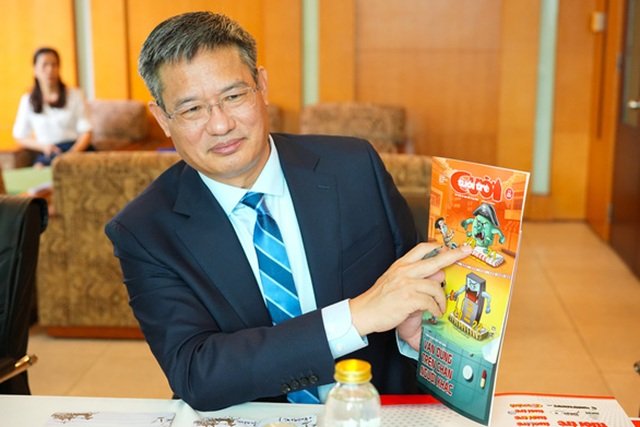
From 2022 to 2025, he served as China’s Consul General in Ho Chi Minh City. His public speeches and signed articles were dominated by practical economic issues. He promoted trade, Chinese investment, market access, infrastructure, connectivity, agriculture, tourism and business cooperation. He wrote about how Chinese farmers obtain loans and used rural finance to explain China’s development experience. He discussed Vietnamese agricultural exports to China, including coconuts, and argued for better transport and trading infrastructure.
He also cultivated relationships outside traditional diplomatic circles. His public activities involved provincial and municipal officials, businesses, agricultural communities and ordinary Vietnamese citizens. In one article, he described encounters with a parking attendant and farmers and wrote about his desire to become an ordinary citizen of Ho Chi Minh City. That public style is worth noting, but it should not be confused with political neutrality.
Wei has been an explicit communicator of Beijing’s political narrative. He has spoken about the Communist Party of China’s development philosophy, China’s model of modernisation, the concept of a community with a shared future for humanity and the Five Principles of Peaceful Coexistence. He has also encouraged Chinese businesses overseas to help communicate China’s story and the Party’s policies. His diplomacy therefore operates on two levels. One is commercial and practical. The other is political.
The commercial side focuses on trade, investment, agriculture, infrastructure, connectivity and market access. The political side presents China’s rise as a development story, stresses sovereignty and non-interference, and places China within a broader developing-country narrative. That combination is particularly relevant to Sri Lanka.
Colombo is not simply receiving another ambassador tasked with maintaining political relations. It is receiving a Chinese representative whose professional experience is unusually well aligned with the issues dominating the bilateral relationship: infrastructure, investment, ports, trade, agriculture, tourism, financing and economic recovery.
Wei’s background also gives him an understanding of government from several levels. He has worked in municipal, provincial and central institutions and has experience with state-owned financial structures. He therefore understands how China’s state apparatus connects political objectives with economic instruments.
His family life, by contrast, remains largely outside the public record. Available biographical information indicates that he is married and has a son, but reliable public sources provide little further information about his wife, child, parents, siblings or private life. There is similarly little credible information about his childhood, hobbies or activities outside his professional career. Those gaps should not be filled with speculation. What is known is sufficient to understand the official who has arrived in Colombo.
Wei’s career has moved through political education, political economy, international trade, commerce, government administration, agricultural finance and diplomacy. That is not the biography of a diplomat who simply learned economics along the way. It is the biography of an economic and political official who eventually moved into diplomacy. That distinction could shape his tenure.
China’s interests in Sri Lanka extend well beyond formal political relations. Trade, investment, infrastructure, ports, logistics, energy, tourism, agriculture and maritime connectivity all have strategic and commercial implications. Sri Lanka, meanwhile, remains under pressure to attract investment while protecting its economic sovereignty and avoiding excessive dependence on any single external power.
Wei is therefore likely to operate in an environment where economic cooperation and strategic calculation cannot easily be separated. His record in Vietnam suggests that he will prefer practical language: markets, investment, connectivity, development, trade and mutual benefit. But his political messaging shows that these economic themes will not exist independently of Beijing’s wider strategic narrative. That is the part Colombo should watch carefully.
The question is not whether Wei will speak about friendship. He almost certainly will. The more important question is what economic relationships he seeks to deepen, which sectors receive Chinese attention, how Chinese companies are positioned, how local political and commercial networks are cultivated, and how Beijing’s economic interests intersect with Sri Lanka’s strategic choices.
Wei Huaxiang has only just begun his tenure. There is therefore no basis yet for judging what kind of ambassador he will ultimately become. But there is already enough evidence to understand what he brings with him.
He arrives in Colombo with decades of experience inside China’s political and economic machinery, a substantial background in trade and development, direct experience in agricultural finance, a senior provincial and municipal record, and three years of diplomatic experience in Vietnam.
That makes his appointment more significant than a routine change of ambassador. Sri Lanka is not simply receiving a diplomat. It is receiving an official whose career has been built around understanding how China’s political authority, economic interests and development strategy can be made to work together.