China’s ambitious race to rival SpaceX’s Starlink with its own constellation of low-Earth orbit (LEO) satellites is running into a critical hurdle: a shortage of rocket launch capacity. As a result, the government appears to be prioritizing its state-run Guo Wang constellation over other regional or privately backed projects, such as Shanghai’s Qianfan network.
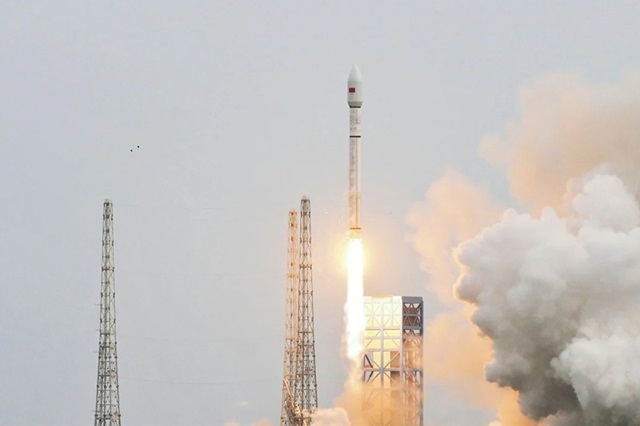
According to a report by the South China Morning Post, China has dramatically increased the pace of launches for the Guo Wang constellation, a massive 13,000-satellite project spearheaded by the central government. In a sign of escalating urgency, three separate batches of Guo Wang satellites were launched within a single week — a stark contrast to the earlier pace of roughly one launch every two months. These missions brought the total number of Guo Wang satellites in orbit to 57.
The rapid deployment was made possible by using a variety of Long March rockets, China’s workhorse launch vehicles, underscoring Beijing’s intent to allocate national resources to ensure Guo Wang remains on track for completion within a decade.
Meanwhile, other initiatives are falling behind. Qianfan, a competing 15,000-satellite constellation backed by the Shanghai municipal government, has not launched any new satellites since March, despite already having 90 in orbit. With state-owned launch vehicles increasingly tied up with Guo Wang missions, Qianfan is now turning to China’s growing commercial space sector for help.
Shanghai Yuanxin Satellite Technology, the company behind Qianfan, issued a new launch tender in late July, seeking seven private rocket launches to deploy 94 satellites before March 2026. The contract is valued at 1.4 billion yuan (approximately US$186 million). Leading contenders include LandSpace, a Beijing-based private company whose Zhuque-2E rocket could meet some of the mission requirements, and the yet-to-fly Zhuque-3, a reusable heavy-lift rocket expected to make its debut later this year.
The push for private sector involvement follows a failed tender earlier this year, where Yuanxin received fewer than three bids to deploy 162 satellites across nine launches, leading to its cancellation.
Experts cited by the South China Morning Post said the bottleneck illustrates a larger systemic challenge: China’s continued reliance on expendable rockets. Unlike SpaceX’s Falcon 9, which is reusable and capable of launching multiple times a week, China’s rockets are mostly single-use and require longer turnaround times.
Until China develops and deploys a fully reusable rocket system at scale, experts warn that limited launch capacity will remain a persistent issue — forcing tough decisions about which satellite projects move forward and which are put on hold.
As Beijing doubles down on Guo Wang, other players in China’s space ecosystem may find themselves increasingly reliant on commercial innovation and private partnerships to stay in the race.