The Indian government’s response to the Cockroach Janata Party (CJP) protests and activist Sonam Wangchuk’s indefinite hunger strike has become the focus of a detailed political analysis published by Frontline India, which argues that the unfolding demonstrations could develop into one of the most significant tests of Prime Minister Narendra Modi’s governing style since he assumed office in 2014.
According to the publication, the protests provide an opportunity to examine how Modi has historically reacted when confronted by sustained public mobilisation. Frontline India contends that the Prime Minister has consistently cultivated the image of a decisive leader who does not yield to public pressure, while simultaneously making calculated political adjustments when the potential electoral or political costs of maintaining a hardline position become sufficiently high.
The analysis centres on the government’s handling of demonstrations led by the CJP and Wangchuk’s continuing hunger strike, arguing that the administration initially responded by avoiding direct political engagement with the protesters. According to Frontline India, the government’s early approach was to present the issue primarily as one involving law enforcement and public order rather than political accountability.
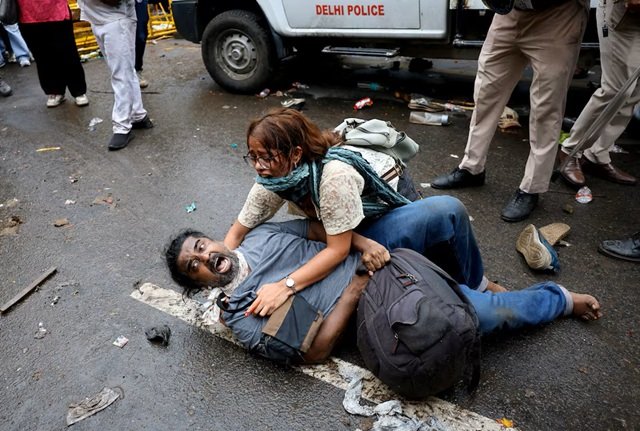
The publication notes that this approach shifted after thousands of demonstrators gathered for the “Chalo Sansad” march towards Parliament, prompting Union Health Minister J.P. Nadda to hold discussions with representatives of the protesters. However, Frontline India points out that those discussions took place alongside police operations that included lathicharges and the use of tear gas against demonstrators, suggesting that dialogue and enforcement were pursued simultaneously.
At the centre of the demonstrations is the demand for the resignation of Union Education Minister Dharmendra Pradhan. According to the analysis, the government faces a political dilemma because agreeing to that demand could be interpreted as conceding to a movement that originated outside India’s established political parties. Frontline India argues that such a concession could also challenge the carefully cultivated image of Modi as a leader who does not retreat under pressure.
The publication argues that this apparent contradiction has characterised several major episodes during Modi’s tenure. While the Prime Minister has often adopted uncompromising public rhetoric, Frontline India says his government has, on several occasions, ultimately altered or withdrawn controversial decisions after assessing their wider political implications.
Among the examples cited is the withdrawal of the three farm laws in 2021 following prolonged nationwide protests by farmers. The publication also points to the abandonment of proposed amendments to India’s land acquisition legislation during Modi’s first term after opposition from political parties and sections of the Sangh Parivar. According to Frontline India, these cases demonstrated that policy reversals have occurred, but generally at moments chosen by the government rather than in direct response to immediate public pressure.
The analysis also refers to the Union Public Service Commission’s 2024 proposal on lateral entry into the civil service. According to Frontline India, the government reversed course amid concerns that the proposal could affect support among Scheduled Castes, Scheduled Tribes and Other Backward Classes, groups regarded as politically significant to the ruling Bharatiya Janata Party.
The publication argues that these episodes illustrate what it describes as a distinction between Modi’s public messaging and his strategic political calculations. It contends that the Prime Minister has sought to maintain an image of firmness while allowing policy adjustments to occur only after political risks have been reassessed.
Frontline India also examines the government’s handling of Sonam Wangchuk’s removal from the protest site to hospital ahead of the parliamentary march. The publication argues that the transfer formed part of broader efforts to contain the movement before the planned demonstration. It further states that the subsequent protests indicated that the government’s expectations were not fully realised, with demonstrations expanding rather than diminishing after Wangchuk’s removal.
Another aspect highlighted in the analysis is the rapid spread of the CJP movement through digital platforms. According to Frontline India, the movement originated as an online satirical campaign before evolving into nationwide street protests. The publication argues that this transition has complicated the government’s response because the movement has consistently sought to distance itself from established political parties, making it more difficult to portray it as a conventional opposition campaign.
The article also revisits several Cabinet reshuffles and ministerial resignations during Modi’s administration. It cites the departure of former Health Minister Harsh Vardhan following India’s second wave of the COVID-19 pandemic, as well as the removal of several senior ministers during the 2021 Cabinet reshuffle. According to Frontline India, those decisions reinforced the image of decisive leadership while limiting direct political consequences for the Prime Minister.
The publication similarly discusses the resignation of former minister M.J. Akbar during the #MeToo movement and the later removal of Ajay Mishra Teni after the 2024 general election. It argues that, in each instance, political timing played a significant role in determining when action was taken.
Looking ahead, Frontline India argues that the government’s future decisions will depend largely on whether the protest movement develops into a broader political challenge capable of influencing electoral support. According to the publication, Modi has historically responded most significantly when political developments threatened to affect key sections of the ruling party’s support base.
The analysis concludes that the government is expected to continue closely monitoring both the physical expansion of the protests and the movement’s rapid growth across digital platforms. While the long-term political trajectory of the CJP remains uncertain, Frontline India argues that the demonstrations have presented a new test for a governing style that has long relied on projecting political resilience, disciplined messaging and resistance to organised public pressure.