


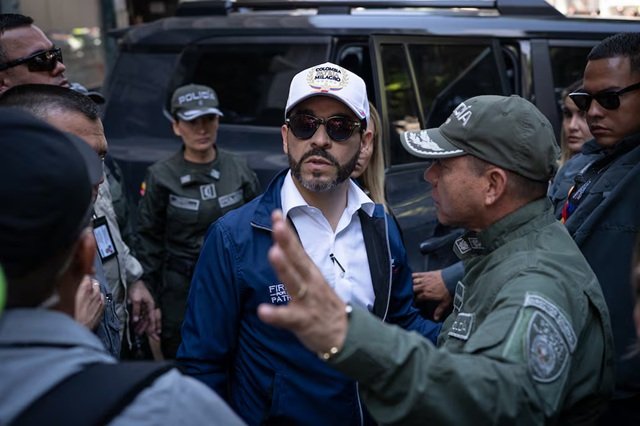
Colombia’s President, Abelardo de la Espriella, has lifted the general suspension on firearm carrying permits, ending a measure that had remained in place since 2015 and reigniting a contentious national debate over civilian gun ownership and public security.
The decision, formalised through Decree 1368 and announced by the President on Tuesday through his social media accounts, revokes a decree introduced in December 2015 during the administration of Juan Manuel Santos. The suspension was subsequently renewed annually under the administrations of Iván Duque and Gustavo Petro.
Under the new measure, people who already held a valid firearm carrying permit will once again be able to use it, provided their individual authorisation has not been suspended, cancelled, revoked or expired, and provided there is no legal or judicial prohibition preventing them from doing so.
The decree also removes an additional requirement imposed during the suspension period. Previously, even individuals holding carrying permits were required to obtain a special authorisation to carry their weapons. The new measure restores the use of existing valid permits without that additional step.
De la Espriella has defended the decision on the grounds that law-abiding citizens should not be penalised for the actions of criminals. He has argued that Colombian citizens who comply with the law should be able to exercise their rights under the existing regulatory framework, while illegally armed criminals should face the full force of the state.
“This has to change,” the President said, arguing that law-abiding citizens had for years been restricted from carrying firearms while criminals continued to obtain weapons illegally.
The President cited figures showing that Colombia’s security forces seized 15,700 firearms between January 1 and September 3, 2026, with significant links to organised crime. The figures were presented as evidence of the continuing challenge posed by illegal arms trafficking and as part of the justification for changing the existing policy.
The decision, however, has raised concerns over the potential consequences of expanding the circumstances in which civilians can legally carry firearms. Opponents of the measure have warned of possible increases in violent crime and gun violence, pointing to experiences in other countries where comparable policies have been associated with rises in crime. Concerns are particularly pronounced in regions affected by violence and drug trafficking.
The debate also reflects Colombia’s long-standing and deeply contested relationship with firearms. The country’s history of violence has shaped public attitudes towards civilian gun ownership, while the latest policy has renewed arguments over whether greater access for authorised citizens can improve security or create additional risks.
De la Espriella has stressed that the decree does not establish unrestricted firearm carrying. Strict controls, requirements and permits remain in force and will continue to be administered by the relevant authorities.
The decree also distinguishes between possession and carrying. Possession permits allow a firearm to be kept at an authorised location, such as a residence or designated headquarters. A carrying permit, by contrast, allows the weapon to be moved or taken outside that location under conditions established by the competent authority. Individuals who hold only possession permits therefore do not benefit from the lifting of the suspension and remain prohibited from carrying their weapons in public spaces or outside the registered location.
The policy reverses an approach strongly associated with former President Gustavo Petro, who repeatedly opposed civilian firearm use. During a Council of Ministers meeting in August 2025, Petro warned: “In Colombia, an armed populace could result in total massacre.”
The new policy will take effect from the day after its publication in the Official Gazette. Decrees 2362 of 2018 and 1482 of 2025, which had maintained and extended the general suspension of carrying permits until December 31, 2026, will subsequently be repealed.
Colombia now faces a renewed test of how far individual firearm rights can be expanded while maintaining controls intended to protect public security. The measure marks a significant shift in policy, but its broader implications remain at the centre of an increasingly polarised national debate.









