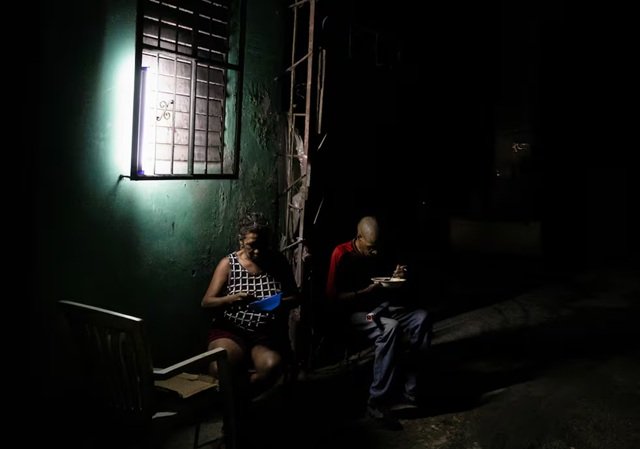
Successive nationwide failures of Cuba’s electricity grid have plunged the island’s nine million residents into prolonged darkness, exposing the cumulative impact of chronic underinvestment, ageing infrastructure, fuel shortages, economic decline, and tightening United States sanctions. As rolling blackouts stretch from hours into days, ordinary Cubans are increasingly forced to adapt to conditions that have become a defining feature of daily life.
For generations, Cubans have lived by two unwritten rules: “resolver” — finding a way to cope regardless of the circumstances — and “no coger lucha”, preserving composure even when conditions deteriorate. Yet those long-standing principles have been tested to their limits as the country endures an unprecedented sequence of electricity failures that has transformed an already fragile power system into one of the island’s most pressing national crises.
Within hours, Cuba suffered yet another total collapse of its National Electric System (Sistema Electroenergético Nacional, SEN), marking the second nationwide failure in less than a day, the seventh such collapse in 2026, and the eleventh over the past two years. The latest blackout struck while technicians from the state-owned electricity company Unión Eléctrica (UNE) were attempting to restore power following a previous nationwide collapse on Sunday night. At the time, only 14% of Havana, home to approximately two million residents, had regained electricity before the entire system failed again. Earlier that same weekend, a partial disconnection had already left half the island without power.
For Cuba’s nine million inhabitants, the repeated failures have blurred the distinction between extraordinary crises and everyday existence. In a country long accustomed to adapting to shortages and disruptions, even the simple act of switching on a light has become increasingly uncertain.
Milagros, a 38-year-old mother of two from the western province of Matanzas, did not immediately realise the national grid had collapsed because her neighbourhood had already been without electricity. “The system went down three days ago. That’s what I heard. At the moment it collapsed, we already had no electricity. And without electricity, we didn’t know whether it was real. Mobile phones lose service, either coverage or data connection. God forbid there’s an emergency because you’re completely cut off,” she said.
The distinction between a total grid collapse and Cuba’s routine blackouts has become increasingly significant. During a full SEN collapse, electricity generation across the entire country falls to zero, producing no megawatts at all. By contrast, the rolling blackouts experienced almost daily result from the country’s inability to generate sufficient electricity to meet demand or from isolated technical failures. In recent weeks, scheduled and unscheduled outages have exceeded 20 hours a day even in Havana, while some provinces have endured uninterrupted blackouts lasting as long as 72 consecutive hours.
According to the Cuban Government, the latest nationwide collapse resulted from “meteorological events” that affected the system and directly disrupted generating units that remained operational. However, Jorge Piñón, a Cuban energy expert and researcher at the Institute of Energy at the University of Texas, argues that the latest failures extend well beyond isolated technical malfunctions. He points instead to the fragility of Cuba’s transmission network, describing interconnected power lines that function like dominoes. Even where electricity generation exists, damaged transmission infrastructure prevents power from reaching consumers, rendering available generation ineffective.
The latest breakdowns have unfolded against the backdrop of heightened pressure from Washington. The United States’ maximum pressure campaign, spearheaded by Secretary of State Marco Rubio, has intensified the difficulties facing an electricity system already weakened by decades of chronic underinvestment. According to the report, the strategy has focused on two principal developments: the capture of Nicolás Maduro in Venezuela, Cuba’s principal fuel supplier, and measures intended to block oil tankers from supplying Havana under tariff threats issued by Donald Trump. Introduced earlier this year, both developments have further worsened Cuba’s already precarious energy situation.
Official data analysed by the newspaper at the end of May illustrated the immediate impact. Electricity generation declined by 20% between January and February, while average daily blackouts in Havana increased from four hours to 18 hours. Conditions temporarily improved after the Russian tanker Anatoly Kolodkin delivered more than 700,000 barrels of fuel oil to Cuba in March. Although the shipment reduced the electricity deficit by 50% during April, Cuba requires approximately 110,000 barrels of fuel every day to operate normally, and the relief proved temporary as supplies were exhausted.
Faced with mounting shortages, the Government introduced measures that would previously have conflicted with decades of official economic policy. Small private businesses were authorised to import limited quantities of fuel, while privately operated petrol stations were also approved. These reforms have emerged during a symbolic year in which the revolution marks the centenary of Fidel Castro’s birth and approaches the tenth anniversary of his death, underscoring the extent to which practical necessity has reshaped official policy.
The crisis has simultaneously exposed widening economic inequalities across the island. Those with access to foreign currency, often through relatives abroad or ownership of private businesses, possess options unavailable to much of the population. Maribel Villalonga, a 65-year-old resident of Matanzas, said the greatest comfort comes from the fact that food stored in her refrigerator does not spoil because relatives in the United States sent her an electric generator. “Imagine it. Yesterday the system collapsed and there’s still no electricity in the circuit where I live. There are days that pass completely, all 24 hours, without electricity. Sometimes longer,” she said.
Despite the limited economic liberalisation, the structural problems underpinning Cuba’s electricity crisis remain unresolved. Even before the latest sanctions, electricity generation had long been a persistent challenge. The backbone of the SEN consists of 16 Soviet-era thermoelectric generating units that have significantly exceeded their estimated 35-year operational lifespan, alongside diesel and fuel oil generators distributed across the country. Together, these account for around 80% of Cuba’s electricity mix.
The oil restrictions have left much of this system unable to function, with all diesel and fuel oil generators reportedly out of operation. Yet Piñón maintains that many of the industry’s difficulties are self-inflicted. He points to decades of insufficient investment, inadequate maintenance, and the long-term damage caused by burning Cuban crude oil, which contains exceptionally high sulphur levels, in ageing power stations. “What is very clear is that the thermoelectric plants are not directly impacted by the lack of fuel as a result of the blockade by the United States,” he said.
Independent analysts outside Cuba, including Piñón, argue that the situation has deteriorated to such an extent that even an immediate lifting of the United States energy embargo would not eliminate the prolonged blackouts. Restoring the country’s electricity sector would require investment of approximately US$10 billion, resources that Cuba does not possess. The Government has compared current conditions to those of a wartime economy, while the prolonged energy shortages have severely curtailed economic activity. The Economic Commission for Latin America and the Caribbean (Cepal) estimates that Cuba’s gross domestic product will contract by at least 6.5% this year, following a cumulative decline of 15% over the previous five years.
For ordinary Cubans, however, the crisis is measured less by economic indicators than by daily survival. Milagros describes how her youngest daughter, aged eight, has spent three consecutive nights crying, drenched in sweat from the intense summer heat and unable to sleep. The lack of electricity has also disrupted water supplies, compounding already difficult living conditions. “And on top of that, there’s no water, because under normal conditions they don’t supply water, so imagine without electricity,” she said.
Even as the infrastructure continues to fail and the economy contracts, Cubans persist with the habits that have long defined life on the island: finding ways to endure and carrying on without surrendering to despair. Yet with nationwide blackouts becoming increasingly frequent and outages stretching into days rather than hours, those unwritten rules are being tested as never before.