by Eric
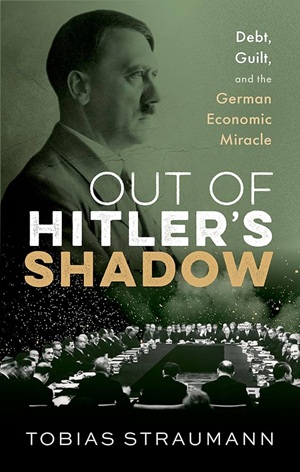
Tobias Straumann’s Out of Hitler’s Shadow is a book that sets out, with cool archival confidence and quiet provocation, to dismantle one of the most comfortable moral myths of postwar Europe: that Germany’s economic and political rebirth after 1945 represented a clean break from the structures, elites, and habits that had sustained Nazism. Straumann’s argument is not that the Third Reich was rehabilitated — he is careful never to say that — but that the Federal Republic’s celebrated stability was built through continuity, accommodation, and selective amnesia rather than rupture. The shock of the book lies in how calmly it demonstrates that democracy in West Germany was not born purified, but compromised — and that this compromise was not an unfortunate side-effect, but the condition of success.
From the outset, Straumann signals his refusal of moral reassurance. The question he asks is not how Germany overcame Hitler, but how quickly it learned to live after him without dismantling the machinery that had made his rule possible. The denazification programme, long enshrined as evidence of Allied moral resolve, emerges here as an exercise in pragmatism bordering on farce. Straumann notes that by the early 1950s, “the overwhelming majority of those who had held influential positions under the Nazi regime were once again integrated into the political, judicial, and economic life of the Federal Republic.” This was not because their pasts were unknown, but because they were deemed indispensable. The book’s most unsettling premise is that moral clarity was treated as a luxury Germany could not afford.
Straumann is particularly unsparing about the judiciary. He documents how judges who had enforced racial laws, signed death sentences, and legitimised expropriation were quietly reinstated. One official justification, quoted approvingly at the time, was that “experience in the law” mattered more than ideological reliability. The implication is devastating: that expertise acquired under dictatorship retained its value under democracy. Straumann remarks dryly that the legal system “never truly purged itself,” and instead opted for what he calls a “functional continuity masked as renewal.” The law changed its language; the interpreters remained.
The book’s most controversial chapters deal with economic elites. Straumann dismantles the myth that German big business was either coerced by the Nazis or marginal to their crimes. He shows instead how industrialists, bankers, and corporate lawyers adapted seamlessly to regime change. “The same men,” he writes, “who had planned production under the Four Year Plan now planned reconstruction under the Marshall Plan.” The skills were transferable; the moral reckoning was not. Corporate complicity in forced labour, Aryanisation, and wartime profiteering rarely resulted in lasting exclusion. Instead, these figures reappeared as pillars of stability, celebrated for delivering growth and employment.
Straumann’s treatment of the so-called economic miracle is deliberately demystifying. Growth, he argues, became a substitute for justice. Rising living standards allowed the Federal Republic to avoid uncomfortable questions about responsibility. He notes that prosperity “softened the memory of dictatorship” and transformed guilt into something abstract, historical, and increasingly irrelevant to the present. When critics warned that moral reckoning was being postponed indefinitely, they were dismissed as destabilising forces. Stability, not truth, was the governing virtue.
One of the book’s most incendiary claims concerns the narrative of democratic learning. Straumann challenges the assumption that Germans emerged from the war chastened and committed to liberal values. Instead, he suggests that many accepted democracy instrumentally — as a framework that delivered security and prosperity — rather than ideologically. He cites polling data and internal reports showing persistent authoritarian attitudes well into the 1950s. “Democracy,” he writes, “was tolerated before it was believed in.” This is a deeply uncomfortable assertion, particularly for those invested in postwar Germany as a model of moral transformation.
Straumann is careful not to exonerate Nazism by normalising it, but he is equally unwilling to mythologise its aftermath. He notes that former Nazis rarely defended the regime explicitly; instead, they reframed their actions as technical, apolitical, or coerced. Responsibility dissolved into bureaucracy. One former official is quoted as saying that he had merely “kept the trains running,” a phrase Straumann allows to resonate without commentary. The silence is accusatory. What matters is not the defence itself, but how easily it was accepted.
Foreign policy emerges as another site of moral compromise. Straumann shows how Cold War imperatives reshaped ethical priorities. Anti-communism became a solvent capable of dissolving past crimes. Individuals once deemed politically unreliable were reclassified as assets. The Federal Republic’s integration into the Western bloc depended, Straumann argues, on presenting Germany as reformed without demanding too much evidence of reform. The West wanted a bulwark against the Soviet Union, not a prolonged reckoning with fascism. In this sense, Germany’s rehabilitation was as much a geopolitical project as a moral one.
The book’s tone is what makes it truly provocative. Straumann does not rage against injustice; he catalogues it. He writes with the confidence of an economic historian accustomed to uncomfortable numbers and institutional logic. When he notes that pensions were restored to civil servants dismissed for Nazi affiliations while compensation to victims lagged or failed entirely, he does so without rhetorical flourish. The implication is left hanging: the state found it easier to care for its perpetrators than its victims.
Critics of Out of Hitler’s Shadow will argue that Straumann underestimates the constraints of the time. Germany was devastated, divided, occupied. Expertise was scarce. Social collapse was a real risk. Straumann anticipates these defences and refuses them absolution. He does not deny necessity; he interrogates its moral cost. “Necessity,” he observes, “became the language through which responsibility was indefinitely deferred.” This line encapsulates the book’s moral challenge: when does pragmatism become complicity?
The book also unsettles contemporary European self-image. Straumann implicitly questions whether postwar Germany’s success should be read as evidence that democracies can emerge untainted from dictatorship, or as proof that stability often requires moral compromise. The Federal Republic’s triumph becomes ambiguous: admirable in outcome, troubling in method. Straumann does not ask whether Germany did enough — he asks whether doing better would have made success impossible.
In its closing chapters, the book turns quietly accusatory. Straumann suggests that Germany’s delayed confrontation with its Nazi past was not an oversight, but a choice embedded in institutional incentives. Memory culture, he argues, matured only once the generation most implicated began to disappear. Justice followed biology. This is perhaps the book’s most devastating claim: that moral clarity arrived not through courage, but through demographic convenience.
Out of Hitler’s Shadow is not a book that reassures. It does not offer redemption arcs or moral triumphs. Instead, it insists that democracy can coexist with unresolved injustice — and often does. Straumann forces the reader to confront the possibility that postwar Germany’s success was not achieved despite continuity with the Nazi past, but partly because of it. The book leaves us with an unsettling question that extends far beyond German history: how much injustice can a society absorb and still call itself renewed?
In refusing to provide easy answers, Straumann delivers a work that is both historically meticulous and morally destabilising. Out of Hitler’s Shadow does not accuse Germany of forgetting its past. It accuses it of remembering selectively — and of building a future sturdy enough to carry that silence.