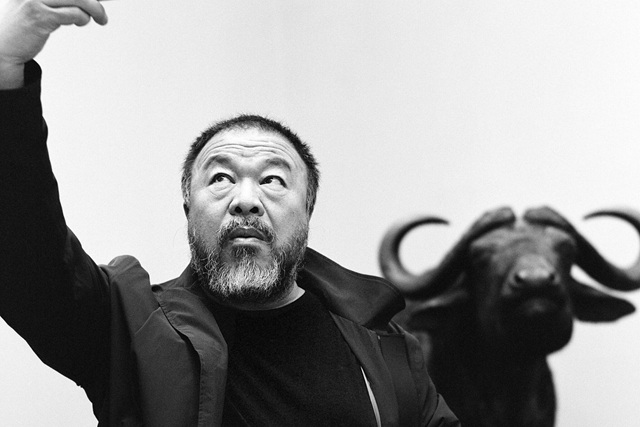
Ai Weiwei, the Chinese artist and dissident, has long used his art as a platform to challenge political norms and confront societal issues. In an insightful interview with The Independent UK, Ai shared his candid views on the state of democracy, the dangers of artificial intelligence (AI), and the moral contradictions of Western governments. His work, both politically charged and intellectually provocative, is a commentary on the fragility of modern civilization and the oppressive forces that continue to shape global politics.
Ai’s rise to international fame began with his 2011 arrest at Beijing airport by Chinese authorities, a move widely interpreted as retaliation for his public criticism of the government’s corruption and human rights abuses. Officially, Ai was charged with tax evasion, but his “citizens’ investigations” into government malfeasance had already made him a target. His 81-day detention, during which he was held in solitary confinement without trial, catapulted him into the global spotlight. Since then, Ai has remained an outspoken critic of not only the Chinese regime but also the contradictions and hypocrisies of Western democracies, which he believes have lost their moral high ground. His latest exhibition, Ai Weiwei: A New Chapter, exemplifies his commitment to using art as a weapon for social change.
Ai’s art has always been deeply rooted in his own personal history. He often references the persecution his father, Ai Qing, a prominent poet, endured during the Chinese Communist regime. These formative experiences of living through political repression in China have undoubtedly shaped his understanding of freedom, art, and the role of the individual within society. In his Straight installation, which features 96 tons of rebar salvaged from collapsed schools in the 2008 Sichuan earthquake, Ai explores themes of loss, corruption, and the vulnerability of human life in the face of political and natural disasters. Similarly, in his notorious piece Dropping a Han Dynasty Urn, Ai questions the value placed on cultural objects, using the destruction of a 2,000-year-old artifact to challenge the fetishization of history and the power structures that underpin cultural identity.
But Ai’s criticism extends beyond China. In his Independent UK interview, Ai spoke at length about the moral double standards of the West, particularly when it comes to human rights. “You cannot talk about human rights in Russia or China and then apply different rights in the Middle East,” he said, criticizing the inconsistency of the West’s stance on global issues. He argued that this selective approach to morality has eroded the credibility of Western democracies, leaving them vulnerable to criticisms of hypocrisy. His 2023 tweet, which controversially suggested that Western guilt over the persecution of Jewish people had been transferred to the Arab world, led to the indefinite postponement of his autumn exhibition at the Lisson Gallery in London. The statement, though mild in its phrasing, seemed too provocative for the current political climate, particularly given the volatile nature of international relations at the time. As a result, Ai faced the painful cancellation of exhibitions in multiple major cities, including New York, Paris, and Berlin.
For Ai, the issue isn’t about whether his statement was “right” or “wrong,” but about the fundamental right to express an opinion, even if that opinion is controversial. “If a society says, you cannot say wrong things, I would say that is an authoritarian society,” Ai remarked, equating the suppression of free speech to the ideological purity demanded by regimes like the Nazis. His art, and his life’s work, have been a constant battle for free expression, a fight that continues in his new exhibition. The works on display in Ai Weiwei: A New Chapter range from the controversial use of the expletive “F.U.C.K.” in his installation made from vintage buttons to his critiques of Western consumerism, technology, and global capitalism.
One of the most striking aspects of the exhibition is Ai’s engagement with the crisis of AI. While he acknowledges the impressive capabilities of artificial intelligence, he remains deeply skeptical of its potential to replace human creativity and expression. In his view, AI can calculate with precision but lacks the unpredictability and emotional depth that define true artistic expression. “The very essence of art lies in its inability to be replicated or predicted,” Ai said. This skepticism toward AI is most evident in his 81 Questions to AI video installation, in which Ai engages with artificial intelligence at Piccadilly Circus. Yet, despite his reservations about AI’s role in the art world, Ai seems to be experimenting with it, as shown in his 2023 work created by ChatGPT, a press release that served as the basis for his upcoming exhibition.
Ai’s reflections on the state of the world also delve into his ominous concerns about nuclear war. His piece Where Do We Come From? What Are We? Where Are We Going? features a Lego rendering of Gauguin’s iconic painting, but with a nuclear mushroom cloud rising ominously above the tropical foliage. “That’s something that’s still hanging over our heads,” Ai says, speaking of the ever-present threat of nuclear annihilation. He believes the U.S. used nuclear weapons without justification at the end of World War II, and with modern tensions between world powers, the possibility of nuclear conflict remains ever-present.
Through his work, Ai Weiwei not only critiques political regimes but also challenges societal complacency, asking his audience to reconsider the way they view authority, freedom, and art. His works are unapologetically provocative, pushing boundaries and questioning long-held assumptions. For Ai, art is a means of questioning the status quo and forcing the viewer to confront uncomfortable truths. In the age of AI, global conflicts, and political instability, his message has never felt more urgent. His art, from the installation of rebar to his critique of Western guilt, forces the audience to grapple with the fragility of human civilization, the consequences of unchecked power, and the role of free expression in a world that increasingly seems to be dominated by technology and authoritarian control.
Ultimately, Ai Weiwei’s latest exhibition is not just a display of art—it’s a declaration. A declaration against political oppression, against the silencing of voices, and against the manipulation of truth. It is, at its core, a rallying cry for the defense of freedom and the individual in a world increasingly threatened by conformity, both ideological and technological.