by Our Correspondent in Colombo
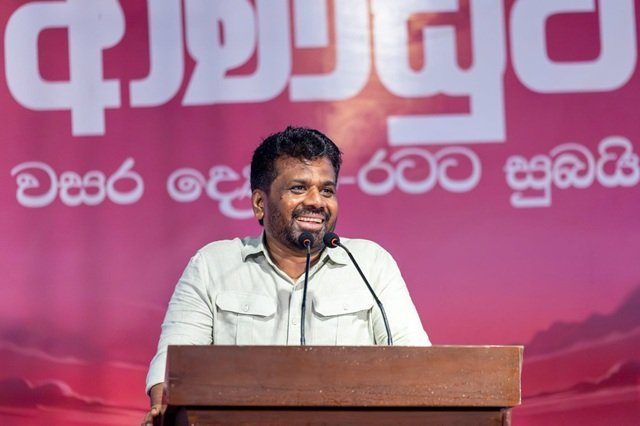
President Anura Kumara Dissanayake has called on Sri Lankans to accept sacrifice and hard work for the sake of rebuilding the country, invoking China’s experience as an example of how successive generations can contribute to national development.
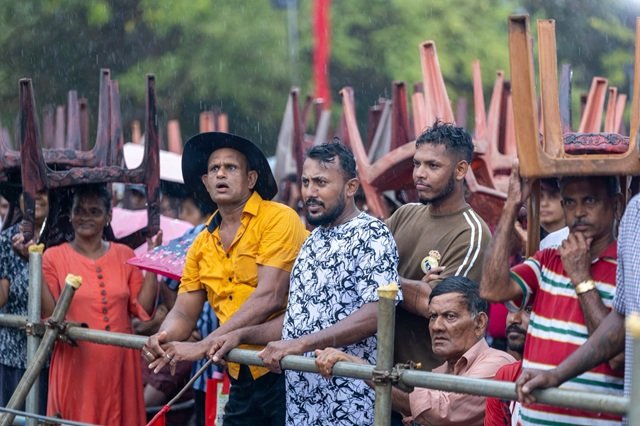
Addressing a mass rally in Nochchiyagama, today, Dissanayake said he had asked the Chinese president about the secret behind China’s “very large achievements”. According to Dissanayake, the Chinese president told him that China’s progress was the result of the sacrifices made by generations of its people.
“What does that mean?” Dissanayake asked. “To build a country, to develop a country, a generation of ours has to make sacrifices.”
He argued that because Sri Lanka had been pushed towards destruction for a long period, the present generation had a responsibility to work hard to rebuild it. Future generations, he said, should be able to look back and say that the people who lived through the present period were the ones who worked hard to build the country.
Dissanayake stressed, however, that rebuilding Sri Lanka could not be the responsibility of the government alone. While the executive presidency, Cabinet, Parliament and local government institutions were now under the government’s control, he said, “the government alone cannot build a country”.
Instead, he called for a broader people’s movement in which citizens would accept their own responsibilities alongside the government. The government, he said, was already carrying out the work required to rebuild the country, but “the people also have a part to play”. Government and people, he argued, must work together if Sri Lanka is to be rebuilt.
The president linked that national effort to what he described as the need to transform Sri Lankan society itself. He said relationships between parents and children, temples and their donor communities, and teachers and students had weakened, leaving society to some extent without civility. A better society, he said, should be one in which people feel another person’s suffering and recognise that everyone has a social responsibility.
Dissanayake also placed the fight against corruption at the centre of his political message. He said the public’s first expectation when voting for the National People’s Power was to stop corruption and punish the corrupt. Rejecting accusations that prosecutions amounted to political revenge, he contrasted his government’s approach with what he described as retaliation under previous administrations.
“We are not a political movement that takes revenge,” he said, pointing to the strengthening of the Criminal Investigation Department, the Commission to Investigate Allegations of Bribery or Corruption, the Attorney General’s Department and the judiciary. He said resources, personnel, equipment, laws and judicial infrastructure had been provided to enable investigations and prosecutions.
“The work is not something that will stop,” Dissanayake said, adding that some investigations required information from other countries and that suspects who had fled abroad could require diplomatic arrangements and agreements to bring them back to Sri Lanka.
He also highlighted the government’s campaign against drugs and organised crime, saying narcotics had been seized through containers, boats, ships, airports and vans. He said authorities were pursuing underworld figures overseas, including in India and Dubai, and seeking to bring them before the law.
The president further presented his government as a force opposed to corruption, organised crime and illicit financial activity, while arguing that Sri Lanka’s political culture itself needed to change. He criticised a system in which political power had become concentrated among a few families and said the era in which political office passed from fathers to sons was over.
For Dissanayake, the broader objective is therefore not merely to preserve his government but to create a different political and social culture. The challenge, as presented in his speech, is whether the present generation is prepared to make the sacrifices he says are necessary so that future generations can claim that this was the period in which Sri Lanka was rebuilt.
Yet the historical meaning of “sacrifice” in the Chinese experience is far more complicated than an account of national development alone suggests. The period preceding China’s economic rise included some of the most devastating episodes of the 20th century. Mao Zedong’s Great Leap Forward, launched in 1958, was followed by a catastrophic famine between 1959 and 1961. Estimates of those who died vary considerably, from about 16.5 million to 45 million, with historian Yang Jisheng putting the figure at roughly 36 million. The Cultural Revolution, which lasted from 1966 to 1976, brought further political persecution, social upheaval, violence and deaths. China’s subsequent transformation cannot therefore be reduced to a story of sacrifice alone: the country’s later economic rise followed a fundamental shift away from many of Mao-era economic policies. The historical record instead illustrates the enormous human costs that can accompany extreme political and economic campaigns carried out in the name of national transformation.
The personal history of China’s current leader also illustrates the human cost of that era. Xi Jinping’s father, Xi Zhongxun, a senior Communist Party figure and former vice-premier, was purged in 1962 and subsequently spent 16 years in political exile, incarceration and humiliation before his rehabilitation after the Cultural Revolution. Xi Jinping himself experienced the upheaval of the Cultural Revolution, including political persecution and years of rural exile and hard labour. His family’s experience therefore places the language of sacrifice within a much more complicated historical setting: the Chinese state’s eventual economic transformation was accompanied by profound suffering, political repression and personal tragedies that affected even members of the Communist Party elite.
Sri Lanka has its own painful history of political movements asking citizens to accept sacrifice in pursuit of revolutionary change. The Janatha Vimukthi Peramuna’s 1971 insurrection ended in a violent confrontation with the state in which the official death toll was put at 1,200, while other estimates have placed the number considerably higher. The second JVP insurrection, from 1987 to 1989, was vastly more lethal, with estimates ranging from about 35,000 to 60,000 deaths. The violence involved killings by the JVP as well as counter-violence and disappearances attributed to state and para-state forces. Historical research on the 1971 movement has also identified self-sacrifice as a recurring concept within JVP political culture.
That history gives particular weight to Dissanayake’s appeal for sacrifice: the word has a deeply charged meaning in Sri Lanka, where earlier revolutionary generations were also mobilised around the promise that individual suffering and sacrifice would produce a radically different society. The central question for the present government is therefore not simply whether citizens are willing to sacrifice, but what kind of sacrifice is being asked of them, for how long, and whether the result will be a more prosperous and democratic society rather than another cycle of political suffering.