by Our Defence Affairs Editor
The evolution of Yemen’s Houthi movement into a technologically sophisticated actor in the realm of drone warfare has profound implications for international security and the future of state-building. The Houthis, or Ansar Allah, exemplify how non-state actors can harness emerging technologies not only to achieve military objectives but also to construct a narrative of legitimacy and modernity. By positioning themselves as a technologically advanced proto-state, the Houthis blur the lines between insurgency and governance, posing a significant challenge to traditional understandings of state sovereignty, terrorism, and international order.
The Houthis’ rise as a force in drone warfare marks a watershed moment in the global proliferation of unmanned aerial systems (UAVs). Historically, the use of drones by non-state actors was limited by technological and logistical constraints. Groups such as ISIS and Hamas leveraged drones primarily for surveillance or rudimentary attacks with improvised explosives. These efforts were notable but fell far short of the scale, coordination, and precision demonstrated by state actors. The Houthis, however, represent a new archetype. Their integration of multi-drone operations, including swarm tactics, into their military strategy showcases a level of sophistication previously unseen among insurgent groups. Notable examples include their 2019 attack on Saudi Arabia’s Aramco oil facilities, which briefly disrupted five percent of the world’s oil supply, and their continued operations targeting strategic infrastructure across Yemen, Saudi Arabia, and beyond.
At the heart of this capability lies a convergence of factors that make the Houthi model particularly significant. First is their access to advanced technology, facilitated by their strategic alliance with Iran. Iranian support has provided the Houthis with sophisticated fixed-wing drones, such as the Qasef-1, which bear striking similarities to Iran’s Ababil-II UAVs. Reports of intercepted shipments and shared serial numbers further substantiate claims that Iran is directly supplying components or complete platforms to the Houthis. This relationship reflects a broader trend in proxy warfare, where state sponsors empower non-state actors to undermine rivals. Yet the Houthis have gone a step further, demonstrating an ability to assemble hybrid UAVs, combining imported technology with domestically produced components. This capacity for adaptation underscores the Houthis’ resourcefulness and highlights the growing accessibility of advanced military technologies.
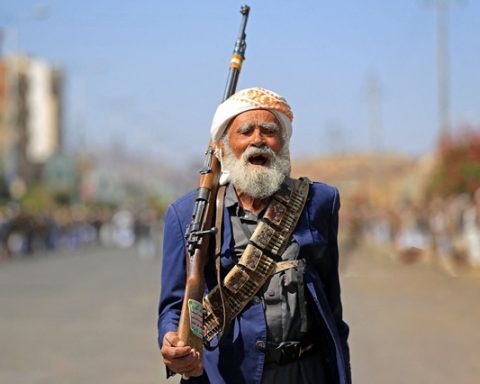
The Houthis’ use of drones extends beyond mere military utility; it is deeply embedded in their broader state-building and propaganda efforts. Central to their strategy is the deliberate portrayal of drone operations as evidence of their legitimacy as Yemen’s rightful government. Unlike many insurgent groups that rely on car bombings or indiscriminate violence, the Houthis frame their drone strikes as precise, calculated actions targeting military and strategic assets. This narrative is reinforced through a sophisticated media apparatus, including televised military parades showcasing their drone fleet and social media campaigns that emphasise their technological prowess. Such efforts serve dual purposes: they bolster domestic support by presenting the Houthis as defenders of Yemeni sovereignty and seek to shift international perceptions away from viewing them as a terrorist organisation.
This narrative construction has tangible implications for the Houthis’ international engagement. By adopting the trappings of a modern state, including the disciplined use of advanced military technology, the Houthis complicate efforts to categorise them strictly as a terrorist group. For instance, their use of drones has facilitated back-channel diplomacy, with regional and international actors engaging with Houthi leaders to negotiate ceasefires and address humanitarian concerns. This dynamic contrasts sharply with how groups like ISIS or Al-Qaeda are treated, highlighting the power of technological and rhetorical sophistication in shaping international perceptions.
From an academic perspective, the Houthis’ actions challenge conventional theories of state formation and sovereignty. In the context of Yemen’s fragmented political landscape, the Houthis have sought to establish a de facto state, complete with governance structures, a military apparatus, and a distinct ideological identity rooted in Zaydi Shia Islam. Their drone operations, while primarily a tool of war, also serve as a symbol of sovereignty, projecting power and control over territory. This aligns with Charles Tilly’s assertion that “war made the state, and the state made war,” yet it diverges from traditional Eurocentric models of state-building. The Houthis operate within a hybrid framework of sovereignty that defies clear categorisation, blending elements of insurgency, governance, and international diplomacy.
The Houthis’ reliance on drones also reflects broader trends in modern warfare. The proliferation of UAV technology has lowered the barriers to entry for non-state actors, enabling them to challenge state militaries in new and unprecedented ways. The use of drones eliminates the risk of human casualties for the operators, increases the precision and psychological impact of attacks, and offers a platform for propaganda that emphasises technological sophistication. These factors make drones an attractive tool for groups seeking to punch above their weight on the global stage.
However, the Houthi model is not without its contradictions. While their rhetoric emphasises precision and legitimacy, their actions often undermine this narrative. Reports of indiscriminate attacks on civilian areas, including systematic shelling of non-combatant populations in Saudi Arabia and the United Arab Emirates, reveal the darker side of their operations. Such actions raise questions about the extent to which the Houthis adhere to their self-proclaimed standards of modern warfare and expose the limits of their efforts to distance themselves from the label of terrorism.
The international community’s response to the Houthis highlights the complexities of addressing non-state actors that defy traditional classifications. The Biden administration’s initial decision to remove the Houthis from the list of Foreign Terrorist Organisations, citing humanitarian concerns, was later reversed in response to escalated attacks on civilian and maritime targets. These oscillations reflect the difficulty of balancing the need to address humanitarian crises with the imperative to deter aggressive actions by non-state actors.
Looking ahead, the implications of the Houthi model are far-reaching. As drone technology continues to proliferate, other non-state actors may seek to emulate the Houthis’ success, adopting advanced UAV capabilities to enhance their military and propaganda efforts. This raises critical questions for policymakers and scholars alike: How can states counter the growing threat of multi-drone terrorism? What role should state sponsors play in the regulation of UAV technology? And how should the international community engage with groups that use modern warfare tactics to assert claims of sovereignty?
The Houthi model illustrates the transformative potential of technology in asymmetric conflict and highlights the enduring power of narrative in the pursuit of legitimacy. For the Houthis, drones are more than weapons; they are symbols of a broader struggle for recognition and autonomy. For the international community, their actions represent a harbinger of the challenges posed by the intersection of technology, insurgency, and state-building in the 21st century.