


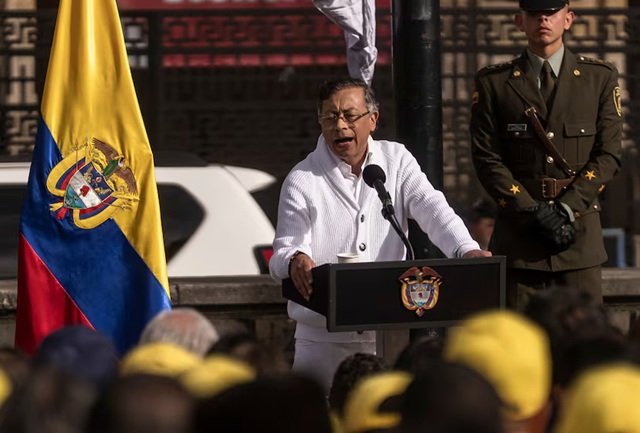
A wave of political uncertainty has gripped Colombia after President Gustavo Petro publicly rejected the preliminary results of the first round of the presidential election released on Sunday night. The quick count, which is traditionally used to provide an early indication of electoral outcomes before official verification, showed far-right candidate Abelardo de la Espriella leading with 43.7 percent of the vote, followed closely by Senator Iván Cepeda of the ruling coalition with 40.9 percent. The result, which diverged from pre-election polling expectations, immediately triggered competing claims of irregularities, alleged manipulation, and political interference, setting the stage for a contentious period before the final certification of votes.
Within hours of the announcement, Petro declared that he did not accept the preliminary count, casting doubt on its legitimacy and the system used to produce it. Speaking through his social media account, he argued that the transmitted count had no binding legal force and should not be interpreted as an official outcome. His intervention was significant not only because of his position as head of state but also because it directly challenged the credibility of the rapid reporting mechanism that has long been part of Colombia’s electoral process. Petro has previously expressed skepticism toward the private contractors involved in electoral logistics, and his latest comments revived longstanding debates about transparency and trust in the system.
In Colombia, elections are subject to a dual counting system designed to balance speed and legal certainty. On election night, a preliminary or “quick count” is conducted to provide an early picture of results. This process is managed through contracted technical operators working alongside the National Registry, and while it has no legal effect, it plays a major role in shaping public perception and political narratives in the immediate aftermath of voting. The official and binding results, however, come later through a more formal process carried out by electoral commissions composed of judges, notaries, and other public officials. This second stage, often referred to as the official count or scrutiny, involves detailed verification of tally sheets, review of irregularities, and, in some cases, legal challenges and ballot box inspections. It is this second stage that Petro emphasized as the only legitimate basis for accepting the outcome.
The president’s criticism focused particularly on the technical integrity of the preliminary system. He alleged that the software used in the counting process had undergone multiple modifications shortly before the election, which he claimed could have altered the number of registered voters included in the system. According to his statement, as many as 800,000 additional voter records may have been introduced through changes to the algorithm, a claim he made without presenting supporting evidence. He also referenced the private firm contracted to manage electoral logistics, referring to it in critical terms and suggesting that its handling of data lacked transparency. These assertions quickly circulated across political and media circles, although electoral authorities had not confirmed any such irregularities at the time of his remarks.
While Petro insisted that he was not rejecting the electoral process itself but only the preliminary count, his comments nonetheless added pressure to an already polarized political environment. He stated that he would only accept the results produced by the official electoral commissions once they had completed their verification work. By distinguishing between the preliminary and final counts, Petro attempted to position his criticism within the boundaries of institutional legality, while still challenging the credibility of the immediate results that showed an unexpected shift in voter support toward the far-right candidate.
Senator Iván Cepeda, Petro’s ally and the ruling party’s candidate in the runoff, also raised concerns about the preliminary data. He claimed that his team had identified inconsistencies involving millions of votes and pointed to what he described as irregular patterns in several polling stations. Cepeda suggested that discrepancies in the electoral register, including the figure of approximately 850,000 voters referenced by Petro, required urgent clarification. However, he also emphasized that his campaign would await the completion of the official counting process before drawing definitive conclusions. His response reflected a cautious approach, balancing concern about potential irregularities with a recognition of the legal framework governing electoral certification.
In contrast, Abelardo de la Espriella responded with a strongly confrontational stance, rejecting both Petro’s objections and Cepeda’s concerns. Speaking at a rally in Barranquilla, he dismissed the allegations of irregularities and framed them as an attempt to undermine the will of voters. His rhetoric escalated tensions further, as he warned against any effort to disregard the preliminary outcome and called for firm resistance to what he described as political interference. He also urged security forces to remain vigilant and invoked the constitutional order as a safeguard against what he characterized as attempts to delegitimize the electoral process. His statements, delivered in a highly charged atmosphere, underscored the deep divisions surrounding the election.
As Colombia now moves toward the official counting phase, the country faces a delicate political moment in which institutional credibility, public trust, and partisan rivalry intersect. The preliminary results have already reshaped expectations for the runoff, but they remain provisional and subject to verification. The competing narratives emerging from the main political actors highlight the fragility of consensus around electoral institutions, even as the legal process continues. With the official scrutiny still ahead, the final outcome will depend not only on the numbers themselves but also on whether the competing sides accept the legitimacy of the institutions responsible for confirming them.









