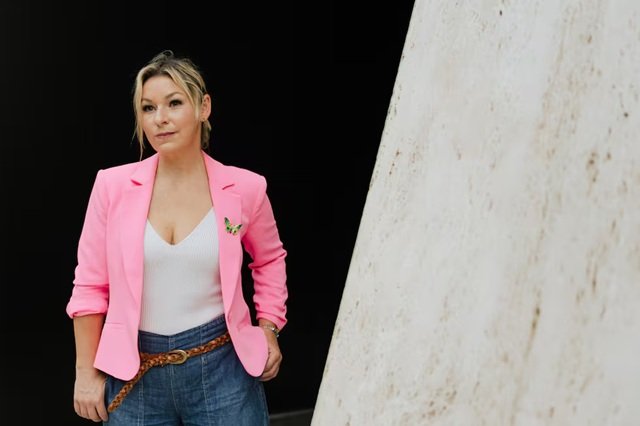
For Dani Bensky, the story began long before Jeffrey Epstein became one of the most notorious names in America’s history of sexual abuse and trafficking. It began when she was 17, a young dancer in New York who dreamed of performing on stage and whose passion for ballet would eventually become the means through which Epstein gained her trust.
Now 39, Bensky is speaking publicly about what happened to her and about what she believes is a second failure by the American system: the handling of the vast archive surrounding Epstein and the continued absence, she argues, of broader accountability.
“United States has failed spectacularly in this case,” Bensky says in an interview from New Jersey, as reported by El País.
Her experience is being revisited at a moment when the US government’s handling of Epstein’s files has placed survivors at the centre of a new controversy. The Department of Justice has been responsible for releasing documents under legislation requiring the publication of unclassified records related to the case. Bensky says the process has compounded the trauma experienced by victims rather than resolving it.
Epstein, who died by suicide in prison seven years ago, led what has been described as one of the largest known networks of sexual abuse and trafficking involving girls and young women. Last year, both chambers of the US Congress unanimously approved the Epstein Files Transparency Act, requiring the Department of Justice to make public unclassified documents connected to the case.
Since then, nearly half of the six million files held by the government have been released, revealing Epstein’s relationships with numerous prominent figures, including US President Donald Trump and Mette-Marit, the consort queen of Norway.
For Bensky, however, the documents are not merely a historical archive. They are evidence connected to an ordeal that began in 2004.
She had left her family home and was looking for ways to continue dancing when another young woman suggested that she visit Epstein. She was told she could earn between $200 and $300 for giving him a massage.
Bensky remembers being uncertain about the proposition. She asked what she would have to do and was reassured that the work would be little more than a massage, with her experience as a dancer presented as an advantage.
She eventually went to Epstein’s mansion at 9 East 71st Street in Manhattan with a friend. During the first visit, she says, Epstein talked continuously and asked questions about their families, living arrangements and ambitions.
The second visits followed a different pattern. Epstein kept her there by talking about ballet and classical music, gradually connecting his promises of professional assistance with demands involving her body.
“If you want me to help your career, give you a space in the studio, buy you pointe shoes, introduce you to the director of the American Ballet Theatre… let’s look at your body,” Bensky recalls him saying.
For a young dancer accustomed to having her body examined during private ballet lessons, the behaviour initially did not necessarily appear as a clear warning. She says Epstein would ask her to undress and then examine her, presenting the encounters as if they were lessons. The massages, she recalls, eventually became inappropriate.
Her understanding of Epstein was also shaped by a family crisis. When her mother was diagnosed with a brain tumour, Bensky believed Epstein might be able to help. She mistakenly thought his wealth came from a medical career and recalled seeing a sculpture of a brain in his mansion.
She brought him her mother’s medical examination results.
Instead, she says, Epstein wanted her to recruit other girls for him. She refused. According to Bensky, he threatened her mother while promising that he could ensure she received treatment from the best specialist.
The next encounter, she recalls, was more aggressive. “He abused me, he grabbed me forcefully,” she says.
After she turned 18, she says Epstein told her: “Now you are a prostitute.”
The abuse continued for about a year, until 2005, when Bensky’s mother underwent surgery. At that point, she says, Epstein no longer had power over her. She stopped answering his calls and he disappeared from her life.
Three years later, Epstein was arrested for the first time. The FBI contacted Bensky and asked her to appear as a victim. She describes the experience as an interrogation rather than a supportive interview.
She says she had no specialist lawyer representing victims’ rights and no legal or support system accompanying her. She initially provided a statement, but warnings from a friend that Epstein had been following her caused her to deny everything eventually.
Even after that, the past did not disappear.
In 2019, the FBI visited her home, before Epstein was charged with sex trafficking. That same year, Epstein died by suicide in prison.
Bensky has since pursued legal action of her own. In 2024, she filed a lawsuit against two of Epstein’s principal associates, his lawyer Darren Indyke and accountant Richard Kahn, who have administered Epstein’s estate since his death. Both remain free.
For Bensky, the release of the government files has raised a larger question about whether the transparency promised by Congress has actually produced meaningful accountability.
She points out that millions of documents have been released but says there has been no new investigation or prosecution in the United States arising from them. Ghislaine Maxwell, Epstein’s former girlfriend and the only major associate currently imprisoned, remains the most prominent person convicted in connection with his network.
“I’ve never been a victim of his, but I do think he must know something,” Bensky says of Trump. She describes her views of the President as contradictory and argues that the efforts to protect his name are troubling. “He has to talk about what he knows,” she says.
The most immediate controversy, however, concerns the treatment of the victims themselves.
Bensky says the Department of Justice’s handling of the files has exposed personal information belonging to survivors. Her full name and other personal details appeared publicly on nine occasions, she says, while some individuals connected to Epstein’s network remained redacted. Other victims have reportedly appeared hundreds of times.
Todd Blanche, who recently became Attorney General and had been Deputy Attorney General when the documents were released, supervised the process.
“Our Government has basically disseminated pornographic material all over the world and someone needs to be held accountable for it,” Bensky says. She testified before the Senate Judiciary Committee and argues that the government’s conduct represents a new form of harm.
“The Epstein case happened a long time ago and there is a lot to investigate; without a doubt, there are guilty people who should end up behind bars,” she says. “But there is another crime being committed right now, which is the actions of the Department of Justice.”
Her criticism is not framed solely as a partisan attack. Bensky argues that Democrats and Republicans can recognise the issue as one involving human rights rather than party politics. She points to criticism within the Republican Party itself and says that Blanche’s own party has acknowledged that issues remain to be addressed.
Her campaign now extends beyond the release of documents. Alongside what she calls her “survivor sisters”, Bensky is advocating for legislation named after Virginia Giuffre, the high-profile Epstein survivor who died earlier this year. The proposed law would guarantee victims access to justice regardless of how much time has passed.
For Bensky, the campaign is ultimately about preventing the passage of time from becoming another barrier to accountability.
Her own life has continued alongside the case. She is now a mother of a young child and a contemporary dance teacher, rebuilding a life around the art that once brought her into Epstein’s orbit.
She says she hates that some of the people she loves most came into her life because of Epstein. Yet she also describes the survivors she has met as extraordinary.
“These girls are magical,” she says.
Her hope is that, eventually, the pieces of a story that has remained unresolved for decades can finally exist in harmony.
For now, the release of the Epstein files has produced a paradox. A process intended to increase transparency has also exposed survivors to renewed scrutiny and, according to Bensky, further harm. The promise of accountability remains, while questions about who should be investigated, who should be held responsible and how victims should be protected remain unresolved.