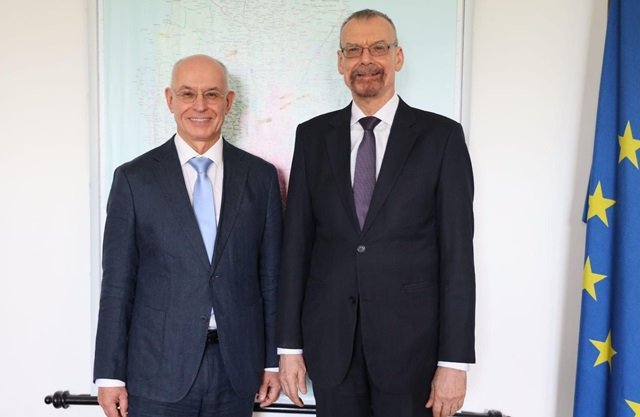
When the French Ambassador to Sri Lanka, Rémi Lambert, and the German Ambassador to Sri Lanka, Dr. Felix Neumann, travelled together to Jaffna, their visit became more than a routine diplomatic engagement in Sri Lanka’s Northern Province.
Over a series of meetings with political representatives, provincial officials, business leaders, academics and civil society groups, the two European envoys encountered a region defined by both possibility and unresolved questions. Their reflections, shared in a joint interview with Jaffna Monitor, highlighted the North’s economic potential, the expectations of local communities and the continuing challenges linked to governance, reconciliation and development.
The ambassadors said their discussions revealed a gap between formal structures and everyday experiences. Ambassador Neumann noted that while some concerns may appear addressed “on paper” from Colombo, conversations in Jaffna placed greater emphasis on lived realities, including dignity, participation and trust in governance.
The German envoy said local business representatives were seeking more transparent and decentralised processes, alongside improvements that would make it easier for investors to establish operations and navigate administrative procedures. Ambassador Lambert similarly pointed to the strength of civil society and the willingness of the private sector to engage, while acknowledging challenges created by the region’s remoteness and limited connectivity.
Both ambassadors highlighted the potential role of the Sri Lankan diaspora, particularly those willing to contribute economically and socially to the North. They also identified agriculture, fisheries, renewable energy, sustainable tourism, digital services and logistics as sectors with significant potential for future investment.
However, they said investors continued to raise concerns over land clarity, regulatory predictability, administrative efficiency and long-term policy stability. Ambassador Neumann pointed to Germany’s support for local entrepreneurship through GIZ initiatives, including Hatch Kalam, Jaffna’s first maker and co-working space, which supports startups and small businesses.
Ambassador Lambert said France was also prepared to work with local entrepreneurs through French cooperation mechanisms and the French Development Agency (AFD), building on previous involvement in projects such as the Jaffna water treatment facility.
The relationship between the Northern Province and the central government was another key issue discussed during the visit. Ambassador Neumann described it as functional but still marked by a degree of distance, with expectations in the North for deeper consultation, quicker decision-making and more consistent implementation of devolution.
Ambassador Lambert said many of the challenges were not exclusive to the North but reflected wider national issues involving transparency, business conditions and coordination. However, he stressed that stronger cooperation between the provincial and central authorities would be important for regional development.
Connectivity emerged as one of the most visible concerns during the journey itself. Both ambassadors recalled the lengthy travel time between Colombo and Jaffna and argued that improved road, rail, port and digital connections would strengthen economic opportunities and national integration.
Ambassador Lambert said infrastructure development should also follow principles of transparency, environmental responsibility and social inclusion. He added that regional connectivity with the Bay of Bengal and the wider Indian Ocean environment was important for the North’s future growth.
The joint Franco-German visit, according to both envoys, reflected a continued European interest in understanding Sri Lanka as a whole rather than focusing only on individual regions. Ambassador Neumann described the mission as part of a shared European commitment to inclusive development and regional balance.
Ambassador Lambert said the visit represented a deepening rather than a shift in engagement, noting previous joint cultural initiatives in Jaffna, including the Itinerant Library project, the Sister Library project and the Roots We Take initiative.
More than seventeen years after the end of Sri Lanka’s war, reconciliation and accountability remained central themes of the discussions. The ambassadors said they heard both about progress in reconstruction and basic services as well as continuing concerns over trust, inclusion and accountability.
Ambassador Neumann said reconciliation was a long-term process requiring sustained effort. Ambassador Lambert said France supported continued efforts related to dialogue, transitional justice and human rights, including through the framework of the UN Human Rights Council.
Land issues and the continued presence of military structures in civilian areas were also raised during the visit. Ambassador Neumann said discussions revealed ongoing concerns regarding land use and livelihoods, while noting that transparent processes and fair restoration of livelihoods were important for durable solutions.
Ambassador Lambert acknowledged that the issue had been raised during the visit and had also received international attention. He said the government’s steps to release some lands were important for building trust with conflict-affected communities and encouraged continued progress.
The ambassadors also addressed long-standing debates surrounding provincial elections, the Prevention of Terrorism Act and Sri Lanka’s commitments under the European Union’s GSP+ trade arrangement.
On provincial elections, both envoys said regular elections were fundamental to democratic governance while recognising that questions surrounding state structure remained part of Sri Lanka’s domestic debate. Regarding the PTA, they said reforms should align with international human rights standards, including judicial oversight and procedural safeguards.
On GSP+, Ambassador Neumann described the arrangement as a trade framework connected to shared international standards, while Ambassador Lambert said it represented an opportunity for Sri Lanka to integrate further into global supply chains.
The ambassadors also discussed the future of Northern infrastructure projects, including Palaly Airport and Kankesanthurai Harbour. They said such developments could have economic importance but would require sustainable planning, local benefit and possible private-sector participation.
Beyond economic development, the two countries continue to support cultural, social and climate-related initiatives in Sri Lanka. France highlighted projects involving women’s empowerment, gender equality and cultural cooperation, while Germany pointed to programmes supporting social cohesion and skills development, including vocational training facilities in Kilinochchi.
The ambassadors also addressed climate resilience following Cyclone Ditwah, emphasising cooperation on renewable energy, disaster preparedness, coastal protection and marine conservation.
As France and Germany continue their engagement with Sri Lanka through bilateral and European frameworks, their Jaffna visit highlighted the complex set of issues shaping the North’s future. The discussions reflected a region seeking stronger connectivity, wider economic opportunities and continued attention to unresolved questions surrounding governance, reconciliation and inclusion.