


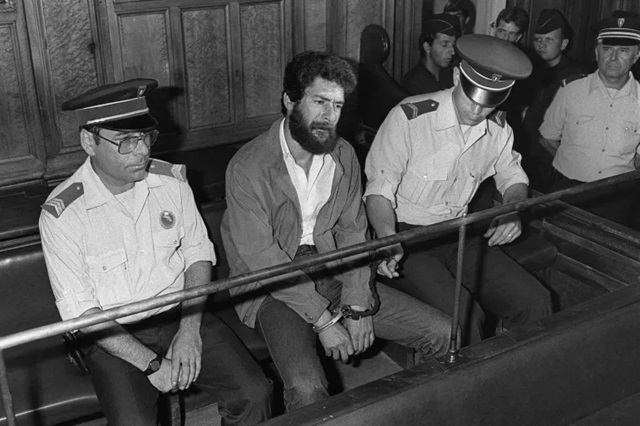
After more than four decades behind bars, Georges Ibrahim Abdallah, one of Europe’s longest-held political prisoners, is set to be released from a French prison and deported to Lebanon on July 25, following a Paris Court of Appeal ruling on July 17. The decision concludes a prolonged legal and political battle that spanned 41 years, sparking celebration in Lebanon and reigniting discussions about political imprisonment, colonial legacy, and the instrumentalization of justice in the West.
Abdallah, a 74-year-old veteran of the Lebanese Armed Revolutionary Factions (LARF), was sentenced to life in prison in 1987 for complicity in the assassinations of American and Israeli diplomats in Paris in 1982. Though he consistently denied direct involvement in the attacks, he took political responsibility, calling them acts of resistance against U.S. and Israeli aggression. The release order, granted conditionally with deportation, marks the end of his twelfth bid for freedom and follows years of international advocacy and grassroots mobilization.
A Prisoner of Politics, Not Just Law
Born in 1951 in the northern Lebanese village of Qoubaiyat to a Maronite Christian family, Abdallah’s political awakening came during his university studies in France, where he became involved in Marxist and anti-imperialist circles. He returned to Lebanon in the early stages of the civil war and aligned himself with Palestinian resistance groups, eventually joining the Popular Front for the Liberation of Palestine – General Command (PFLP-GC). His involvement in the armed struggle for Palestinian liberation later led to his association with the LARF, a group that became known for targeting Western diplomatic and military figures.
Abdallah was arrested in Lyon in 1984 for possessing forged documents, but the charges quickly escalated. French authorities, under pressure from the United States and amid a wave of Middle Eastern-related terror attacks, accused him of being involved in the killings of U.S. military attaché Charles R. Ray and Israeli diplomat Yacov Barsimantov. Despite weak physical evidence, Abdallah’s political affiliations and his refusal to denounce militant resistance sealed his fate in a highly politicized trial.
Throughout his incarceration, Abdallah was widely recognized by human rights organizations and legal experts as a political prisoner. His case raised serious questions about judicial independence in France, particularly after declassified documents revealed U.S. pressure played a key role in thwarting several court-ordered release decisions.
A Landmark Legal Decision, Decades in the Making
Though eligible for parole since 1999, Abdallah’s release was repeatedly blocked—either by appeals pushed by prosecutors at the French government’s urging or by the refusal of authorities to sign off on deportation. His most recent attempt, the twelfth, was approved in November 2024 when judges ruled his continued imprisonment to be “disproportionate” and a threat to public order, citing frequent demonstrations in support of him as evidence. The court acknowledged his age, his lack of involvement in any violent activity since 1984, and the shifting political context that made his continued detention indefensible.
However, that decision was immediately suspended when France’s National Anti-Terrorism Prosecution appealed, arguing that Abdallah had not shown “repentance” or made “sufficient effort” to compensate the victims’ families. French law does not require such repentance for parole, a point forcefully argued by Abdallah’s lawyer, Jean-Louis Chalanset, who accused the state of using extra-legal standards to justify indefinite detention. “I told the judges, either you release him, or you sentence him to death,” he said after the appeal hearing.
The court ultimately accepted that €16,000 set aside in Abdallah’s prison account, partially raised through donations, could serve as symbolic restitution, thereby satisfying the final condition for his release.
An Unrepentant Revolutionary
Over the years, Georges Abdallah has remained ideologically steadfast, refusing to renounce his support for armed resistance or to express regret for his political convictions. From his prison cell in Lannemezan, southern France, he authored dozens of statements supporting Palestinian prisoners, denouncing imperialism, and calling attention to injustices across the Arab world. In 2024, he marked Palestinian Prisoners’ Day with a statement reaffirming that their struggle was central to liberation movements and condemning ongoing Israeli occupation practices.
His refusal to compromise earned him reverence among Arab leftist movements and international solidarity networks, who long argued that he was being held as a symbol—a cautionary tale to those who defy Western hegemony through armed resistance. His supporters hailed him as a political martyr, unbroken by time, prison, or diplomatic manipulation.
Lebanon and the Global Response
News of Abdallah’s impending release was met with celebration in Lebanon. Preparations for his return are already underway in Qoubaiyat, where he is expected to live out his final years. His homecoming will mark a significant symbolic victory for many Lebanese and Palestinians, as well as for Arab nationalist and leftist groups who have kept his name alive through decades of campaigning.
The Lebanese state itself has also played an intermittent but crucial role in pressing for his release. In 2012, then-Prime Minister Najib Mikati publicly demanded Abdallah’s freedom. In 2013, a court again authorized his release, contingent on deportation, but the French Interior Ministry failed to follow through. In 2018, President Michel Aoun’s administration dispatched top intelligence officials to negotiate with France, underscoring the issue’s high-level significance.
Meanwhile, demonstrations continued annually outside the French Embassy in Beirut and Lannemezan Prison, often drawing crowds chanting, “Freedom for Georges Abdallah!” and branding his detention as an emblem of France’s colonial legacy in the Middle East.
A Case That Transcends Borders
Georges Abdallah’s story is more than one of an imprisoned man. It is a chronicle of a Cold War-era revolutionary whose incarceration became a symbol of the shifting nature of justice in a global order dominated by imperial politics. While Western governments labeled him a terrorist, his supporters framed him as a freedom fighter standing at the intersection of Palestinian resistance, anti-colonial struggle, and revolutionary Marxism.
His 41-year incarceration has outlasted the Cold War, several French presidents, and numerous geopolitical transformations, yet he emerges as a figure whose relevance remains sharply intact—perhaps even more so in today’s era of revived global struggles for decolonization, Palestinian justice, and state accountability.
With his release on July 25, Georges Ibrahim Abdallah will not only reclaim his physical freedom but also re-enter a world that, in many ways, is still wrestling with the very ideologies and inequalities he fought against. His freedom closes a dark chapter in European political imprisonment—but also opens another on the memory and meaning of resistance.









