by Our Diplomatic Affairs Editor
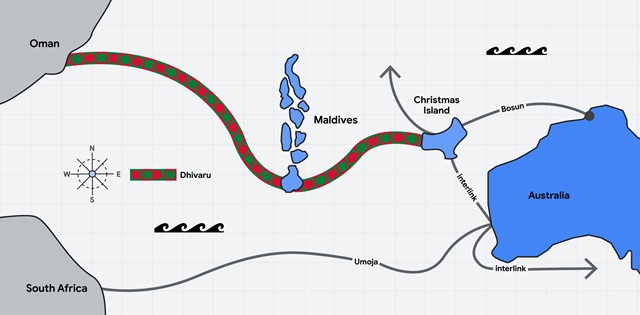
Google has unveiled Dhivaru, a major new Trans-Indian Ocean subsea cable system designed to connect the Maldives, Christmas Island, and Oman—marking one of the company’s most consequential infrastructure expansions in the region to date. In parallel, Google will establish two new connectivity hubs in the Maldives and Christmas Island, signaling an ambitious push to strengthen the reliability, reach, and resilience of global internet pathways, especially as demand for AI-driven services continues to surge.
The new cable system takes its name from “Dhivaru,” the Maldivian term for the line that controls the main sail on traditional vessels—symbolizing mastery, strength, and navigational prowess. In the context of a fast-changing digital world, the name reflects Google’s broader mission: to steer the future of global connectivity as AI adoption accelerates at unprecedented speed. With platforms such as Gemini 2.5 Flash Image (also known as Nano Banana) and Vertex AI rapidly gaining global traction, Google emphasizes that dependable connectivity is no longer optional but essential to sustain AI-powered experiences for users and enterprises.
The Maldives is emerging as a pivotal strategic partner in this transformation. Alongside Christmas Island, it will host one of Google’s newest connectivity hubs—specialized facilities built to enable cable switching, content caching, and colocation. These hubs will reduce latency, boost resilience in the event of cable interruptions, and support the next generation of digital services for regions stretching from Africa and the Middle East to South Asia and Oceania. Subsea infrastructure—already one of the world’s most energy-efficient networking solutions—will be further reinforced by the hubs’ compact yet high-impact capabilities. Google is also exploring the potential to leverage these hubs to stimulate local renewable energy investments in areas where power demands remain challenging.
Maldivian leadership hailed the Dhivaru initiative as a powerful vote of confidence in the nation’s digital and economic trajectory.
“Google’s decision to invest in the Maldives is a strong signal of confidence in our country’s stable and open investment environment,” stated His Excellency the President of the Republic of Maldives. He highlighted the project as a cornerstone of a diversified, inclusive, and digitized Maldivian economy, positioning the island nation as a crossroads of global connectivity in an AI-driven era.
Local telecom leaders echoed this optimism. Ooredoo Maldives CEO and MD Khalid Al Hamadi described the partnership as “a major step forward” that will strengthen national digital infrastructure and support new growth opportunities in sectors such as tourism. Dhiraagu’s CEO and MD Ismail Rasheed underscored the historic importance of Google’s collaboration, noting that the new hub in Addu City will further enhance the country’s digital ecosystem and global relevance.
A separate press release issued by the Maldives’ Ministry of Economic Development and Trade formally welcomed Google’s investment in the new international submarine cable landing station in Hithadhoo, Addu City. According to the ministry, the project—initiated after President Dr. Mohamed Muizzu’s meeting with Google executives in New York in September 2024—represents a multi-million-dollar move that cements the Maldives’ status as a secure digital gateway linking Asia, Oceania, Africa, the Middle East, and Europe.
The government highlighted that with landing points now in the north (Kulhudhuffushi), center (Greater Malé), and south (Hithadhoo), the Maldives is developing a distributed national network that boosts resilience and elevates its strategic role in international connectivity corridors. The investment is seen as a catalyst for nurturing emerging industries, including cloud services, fintech, digital content, and technology start-ups—sectors central to the administration’s economic diversification agenda.
Both Dhiraagu and Ooredoo Maldives were recognized as essential local partners in the development of the new infrastructure, ensuring that the project incorporates local expertise, knowledge transfer, and meaningful value creation.
As Google advances its long-term plan to deepen the Internet’s reach across the Indian Ocean region, the Dhivaru cable and its supporting hubs promise not only enhanced digital performance but also a broader societal impact. Improved connectivity is expected to stimulate local economies, empower small businesses, and extend the transformative benefits of AI to communities across multiple continents.
The Government of Maldives reaffirmed its commitment to facilitating the successful deployment of the project, describing it as a transformative milestone in the nation’s digital evolution.
With Dhivaru, Google has set the stage for one of the most significant connectivity upgrades in the Indian Ocean’s modern history—one that could redefine how nations across the region participate in the rapidly expanding global digital economy.