
“This conflict with Iran is not regional. It is” – in his words – “a war really for the West, for free societies. And I am very much in favour of any steps that can free the people of Iran, free the peoples of the region, and take away this threat to free societies across the world.” He is unapologetically direct and defines the terms of engagement from the first sentence: this is a conflict not only for Israel, but a global one; an existential challenge to liberal values everywhere. He is one of Israel’s senior most diplomats having been ambassador to the UK and a key negotiator on highly charged issues, defining policy and representing Israel on a world stage.
Daniel Taub is a British-born Israeli diplomat, international lawyer, negotiator, writer, and academic. Born in London in 1962, he later took Israeli citizenship, building a formidable career in diplomacy and international law, subsequently holding the position of Director of Strategy and Planning at Yad Hanadiv Foundation after his term as ambassador. Before and throughout his diplomatic career he engaged in peace-process dialogue with the Palestinians, was part of the Israeli negotiation teams with Syria, and represented Israel on international legal forums like the UN and at the International Court of Justice.
Last night I sat down with him for a lengthy discussion ranging over the role of Israel in the region, the influence of Iran and its proxies, the dilemmas of the Palestinian issue, international law and the practice of public diplomacy in the age of instantaneous information and social media.
Taub anchors this conflict to 47 years ago with the ascendance of Khamenei’s father, establishing a clear throughline of sustained state-sponsored aggression: “We have seen non-stop exporting of terror from Iran to what they called the Ring of Fire, these proxies around the region, exporting terrorist attacks throughout the world, including throughout Europe, an attempt to get nuclear weapons, and daily calls for the destruction of Israel, the small Satan, and America, the big Satan.” His vision, in its starkness, eliminates any ambiguity regarding negotiation; certain ideological imperatives – in this case, the need for Israel to be eliminated – are beyond discussion: “When you have somebody, a leadership, whose core identity is the destruction of Israel, then there really is no basis for negotiation. It’s the same as Hamas. You know, on that terrible October the 7th, when Hamas brutally murdered 1,200 Israelis, they were not shouting, ‘give us a state,’ or ‘give us a negotiated solution.’ They were shouting, ‘death to the Jews.’ And if that is your core ideological extremist belief, then I think that’s something that doesn’t need to be negotiated with. That’s something that needs to be defeated.”
Taub’s assessment of when negotiation is impossible comes from hard-won experience. A negotiator and senior diplomat at that, he has long operated under the understanding that you can only negotiate with a party who envisions a peace. This definition guides his view of both Iran and Hamas and has shaped the parameters of his work: “At the very beginning, there was a tendency on each side to see the other side as monolithic. And I think one of the things that you have to learn in the course of the negotiations is actually, the team is made up of very different elements.” For Israel, this means navigating complex internal politics and a deeply embedded sense of realism forged by decades of conflict, both internally and with neighbours.
Taub was born in London in 1962, but made aliya (immigrated) to Israel in the late 1980s. The reasons for this, as he says, are twofold and quite poetic: “I met my wife, and she would only marry me if we would live in Israel. But I also have a feeling that if I wanted to have a kind of impact on society, I would have more of an impact in a small, young country like Israel than in the UK, even though I’m still very close to the United Kingdom.” Taub also sees this as a rejoining with his heritage, the return to the ancestral land after 2000 years of exile: “I feel very honoured that I am now living in the country of my ancestors, you know, after an exile of 2000 years that I’m raising my children there.” However, he hasn’t forgotten the influence of the UK on his life, expressing admiration for how the country helped shape his family’s post-WW2 history, so “building Anglo-Israeli relations has become a key focus in my work.”
His university education was at Oxford, UCL and Harvard Kennedy School, all of which Taub looks back upon as “very warm memories” and “a privilege.” Today, he laments the rise of tribalism on campuses and the shutting down of opposing viewpoints, saying, “the approach of many people to opposing views is not to argue with them, but to try to shut them down. And I think, sadly, universities are losing sight of their critical role as custodians of open debate.” His careful adherence to using the diplomat’s exact words preserves his cadences and the sense of authority.
He is insistent that his family were not wealthy or privileged, stating, “there was not a sense of parental pressure” in pursuing his studies but that his education and the encouragement of his teachers, as well as sheer chance, set him on his path. In Israel, he notes that university students have a different educational experience and a sense of realism forced on them by their obligatory military service: “In Israel, the university experience is very different because, sadly, every 18-year-old doesn’t go to university but goes to the army for three years or more. And in many ways, that’s an incredibly maturing experience. It gives people responsibility. It makes them require skills. It makes them grapple with ethical issues and so on and so forth.”
Taub first became involved in public service not as a diplomat but as a speechwriter for the President of Israel, a meteoric rise from new immigrants’ absorption centre: “There was only one phone in the absorption centre. And they say, it’s for you. It’s the President. And here was the President of Israel phoning me as a new immigrant in the absorption centre and inviting me to come and help him write the speeches.” He remembers the President’s voice as distinctly Israeli, with a lingering Irish accent, as “a message…that it doesn’t matter where you come from. You can always make a contribution.”
His eventual shift to negotiation helped him “understand the difference between the descriptive [aspects] of diplomacy and the prescriptive ones,” saying, “in one situation, you are trying to describe the situation. And then the other, you’re trying to change the situation. And that’s a very different change, a very different task.” The early 90s with the Palestinians were an exciting yet terrifying period of negotiation, of “tremendous hope,” ultimately shattered by “the violent elements that didn’t want to see peace.”
Taub rejects any simplified view of negotiating parties. He explains the complexity on the Palestinian side as, “the team is made up of very different elements. On the Palestinian side, you had the leadership who had grown up in the West Bank and in Gaza, leadership who had flown in from exile, and a few Palestinian diaspora academics who had been shifted from universities to advise the delegation. Often the hardest people to reach agreement with were the diaspora academics. They were the ones who took the most extreme positions.” This personal experience has informed his assessment of when and how to negotiate.
He speaks of moments of common humanity amidst conflict. At times during negotiations, a Jewish fast day has overlapped with Ramadan: “So the Palestinians were because of their religion, and we were fasting because of our religion. At the end of the day, we would break our fast together. And that was very moving.” Yet he acknowledges the horrific moral compromises inherent in such conflict: “Imagine you are in a negotiation, many of these took place in Egypt. And you come down to breakfast in the morning. And you learn that there was a Palestinian suicide bomb attack the night before. And then the question is, what do you do? Do you carry on with the negotiations? Or do you stop? Are you betraying the victims of that attack? Or are you helping prevent the next attack? So those were some of the emotional moments in the negotiation.”
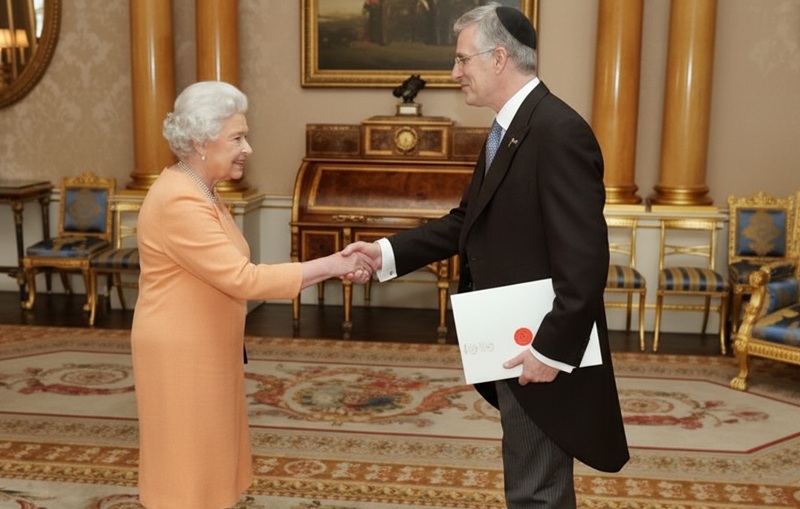
During his term as ambassador to the UK, Taub saw public diplomacy as key to shifting perspectives on Israel. He believes that it is only by bringing people to Israel and allowing them to see its reality that they can overcome preconceptions: “One of the ways in which you can realise what misconceptions people have is by bringing them to Israel. And you see what surprises. The first thing that surprises them is how tiny the country is. I think Sri Lanka is probably three times as big as Israel. You can drive from top to bottom in maybe five hours. You can drive from side to side in less than an hour.” People are further surprised by the diversity of the population, “half of our population goes back to the Middle East. We have Ethiopians, we have Russians, we have some Sri Lankans who are living in Israel. But all together,” he concludes, “I think there’s something about the variety and the energy of the country that surprises them as well.”
When he reflects on current means of public diplomacy, Taub places faith in tangible experience over rhetorical pronouncements: “I really think the reality of Israel, which is complicated, is our greatest ally. People that pose themselves to the reality of Israel and see our complexities, but see the energy of the country. So my suggestion is to bring people to Israel, to share Israel as much as we can, on social media, on media. Israel has punched above its weight. In the film industry, in the television industry, there are TV series around the world that either were made in Israel or were remade after they were made in Israel. And I think just sharing the humanity. One of the things that Israel has a lot of is stories.”
Taub’s view on the two-state solution is definitive. “The difficulty that many Israelis have today with the phrase, the two-state solution, is less with the word state, and more with the word solution. There doesn’t seem to be a sense that this is really what the Palestinian leadership is after. Again and again, the message seems to be they are less interested in the establishment of their own state, and more interested in the destruction of ours. And until it is, it’s not going to be a basis for peace.” He insists that Israel wants “nothing more than a prosperous, stable Palestinian society that we could trade with living next door to them,” but this ambition has been repeatedly thwarted: “Whether it was the partition resolution, whether it was the Camp David proposals, whether it was the Olmert proposals, whether it was the Barak proposals, all of them were rejected.”
His analysis is extended to the broader Middle Eastern region where he places Iran at the centre of ongoing conflict and instability: “If the current efforts are successful, both in disempowering Iran, which has been the force behind so much negativity, so much hostility, so much destruction…we are beginning to see Lebanon, actually the government of Lebanon, stand up to Hezbollah. We haven’t yet seen it in the Palestinian territories, but that’s what we’re hoping for.” Iran’s strategic goal is not conquest, but dominance and regional hegemony: “The Middle East hasn’t just become unstable. We have had decades of instability, of terror, of brutal repression that starts in Iran and goes out through its proxies to the country of the region, all of the while sending acts of terror throughout the world, including states in Europe and the West.”
Regarding international law, Taub expresses deep respect for its foundations but grave disappointment in its current state: “I have tremendous respect for international law. What has happened to international law has been incredibly, incredibly sad for me to see. International law, particularly the law of armed conflict, is one of the great achievements of the 20th century. The Geneva Conventions and legal institutions were designed to give protection to civilians that didn’t have it in the wars that took place before.” Yet he argues these have been weaponised by terrorist entities: “Far from protecting civilians, they are deliberately creating environments where their weapons factories, where their terrorist headquarters are abusing civilians, are being hidden under civilian houses in the heart of hospitals. There is an attempt to rewrite the principles of international law in a way that is very troubling.” He takes particular issue with the concept of proportionality, arguing that “Some Western leaders say you cannot fight against terrorists, but you cannot endanger the lives of civilians. That is a rewriting of international law…you are issuing an open invitation to every terrorist organisation in the world to set up shop inside a school or a hospital.”
The International Criminal Court (ICC) is cited as an example of this politicisation. Taub believes that although the ICC operates on the principle of complementarity, it has demonstrably failed in this aspect: “The ICC is supposed to operate on the basis of complementarity, which means that it only enters proceedings if the country concerned is not shown itself willing to investigate its own citizen. It is hard to find a country that has done that more than Israel. And strangely, on the day that the prosecutor of the ICC was supposed to come to Israel to see the principles of complementarity, he cancelled the visit and issued the arrest warrant. It is hard to escape the suspicion that these arrest warrants have more to do with his own issues than with anything happening in the region.”
Dialogue and disagreement are central themes in his work. His book ‘Beyond Dispute’ explores how to navigate these complexities. However, he makes it clear that genuine disagreement necessitates a shared goal of peace. When adversaries are ideologically driven to destroy Israel, negotiation becomes untenable: “If you find yourself up against an adversary who is not interested in any kind of peace, whose identity calls on them to campaign and work for your destruction, then that is not the place you need to have a conversation. You need to defend yourselves.” He does, however, acknowledge the value of well-structured disagreement in broader conflict mediation: “These principles may be helpful for people that see themselves as supporters of Israelis and supporters of Palestinians or supporters of other groups around the world. Unfortunately, those conversations have become very difficult, even toxic. We live in echo chambers. We live in environments where it is very easy to spread fake news…a horrendous allegation that was made against Israel that it had bombed a hospital turned out to be Hamas missiles. By the time it became clear, so much of the world had bought into these lies.”
Despite the challenges, Taub believes that coexistence is possible. However, this is contingent on protecting fragile spaces of genuine communication: “We have had very good relations between Israel and Lebanon in the past. We had excellent relations between Israel and Iran before 1979. There is no reason why we cannot have productive relations again. But if we are going to do that, we have to recognise that the spaces in which we can have the conversations are rare spaces that need to be cherished, that need to be protected. There are leaders who are opposed to that kind of open conversation. Think of the thousands of people murdered in Iran for wanting basic freedom. The answer is not to have a conversation with those leaders. The answer is to try and release the stranglehold of that leadership so that the people of society can speak.”
The current situation is part of a long historical pattern: “Everyone in Israel recognises that we are going through a period that is necessary if we are going to ensure the security of our society and ensure the other societies of the region onwards. In the West, there are people critical of this war, but the closer you get to Iran, the more countries are in favour of it. Look at the countries fighting alongside the United States and Israel: the Gulf States, the UAE, Bahrain, Qatar, even Saudi Arabia. Because when you get closer, people realise Iran and its proxies are the real cause of so much negativity.”
His critique of the United Nations is sharp: “The UN in some fields does very important work. In other areas, unfortunately, it has allowed itself to become instrumentalised. It cannot be an appropriate use of UN resources that it passes more resolutions to condemn Israel in any given year than every other country combined. The victims of that politicisation are not Israel, but victims of human rights abuses elsewhere that never get attention. People really need to ask themselves, there is so much performative political campaigning, and so little practical benefit.” He calls for resources to be redirected to grassroots, constructive initiatives: “If you take a fraction of the vast sums the UN spends each year, and use them instead of passing hostile resolutions, you could identify the people in the region, Israeli, Palestinian, Lebanese, who are trying to build a better future, educate to excellence, model society, create medical teams, urban planning, and education. That is where effort should be concentrated.”
The ethical basis of Israeli diplomacy rests, for Taub, on human agency, pragmatism and necessity. He believes Israel’s security is inseparable from a moral-legal framework of proportional, humane engagement and rejects attempts to politicise international law. His advocacy of human interaction, evident both in his personal accounts of negotiations and in his efforts to facilitate direct experience of Israel for foreign nationals, underscores his dedication to practical diplomacy grounded in lived reality: “One of the things that Israel has a lot of is stories. Bringing people together from very different backgrounds, after a turbulent century, creates human interaction you probably don’t get in a country where everybody is the same.”
Taub also sheds light on the complex interplay of regional societies and insists on Iran’s proxy role in destabilising Lebanon, Syria, Yemen and the Palestinian territories: “Consider almost every society that Iran has sent its proxy tentacles into…they do it with no care, no concern for the local population. Their strategy is to use the local population as shields, as part of a perverse military campaign.” He tempers this dark picture with conditional hope for autonomous agency: “We are beginning to see Lebanon’s government stand up to Hezbollah…we hope for a Palestinian leadership that will say, we do not want this Hamas, which has been stealing our aid and hiding weapons in schools and hospitals. We want to have a prosperous society.”
To conclude, Taub stresses the need for intellectual humility and dialogue geared toward learning rather than antagonism. In an atmosphere clouded by fake news and hostility, repeated engagement and critical thinking are vital: “We need a certain kind of humility. We need to encourage people to recognise that we are all on a journey. We need to have learning conversations. We can learn from each other and from additional people together.”
Daniel Taub’s journey from the Oxford and Harvard, through Israeli absorption centres, presidential offices, negotiation rooms, and ambassadorships, illustrates a rare synthesis of scholarly rigour, lived experience, and realism. He views Israeli security through the lens of ideological conflict, regional destabilisation, and international law, all the while never losing sight of the human component of diplomacy. His insistence on evaluating adversaries with clear eyes, upholding proportionality in all actions, and engaging in strategic intervention reveals a belief in the intrinsic connection between morality and effectiveness: “If you find yourself up against an adversary who is not interested in peace, whose identity calls on them to campaign for your destruction, then you do not negotiate. You defend. But you can learn, and we can have constructive disagreement with those willing to engage, building space for understanding where it is possible.”