


by Our Diplomatic Affairs Editor in Colombo
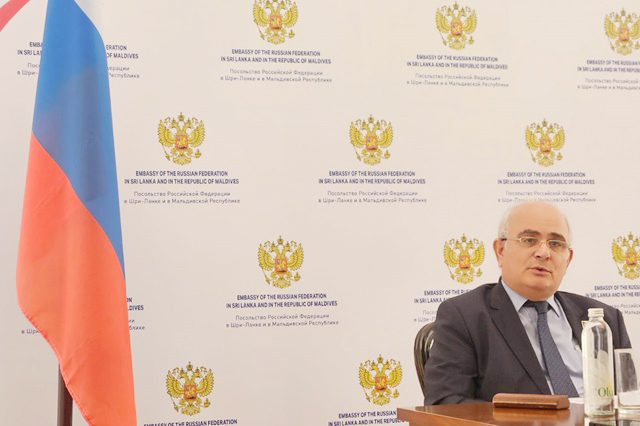
No Russian investment is flowing into Sri Lanka despite strong Russian interest in boosting the country’s economy, and Russian citizens are barred from using cards, being forced to rely on cash or third-party payments due to Western sanctions that Sri Lanka has seemingly enforced, Russia’s Ambassador to Sri Lanka, Levan Dzhagaryan, said in response to a question raised by Sri Lanka Guardian during a special press briefing at his embassy yesterday morning, 18 February 2026, in Colombo.
Ambassador Levan Dzhagaryan did not mince his words as he addressed a wide range of international and regional issues, speaking with a directness that was at times provocative and highly controversial. From Ukraine to Iran, Cuba, Russia’s relations with India, the United States, and Europe, Dzhagaryan repeatedly framed global conflicts through a lens of Russian national security, historical grievances, and a sense of betrayal by Western powers. In his comments on Ukraine alone, he declared that the country is ruled by a “fascist regime,” and even described President Zelensky as “an illegitimate president of Ukraine, expired president. His term was over in May 2024.” He insisted that Russia’s demands for demilitarisation, denazification, recognition of Crimea, Sevastopol, Donetsk, Lugansk, Kherson, and Zaporizhia as part of Russia, and lifting of all Western sanctions are non-negotiable. “No way,” he said, “Ukrainians must do concessions. They must accept our demands. No way.” He explicitly blamed Western powers for obstructing peace, recalling that when a draft agreement for a ceasefire was ready in Istanbul, “Former Prime Minister of UK, Boris Johnson, came to Ukraine and said, no peace deal with Russia. Continue the war.”
Dzhagaryan repeatedly returned to the theme of double standards, contrasting Russia’s actions with those of NATO and Western countries. On the 1999 bombing of Serbia, he asked, “What about territorial integrity of Serbia? When they started bombing of Belgrade, former Yugoslavia… It is different. Because it was Serbia. It’s okay.” He also criticised European silence over the banning of the Russian language in Ukraine: “European countries, democratic countries keep silence about it. Why? They say it’s different. It means double standards and hypocrisy. As we usually condemn them for double standards and hypocrisy.” Similarly, he linked sanctions on Russia and other countries to collective punishment, observing that “any sanction is directed against the people… The people are suffering, first of all.” He described the impact of Western sanctions on ordinary Russians, tourists, and businesses, saying, “My visa card is blocked… It’s a collective punishment of Russian citizens.”
Levan Dzhagaryan, the Ambassador Extraordinary and Plenipotentiary of the Russian Federation to Sri Lanka and the Maldives, has had a long and varied diplomatic career, including an eleven-year tenure as ambassador to Iran, from 2011 to 2022, during which he helped negotiate the JCPOA nuclear deal. In his briefing, he recounted the challenges of dealing with Western powers, highlighting the withdrawal of the United States under President Trump from a deal endorsed by the United Nations Security Council Resolution 2231, and commenting, “How can we trust? It was a deal signed not by the Democratic Party of President Obama. It was signed by the United States.” He portrayed Russia as a strong, sovereign country capable of withstanding external pressures, asserting, “We are a sovereign country… We are strong enough. We will overcome this problem.”
Dzhagaryan’s commentary on Cuba and Venezuela further illustrates his perspective on Western intervention. He condemned sanctions as inhumane, stating, “It is a big tragedy. It is very inhuman, inhuman decision,” and explained that Russia had declared readiness to provide humanitarian aid, including oil, to Cuba. He drew parallels between Cuba and Russia, highlighting that sanctions and blockades primarily harm ordinary citizens, and not just governments, noting, “When they say it is against Russian leadership, it is not against Russian leadership. It is against Russian people.”
Russia’s relations with India and China also featured prominently. On India, he underscored the “sovereign right for India to decide” regarding its trade and energy policies and described the bilateral partnership as “very good,” particularly in the nuclear sector in Tamil Nadu. Despite speculations about President Trump’s attempts to influence India to stop buying Russian oil, Dzhagaryan emphasised that “Indian businessmen are wise enough and flexible enough to choose very right decision, which is very suitable for them.” He also noted labour cooperation, with Indian workers recruited for the Russian economy, while highlighting similar initiatives for Sri Lankan workers. His comments emphasised that Russia seeks pragmatic, mutually beneficial relations with friendly countries, even amid global tensions.
Throughout the briefing, Dzhagaryan returned to the theme of Western hypocrisy and failed promises. He cited NATO expansion as a major grievance, stating, “From the very beginning, we believed in them. We wanted to have good relations with them. And what happened? They turned out to be liars. Big liars. A lot of promises, nothing.” He recalled assurances given to Russia regarding NATO not moving eastward after German reunification in 1989, which were subsequently broken, and drew parallels with missile placements near Russian borders during the Cold War, arguing, “It was in 1962… very close to the Third World War… But what about American missiles or European missiles close to our borders? It is different. It is different.”
On global energy, Dzhagaryan stressed the economic consequences of sanctions on Europe. He noted that European countries had previously relied on Russian gas for prosperity and warned, “Before, I think in the 1980s, economic prosperity of Germany and many other European countries was based on cheap Russian natural gas. Then they blew up this pipeline in the bottom of the Baltic Sea. And they decided to impose sanctions against us… But now they depend on very expensive American LNG. Is it a wise decision? It is up to you to decide.” He highlighted countries like Hungary and Slovakia as examples of how continued energy cooperation with Russia remained economically advantageous, contrasting it with the self-imposed costs of sanctions.
Dzhagaryan also addressed practical challenges posed by sanctions on tourism and finance. He explained that Russian tourists visiting Sri Lanka face restrictions due to blocked cards, adding, “Some tourists… use credit cards from third countries, from CIS countries… Some of them have Chinese cards. They can use it here.” While acknowledging these difficulties, he emphasised Russia’s resilience and capacity to circumvent obstacles: “We will use other facilities, other possibilities to bypass and to spend money. It’s not a problem. Okay.”
His remarks on multilateralism and global governance further conveyed Russia’s broader diplomatic philosophy. Criticising a perceived unipolar world dominated by the West, he stated, “We are against unipolar world. We are for multilateralism. We are against domination of any nation in the world. Domination of any nation in the world, one country, is totally unacceptable. They will dictate their wish to all, which is totally unacceptable. We must respect each other. Big countries, small countries, don’t lecture.” He argued that Western criticism of Russia often ignores domestic failings in their own countries, pointing to U.S. law enforcement and domestic political issues as examples, and sarcastically commenting, “Better to focus and to discuss.”
Dzhagaryan’s discussion on cultural diplomacy illustrated Russia’s soft power approach. He described efforts to expand Russian language education in Sri Lanka, including in Jaffna and other provinces, noting, “We also visited Trincomalee several times… we were thinking about the possibility to organize Russian language courses.” These initiatives were presented as part of a broader commitment to friendly bilateral relations and cultural engagement, alongside tourism and private business interests.
On the question of reforming the United Nations Security Council, Ambassador Dzhagaryan emphasised that Russia fully supports India’s bid for a permanent seat, citing the country’s growing global influence and the need to balance Western dominance. He stated, “We support Indian candidates, as well as Brazil. It is enough that USA, UK, France occupy permanent seats. Big countries must be respected. We don’t support Japan and Germany, but we support India.” This reflects Russia’s broader position favouring a more multipolar international order and recognition of emerging powers in global governance.









