Editorial
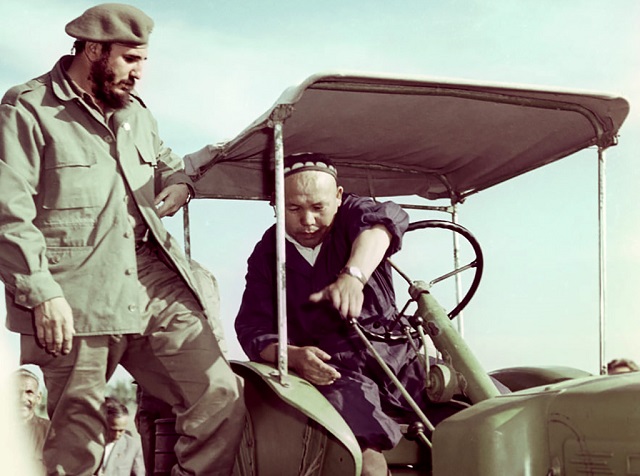
Yesterday, November 25, 2024, marks eight years since the death of Fidel Castro—a man whose name continues to ignite debates, inspire movements, and challenge conventional narratives about power and resistance. Castro’s life was a paradox in motion: a guerrilla who took up arms but envisioned a society led by books; a defiant leader of a small Caribbean island who held his ground against the world’s largest superpower; and a revolutionary who, in the face of unrelenting hostility, chose to arm his people with medicine and education rather than missiles and bombs. Whether one reveres him as a liberator or reviles him as a dictator, Fidel Castro’s legacy reshaped the global order and continues to provoke vital questions about justice, liberty, and solidarity.
Castro turned Cuba into a symbol of defiance. When his ragtag band of revolutionaries toppled the Batista regime in 1959, it was more than the victory of a small island—it was a rallying cry for oppressed peoples worldwide. “The revolution is not an apple that falls when it is ripe. You have to make it fall,” he declared, casting Cuba as a David challenging the Goliath of American imperialism.
The Cuban Missile Crisis of 1962 showcased his audacity. Even as the United States and the Soviet Union negotiated the removal of nuclear weapons from Cuba, Castro’s unbending demand for national sovereignty forced both powers to recognise that Cuba was not merely a pawn in their Cold War chess game. “We are not afraid of death,” he told his people. “We are not afraid of a nuclear holocaust, because we believe in our principles.” His defiance continues to resonate with nations seeking to assert their independence against overwhelming odds.
One of Castro’s most profound contributions was his decision to prioritise health and education over military dominance. Cuba under Castro measured strength of his nation by the health and knowledge of its citizens. Despite the U.S. embargo, which sought to cripple the Cuban economy, Castro declared, “We have no bombs or missiles, but we have ideas, and ideas do not need weapons.”
Cuba eradicated illiteracy within a year through nationwide campaigns, reflecting Castro’s belief that education was not a privilege but a human right. By the 1980s, its healthcare system, despite limited resources, rivalled that of much wealthier nations. Cuban scientists developed vaccines, while its doctors were dispatched to disaster zones worldwide, earning the country a reputation as a “medical superpower.”
The Latin American Medical School (ELAM), founded under Castro’s leadership, stands as a monument to his vision. Training thousands of doctors from impoverished countries free of charge, ELAM embodies his commitment to global solidarity. Castro’s “army in white coats” served in regions devastated by war, disease, and disaster. During the Ebola crisis in West Africa, Cuban doctors led the international response while richer nations hesitated. “Our country does not drop bombs on other peoples,” Castro declared, “nor does it send thousands of planes to bomb cities. Our country does not have nuclear weapons. The tens of thousands of Cuban doctors… are the weapons we have used.”
Today, the U.S. embargo on Cuba remains one of the most glaring vestiges of Cold War-era aggression. Condemned annually by the United Nations—supported only by the United States and Israel—it has inflicted untold suffering on the Cuban people. Basic necessities, from food to medicine, have been denied to a nation whose defiance was its only crime. Yet, rather than capitulate, Castro turned the embargo into a source of resilience. “They talk about the failure of socialism,” he once said. “But where is the success of capitalism in Africa, Asia, and Latin America?”
Cuba’s survival, and in some ways its triumph, under these conditions is a testament to the tenacity of its people and the resourcefulness of Castro’s vision. The embargo, far from crushing the revolution, became its rallying cry, inspiring anti-imperialist movements across the globe.
To his detractors, Castro was an autocrat who silenced dissent, curtailed freedoms, and consolidated power within a one-party state. There is undeniable truth in these critiques. Political opposition was suppressed, and many fled Cuba in search of greater liberty. Castro’s uncompromising approach to governance often prioritised the survival of the revolution over individual freedoms, a trade-off that remains deeply controversial.
Yet, to millions in the Global South and beyond, Castro was a hero who dared to stand against imperialism. “The revolution is a dictatorship of the exploited against the exploiters,” he declared unapologetically, framing his governance not as tyranny but as the reclamation of power by the oppressed. His actions inspired not just political movements but a moral awakening about the inequalities of the global system.
In 2024, Castro’s ideas feel disturbingly relevant. As global inequality widens, ecological crises escalate, and the spectre of neo-imperialism looms large, his insistence on prioritising human needs over profit resonates deeply. He once asked, “What is the worth of a billion dollars when compared to the life of a child?” In an era where billionaires hoard obscene wealth while millions starve, this question remains a searing indictment of capitalism.
The U.S. embargo, a cruel relic of a bygone era, continues to highlight the moral contradictions of a world that claims to value human rights while punishing those who dare to defy its power structures. Cuba, despite its hardships, stands as a symbol of what resilience can achieve.
Fidel Castro was a man of contradictions: ruthless and compassionate, pragmatic and idealistic, a soldier of revolution and a healer of nations. To reduce him to a caricature of either a saint or a tyrant is to misunderstand the profound complexity of his legacy. His death eight years ago did not end his revolution. It lives on in the doctors he trained, the literacy programmes he inspired, and the millions worldwide who still dream of a fairer, freer world.