


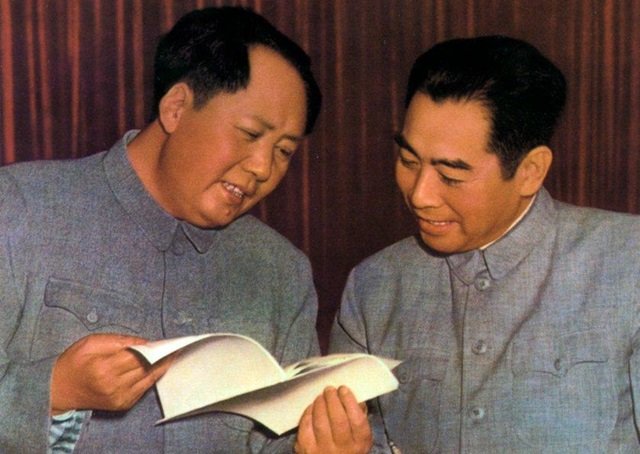
Fifty years after Mao Zedong died, China has changed almost beyond recognition, yet one of his most enduring ideas remains firmly embedded in the political machinery of the Communist Party. China is richer, technologically more sophisticated and globally more powerful than the country Mao inherited in 1949, but the principle that ultimately determines political authority has changed remarkably little. Mao’s famous declaration that “political power grows out of the barrel of a gun” was not merely a revolutionary slogan. It was a statement about who rules China and why. Mao understood that a communist party could not survive without controlling the military, and his successors have understood the same thing. Deng Xiaoping relied on his position as chairman of the Central Military Commission to remain China’s paramount leader even after relinquishing other senior posts. Jiang Zemin retained control of the military after handing the Communist Party leadership to Hu Jintao. Xi Jinping has taken the principle further, concentrating military authority around himself and insisting that the People’s Liberation Army exists first to serve the Party and ultimately its chairman. The China of 2026 may possess artificial intelligence, advanced missiles, global corporations and enormous financial power, but beneath that modernity remains an old revolutionary calculation. The gun still matters because whoever commands it commands the state.
Mao’s own relationship with power was more complicated and more human than the monumental portraits suggest. He was not simply the granite-faced revolutionary preserved in official imagery. Accounts from his physician Li Zhisui describe a man with extraordinary sleeping habits, chronic insomnia, serious health problems and a private life marked by behaviour that would have been almost impossible to reconcile with the austere public image of a revolutionary leader. Mao reportedly worked according to his own biological clock, summoned officials at unusual hours and could remain awake for exceptionally long periods. Li also described unusual personal habits involving bathing and dental hygiene and portrayed Mao as having an extraordinarily active sexual life. Some of these intimate claims remain disputed because they depend heavily on Li’s memoir and cannot always be independently corroborated. Yet even where the details require caution, they reveal something important about Mao’s personality. The man who demanded revolutionary discipline from hundreds of millions of people did not necessarily impose the same discipline upon himself. He could be charming and intellectually engaging, but also suspicious, calculating and ruthless. His increasing power produced not security but isolation. People around him could become indispensable one year and politically dangerous the next. His political campaigns destroyed colleagues who had once stood beside him, while the Cultural Revolution turned suspicion into a mechanism of government. Mao’s private eccentricities therefore matter not because they provide scandalous gossip, but because they expose the distance between the human being and the political monument constructed around him.
That monument remains extraordinarily difficult for the Communist Party to dismantle because Mao did something few political leaders have achieved. He did not merely govern China. He created the political system that continues to govern it. His greatest legacy is therefore not any individual economic policy or revolutionary campaign, but the relationship between the Party, the state and the armed forces. Mao’s military experience taught him that revolutionary authority depended on control of organised force, and he repeatedly insisted that the Party must command the gun rather than allow the gun to command the Party. Xi Jinping has adopted that doctrine with exceptional determination. Soon after becoming general secretary in 2012, Xi launched an anti-corruption campaign that reached into the highest ranks of the military and brought down powerful figures including former Central Military Commission Vice Chairman Guo Boxiong. After Xi began his third term in 2022, the campaign intensified. The removal of senior officers, including former Xi ally Zhang Youxia according to the supplied account, has left a military leadership far more tightly concentrated around Xi. At the beginning of Xi’s third term, only Xi and current Vice Chairman Zhang Shengmin among the seven CMC members remain. The result is an extraordinary concentration of authority. Mao had powerful military figures around him, including the famous Ten Marshals who had earned their reputations through war. Xi has progressively eliminated comparable independent military centres of authority. In that sense, his control over the armed forces may already exceed Mao’s in institutional terms, although the political stature Mao accumulated through revolution, war and the founding of the People’s Republic remains difficult to reproduce.
Taiwan is now the measure against which Xi’s historical ambition will increasingly be judged. Mao died without accomplishing the Communist Party’s long-standing objective of bringing Taiwan under Beijing’s control. Xi has not renounced force as a means of achieving unification, and the approach of 2027 gives the issue additional significance. That year marks the centenary of the founding of the People’s Liberation Army, while US intelligence analysts assess that China could possess the military capability by then to forcibly unify Taiwan with the mainland. Beijing is preparing not only militarily but domestically, with revised legislation due to take effect in October making it easier to mobilise people with expertise in technologies such as artificial intelligence and drones. The current five-year plan through 2030 also sets targets for increasing food and energy production. These measures suggest that military power is no longer understood simply in terms of soldiers, ships and missiles. Modern war requires technological expertise, industrial capacity, food security and energy security, all of which are being incorporated into China’s preparations. For Xi, Taiwan is therefore not merely a territorial dispute. It is potentially the achievement that could determine how his place in Chinese history is measured.
Yet Xi still lacks something Mao possessed in abundance, an almost mythological authority within the Party. The 2022 constitutional revisions brought the number of references to Xi’s name to 12, placing him on a level with Deng Xiaoping but still below Mao’s 13. There had been speculation that Xi might receive Mao’s old title of chairman or the designation lingxiu, meaning leader, but neither was adopted. That restraint may itself reveal the problem Xi faces. He has accumulated extraordinary institutional control, but historical legitimacy cannot simply be ordered into existence. Mao’s authority was forged through decades of revolutionary struggle, military victory, civil war and the creation of a new state. Xi inherited the state Mao built and has transformed its economic and technological capacity, but he must still prove that his leadership can produce an achievement of comparable historical magnitude. Taiwan could become that achievement. If Xi were to accomplish unification, he would not merely add another victory to his record. He would complete an objective Mao could not achieve and potentially place himself alongside the founder of modern Communist China. That possibility explains why the old Maoist principle remains so relevant fifty years after Mao’s death. China’s economic miracle may have changed the country, but the Party’s conception of ultimate power has not. Mao believed the revolution survived because the Party controlled the gun. Xi appears to believe that China’s future greatness will depend on the same principle. The language is old, the technology is new, and the political ambition remains remarkably familiar.









