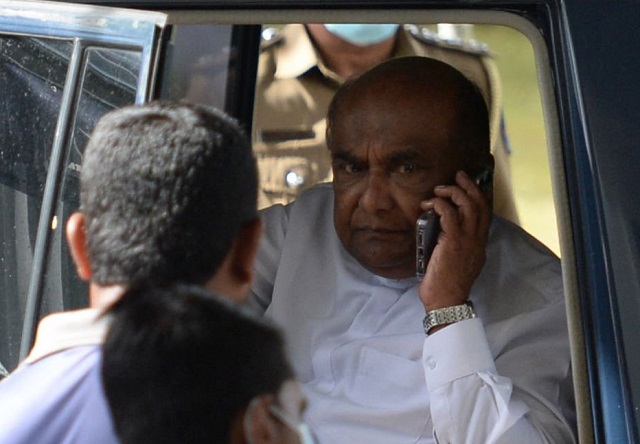
Former Speaker of Sri Lanka’s Parliament Mahinda Yapa Abeywardena has accused unnamed political actors and others of deliberately distorting information contained in a special audit report on parliamentary vehicles and fuel consumption, saying selective use of the figures is creating a misleading public impression about his tenure.
In a detailed statement issued to the media, Abeywardena said the special audit covered vehicle and fuel use involving a range of parliamentary officeholders between 2015 and 2024, including Speakers, Deputy Speakers, committee chairpersons, the Secretary-General, Assistant Secretaries-General and heads of departments. He argued that the report had subsequently been used in a manner that detached its figures from the circumstances in which the vehicles were actually deployed.
“I consider it my responsibility to clarify once again the facts regarding the use of vehicles and fuel mentioned in this special audit report,” Abeywardena said, recalling that he had already issued explanations to the public and media on two occasions in March 2025.
According to the former Speaker, one of the claims circulating publicly—that he had used nine vehicles while holding office—was completely false. He said the audit report itself confirmed that the vehicles available to him were officially provided by Parliament.
“I used only the vehicles officially provided by Parliament during my tenure as Speaker,” he said, describing the allegation that he had personally used nine vehicles as a “false accusation” made with malicious intent.
Abeywardena said the vehicles assigned to him were provided for official duties and security requirements under the relevant circulars issued by the Secretary to the President and within established government provisions.
The former Speaker also rejected the interpretation of the fuel figures, particularly the increase recorded during 2023 and 2024. He argued that an increase in total fuel consumption could not, by itself, be described as excessive personal consumption without taking into account the number of vehicles involved, their individual fuel efficiency, distances travelled and the nature of official and security-related journeys.
“If there is data showing that fuel consumption increased in 2023 and 2024 compared with previous years, taking that data alone and interpreting it as ‘excessive personal fuel use’ is a complete distortion of the truth,” he said.
He further complained that figures relating to several vehicles had been presented on social media in a way that could give the impression that the entire quantity of fuel had been consumed by a single vehicle.
According to Abeywardena, the audit report itself makes clear that the expenditure related to all the vehicles concerned.
He argued that the distinction was important because his security arrangements changed significantly following the political and social upheaval of July 2022.
“The particularly important matter that must be taken into consideration here is the exceptional security situation that existed in the country after July 2022,” he said.
Abeywardena said his security had been substantially strengthened during that period and that additional personnel had been deployed alongside existing Special Task Force and police personnel. Special security arrangements, he said, had also been introduced at his official and private residences.
Security around Parliament itself had also been intensified, he said, at a time when the country was undergoing a constitutionally sensitive transfer of political power.
“In such a background, vehicles were operated not only for the Speaker’s official travel, but also for the duties of security advance vehicles, escort vehicles and security officers, in accordance with recommendations from the Ministry of Defence,” Abeywardena said.
He added that two additional vehicles had been provided to him by the Presidential Secretariat during the period referred to in the audit. One of those vehicles, he recalled, was a bulletproof vehicle with particularly high fuel consumption.
“I remember that one of those vehicles was a bulletproof-type vehicle with very high fuel consumption,” he said.
Abeywardena said the increase in vehicle and fuel use that began towards the latter part of 2022 became more pronounced during 2023 and 2024 because of an increase in official duties and travel.
As Speaker, he said, he was required to travel to different parts of the country in his official capacity. The Speaker, he stressed, occupies a position requiring both official transportation and security arrangements.
Therefore, he argued, comparing the vehicle and fuel use associated with the Speaker’s office with the private vehicle use of an ordinary individual would be inappropriate.
“The vehicle use and fuel consumption of a Speaker for official and security purposes should not be compared on the same basis with the private vehicle use of an ordinary person,” he said.
The former Speaker also directly addressed claims that the fuel consumption attributed to him occurred while ordinary Sri Lankans were enduring long queues during the country’s 2022 fuel crisis.
He rejected the claim as factually incorrect.
“There is another allegation made by certain people through social media that this fuel consumption took place at a time when the people of the country were standing in fuel queues,” he said. “This is clearly incorrect according to the data.”
Abeywardena acknowledged that Sri Lanka experienced severe fuel shortages and lengthy queues in 2022, but pointed to the introduction of the National Fuel Pass, or QR system, on 1 August 2022.
According to his statement, the system was introduced to ensure the fair distribution of limited fuel supplies and to bring an end to the long queues. He therefore argued that the fuel figures attributed to him for 2023 and 2024 should not be portrayed as consumption during the period when the country was experiencing the worst of the fuel queues.
“Presenting the fuel consumption relating to me in 2023 and 2024 as fuel used at the time when the people were standing in fuel queues in 2022 is completely false and misleading,” he said.
He also noted that the national QR fuel system was eventually discontinued in September 2023 after fuel supplies had returned to more normal conditions.
Abeywardena rejected another allegation—that he had used fuel without limit—saying that such a conclusion could not reasonably be reached from aggregate figures alone.
“When comparing fuel consumption, the number of vehicles, the fuel efficiency of the vehicles, the distance travelled, the number of official journeys, occasions on which security advance and escort vehicles were used, and the relevant period for each vehicle must all be considered separately,” he said.
He maintained that describing the total amount recorded in the audit as “unlimited fuel use” or “personal consumption” without considering those factors amounted to an “untrue and unscientific analysis”.
The former Speaker also pointed to Parliament’s own records as a means of settling the dispute.
He said Parliament maintains the running charts and fuel records relating to the vehicles assigned to him and that maintaining those records was not his personal responsibility.
“Any citizen can verify the actual situation by separately examining the running charts of each vehicle, the amount of fuel obtained, the relevant period and the official use of each vehicle,” he said.
Abeywardena also argued that the security circumstances surrounding his tenure should be considered when comparing fuel consumption between different years.
He said that looking only at year-on-year fuel quantities without considering the additional security provided after July 2022, official travel requirements and the use of security vehicles could not produce a complete picture.
The former Speaker stopped short of rejecting the possibility of wrongdoing in the wider parliamentary expenditure system. Instead, he said that if evidence of an irregularity existed, he would support appropriate legal and administrative action.
“If there is evidence that an irregularity has occurred, I have no objection whatsoever to taking the appropriate legal and administrative action,” he said.
He added that if an irregularity had taken place, the law should apply regardless of who was responsible.
His principal objection, he said, was to the use of partial figures for political purposes.
“I only request that the full facts be placed before the public without using partial data for narrow political objectives or for social-media sensationalism,” Abeywardena said.
He warned that figures extracted from an audit report should not be separated from their surrounding context in a manner that allows the truth to be distorted for political purposes.
The former Speaker’s latest statement comes amid renewed public attention to the special audit covering vehicle privileges, fuel allocations and related expenditure involving senior parliamentary officials. Recent reporting on the audit has highlighted questions surrounding fuel controls and vehicle use, while Abeywardena has called for the underlying records to be examined rather than relying on aggregated figures.
The dispute is not new. In March 2025, Abeywardena had already rejected allegations concerning fuel expenditure and called for a special audit, arguing that the reported figures were inconsistent with the number of vehicles officially assigned to him. He had also urged journalists to obtain the relevant records from Parliament and examine them over a longer period rather than focusing exclusively on 2023 and 2024.
In his latest statement, however, Abeywardena has sought to place the controversy within the wider circumstances of his tenure, particularly the security situation after July 2022 and the official duties associated with the office of Speaker.
His central message is that the numbers should not be interpreted in isolation.
“The truth should not be distorted by separating the figures mentioned in an audit report from their complete background,” he said, calling for the relevant records to be examined in full.
He concluded by reiterating that the vehicle running records and fuel records remain available with Parliament and that the factual position can therefore be independently examined.