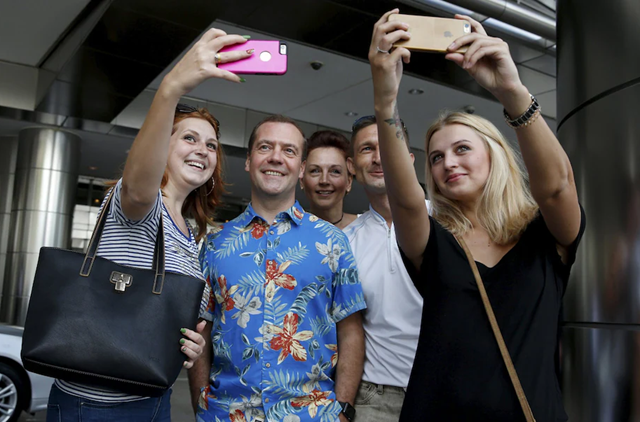
Former Russian President Dmitry Medvedev, once hailed by the West as a liberal reformer, is back in the global spotlight — this time not as a symbol of modern Russia, but as a social media firebrand invoking nuclear threats and goading the President of the United States.
In a rare public statement last week, US President Donald Trump revealed he had repositioned two nuclear submarines in response to what he called “highly provocative” comments from Medvedev, who suggested that the US was steering dangerously close to war with Russia.
“Words are very important and can often lead to unintended consequences,” Trump posted on his Truth Social platform. “I hope this will not be one of those instances.”
Medvedev’s comments came via X (formerly Twitter) and Telegram, where he has become a frequent source of incendiary rhetoric since Russia’s full-scale invasion of Ukraine in 2022. In the latest posts, he denounced a US-imposed ceasefire deadline for Russian President Vladimir Putin, calling it a provocation that risks all-out war. He also invoked Russia’s “Dead Hand” — a Cold War-era nuclear deterrence system — in warning the West against further escalation.
While the Kremlin has downplayed the remarks, insiders are puzzled as to why Trump would take the bait from a figure seen as increasingly marginal in Putin’s power structure.
Once considered the West’s best hope for reform in Russia, Medvedev’s transformation into a nuclear hardliner has shocked many who once courted him. During his presidency from 2008 to 2012, he visited Silicon Valley, received an iPhone 4 from Steve Jobs, and gave interviews to major Western outlets — including a widely read Financial Times profile that painted him as a modernizer.
Yet analysts warn against dismissing him entirely. “People are wrong when they dismiss his posts as insane,” said Greg Yudin, a Russian political philosopher. “He would never dare to say anything not in line with Putin’s thinking.”
Indeed, Medvedev’s shift began even before the Ukraine invasion, but it accelerated sharply in recent years. Now deputy head of Russia’s Security Council, a role many see as largely ceremonial, Medvedev has become known more for his online tirades than his policymaking — calling European leaders “freaks” and “lapdogs,” and labelling Ukrainian President Volodymyr Zelenskyy a “drug addict.”
Michael McFaul, the former US ambassador to Russia during Medvedev’s presidency, suggested the ex-president’s behavior may be rooted in political insecurity. “He comes from a very different background than the FSB crowd,” McFaul said. “I think it’s this anxiety about his position among that crowd that compels him to say the outrageous things that he does.”
There are even questions over whether Medvedev’s posts are the product of political strategy or personal decline. Investigative outlet The Insider previously noted a pattern between Medvedev’s most inflammatory posts and wine deliveries to a vineyard linked to him. A former acquaintance added: “One theory is that he drinks too much… The other is that it’s an act — which is a fully rational explanation.”
Still, his words are having real-world consequences. Trump’s decision to deploy nuclear submarines is a stark signal of how seriously Washington is now taking the rhetoric from even second-tier Russian officials — a sign of the fragile state of global security.
The episode also marks an ironic twist for Medvedev, once seen as the man who could bring Russia closer to the West. As the Financial Times previously chronicled, he was once “a partner the West could do business with.” Today, he is more often regarded as a mouthpiece for Moscow’s most extreme positions, and a reminder of just how far that partnership has unraveled.