


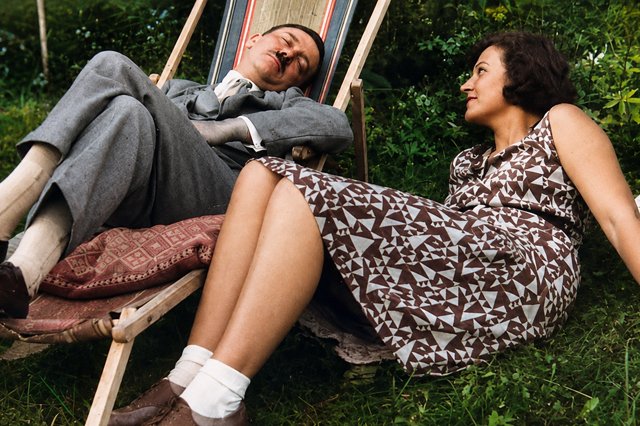
As Der Spiegel has examined in its reporting on “Hitler’s Fangirls”, Adolf Hitler’s appeal to women remains one of the more disturbing paradoxes of the Nazi era. The man who could appear awkward, cold and almost comically unimpressive to those who knew him nevertheless inspired intense devotion among women. Their support was not peripheral to his political rise. Without their support, and particularly their votes, Hitler and the National Socialists would never have reached power.
Even before Hitler became Chancellor of Germany on 30 January 1933 and subsequently fashioned himself as the “Führer”, there were indications of an unusual fascination with him. His friend and patron Ernst Hanfstaengel once thought Hitler looked “like a suburban hairdresser on his day off”. Another member of his entourage secretly compared the future dictator to “the head waiter of a provincial railway-station restaurant”. His childhood friend August Kubizek likewise remembered him as poorly dressed and socially reserved. Yet Kubizek also recorded in 1953 that women were sufficiently attracted to Hitler that some would turn their heads as he passed.
After 1933, that attraction became part of a much larger political phenomenon. Photographs and film footage show women among the crowds becoming hysterical when Hitler drove past them in his open-top car. Historian Martha Schad described the intensity of this devotion by writing that women were “ready to bear him children, even ready to die with him”.
The relationship between Hitler and women was nevertheless deeply contradictory. He rejected female emancipation and declared that “the woman has the task of being beautiful and bringing children into the world”. Yet the Nazi system also created spaces in which women could participate outside the family. Through the Bund deutscher Mädel, female teenagers gained experiences away from their families and without parental supervision. Women joined Nazi women’s organisations and found roles in the party, welfare work and the wartime economy. Political participation, belonging and a sense of purpose could therefore coexist with an ideology that demanded female subordination.
The extent of personal devotion became clearer decades later when thousands of letters written to Hitler by female admirers came to light. After the war, US officer William C. Emker entered the bombed Reich Chancellery and discovered approximately 8,000 letters addressed to Hitler. Their language was strikingly intimate: “My dearly beloved Führer!”, “my dearly beloved little heart”, “Sweet Adilie” and repeatedly “Beloved”. Emker took the letters to New York, initially intending to study them, but decided against publication because he did not want to cause embarrassment to those involved. He eventually handed them over to Frankfurt city councillor Helmut Ulshöfer in the early 1990s. The letters were first published in 1996.
Some of the writers paid a heavy price for their fixation. Anna W., who repeatedly wrote to Hitler despite police warnings to stop, was confined to the Heil- und Pflegeanstalt Wittenau, an institution that became a killing site under the Nazi regime. She survived the Nazi euthanasia programme and was placed under her parents’ guardianship in April 1943. Other letters were openly intimate, with one woman addressing Hitler as “Sweet Adi”, sending greetings to the Eastern Front and signing off with “intimate kisses”. Eva K. wrote to “Adölflein” in language that was similarly explicit.
What produced such devotion remains contested in the material examined by Der Spiegel. Psychoanalyst Helm Stierlin suggested that Hitler’s apparent awkwardness and reluctance towards intimacy might itself have attracted some women and encouraged desires to mother him. British author Phil Carradice offered another explanation, arguing that the attraction had less to do with Hitler’s appearance than with the aura of power surrounding him. His apparent strength and control, Carradice suggested, could have fed fantasies of security and protection.
Yet the regime Hitler built offered women little genuine emancipation. Make-up, short skirts and high heels were frowned upon, smoking in public was forbidden, and women were largely absent from public office. Their presence in universities, teaching and the legal profession declined sharply. Working women were expected to occupy roles such as factory workers, secretaries or nurses. The Nazi Party remained firmly opposed to female emancipation and increasingly pressured women to remain at home and bear children for the Reich.
The attraction of Hitler therefore cannot be reduced simply to romantic fascination. Historian Katja Kosubek examined 36 essays written by women in 1934 as part of a supposed competition asking why participants had joined the NSDAP before 1933. The writers did not know that the exercise was actually part of a research project by US sociologist Theodore Abel. Their accounts, Kosubek argues, are particularly valuable because they were contemporary testimonies rather than later attempts to reshape the past.
The women described active political commitment. Helene Radtke from Alsace made herself a brown women’s blouse to demonstrate her solidarity with the SA and the movement, despite being publicly insulted for wearing it. The 20-year-old Erna Stoyke from Marienburg in West Prussia helped establish support for unemployed SA men, collecting food and necessities for them. Women sewed uniforms and flags, organised soup kitchens and joined organisations such as the German Frauenorden Rotes Hakenkreuz. Their work helped sustain the SA and, in their view, contributed to the movement’s success.
Hitler also deliberately cultivated relationships with women who served different purposes in his political and private life. Hermine Hoffmann, the widow of a senior school director and more than 30 years older than Hitler, became a maternal figure whom he called “Mutterl”. Helene Bechstein, eleven years older than Hitler, helped dress him, introduced him to elite social circles and supported him during his imprisonment in Landsberg after the failed 1924 putsch.
His relationships with younger women revealed a darker dimension. In 1926, the 37-year-old Hitler courted the 16-year-old Maria Reiter. After he disappeared, Reiter attempted to hang herself. Other women around Hitler also died by suicide. Unity Mitford shot herself in the head. Geli Raubal, Hitler’s 19-years-younger niece, died by suicide after the troubled relationship with her uncle. Eva Braun, 22 years younger than Hitler, ultimately took cyanide.
Perhaps the most extreme example was Magda Goebbels, who believed Hitler would have married her had Germany not been his “bride”. In the Führerbunker, after Hitler killed himself, she murdered her six children before taking her own life. In her farewell letter, she justified the killings by declaring: “The world that comes after the Führer and National Socialism is no longer worth living in.”
The women surrounding Hitler were therefore not merely passive spectators of his rise. Some voted for him, some organised for his movement, some sustained its institutions and others transformed political devotion into personal obsession. Their stories reveal the breadth of the Nazi cult: a system in which political allegiance, social belonging, propaganda, personal fantasy and the attraction of power could become inseparably intertwined.









