


A court in Hong Kong has convicted two organisers of annual vigils commemorating the bloody suppression of the 1989 pro-democracy protests in Beijing, further narrowing the space for public remembrance of an event that China has sought to erase from the national memory.
Chow Hang-tung, 41, and Lee Cheuk-yan, 69, were found guilty on Friday in the Chinese special administrative region of “incitement to subversion”. The court said the two democracy activists had encouraged other people to take part in “illegal” actions. Each faces up to 10 years in prison, although the sentences will be announced at a later date.
According to the judgment, the two had “incited other persons to organise, plan, commit or participate in illegal acts”. Their objective, the court said, was to “subvert state power”.
The case centres on the long-standing campaign to preserve public remembrance of the events of 4 June 1989, when the Chinese army moved against students demonstrating for greater democracy in Beijing’s Tiananmen Square. Tanks were deployed during the crackdown, in which hundreds of people were killed. Some estimates put the death toll at more than a thousand.
For decades, Hong Kong stood apart from mainland China in allowing large-scale public commemoration of the crackdown. Chow and Lee were leading members of the Hong Kong Alliance, an organisation that for three decades organised public events marking the suppression of the Tiananmen protests.
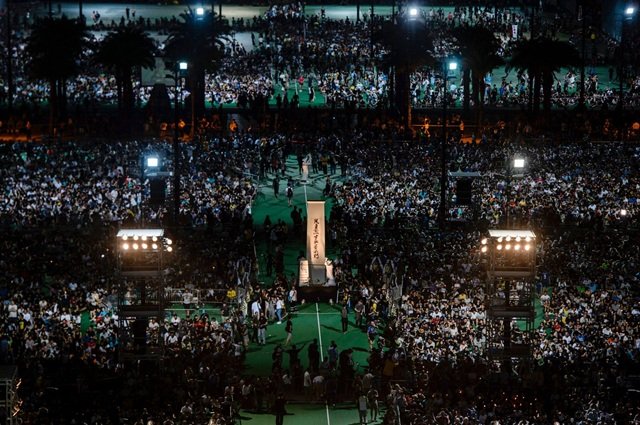
Every year on 4 June, thousands of people gathered in Hong Kong’s Victoria Park for a candlelight vigil. The annual event became one of the most prominent public commemorations of the 1989 crackdown outside mainland China.
That tradition ended in 2020, when the Tiananmen commemoration in Hong Kong was banned. The same year, Beijing introduced a national security law aimed at tackling the city’s democracy movement. Following the arrests of its leading members, the Hong Kong Alliance dissolved in 2021.
The convictions of Chow and Lee now mark another significant development in the dismantling of the public space that once allowed Tiananmen to be remembered openly in Hong Kong. The court’s ruling treats efforts associated with organising or encouraging participation in such activities as conduct capable of constituting “incitement to subversion”.
The judgment comes against the backdrop of China’s continuing efforts to prevent discussion and commemoration of the 1989 crackdown. For years, Hong Kong provided a rare setting where the events could be publicly remembered, with thousands gathering each year to honour those killed.
The verdict therefore carries significance beyond the two defendants themselves. It concerns not only the fate of two democracy activists but also the shrinking ability to publicly commemorate one of the most consequential episodes in modern Chinese history. With sentencing still to come, Chow and Lee face the prospect of lengthy prison terms for activities connected to a tradition that once brought thousands of people together in central Hong Kong.










