Seventy years before Israel again faced the question of what to do with the Gaza Strip, its first prime minister, David Ben-Gurion, warned that occupying and governing the territory could expose the country to terrorism, international sanctions, an arms embargo and serious damage to its moral standing. Newly released transcripts of discussions among senior Israeli military officers in 1957 reveal that Ben-Gurion regarded continued control of Gaza as a potentially existential danger, despite acknowledging that there was no satisfactory solution to the territory’s future.
The documents, made public on Sunday by the IDF and Defense Establishment Archives to mark the 70th anniversary of the Sinai Campaign of November 1956, record Ben-Gurion’s assessment of the military, diplomatic and political consequences of Israel’s decision to withdraw from territories captured during the war. The campaign, in which Israel fought alongside Britain and France against Egypt, resulted in the Israeli occupation of the Gaza Strip and the Sinai Peninsula. Israel withdrew from both territories four months later.
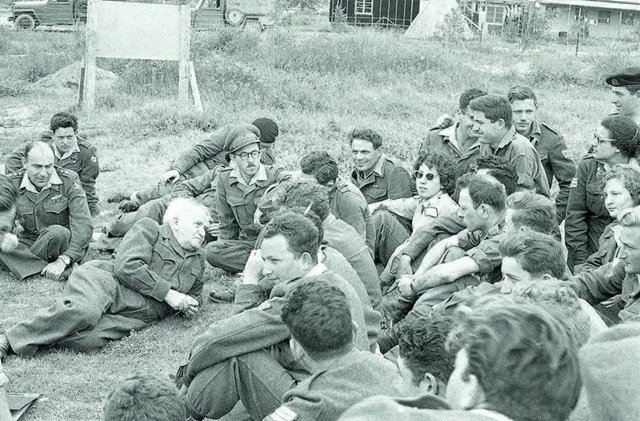
In a conference for senior officers in April 1957, Ben-Gurion explained why he had opposed proposals to retain Gaza, arguing that the consequences of governing its predominantly Arab population could undermine Israel’s international position and its own understanding of its legitimacy. His argument extended beyond immediate military calculations to the moral implications of ruling over another people.
“This might have destroyed us, not militarily, but morally,” he said. “In my view, the moral aspect confers our entire existence. If we lose our moral right to exist, in our own eyes and in the world’s eyes, Israel can’t exist.”
The newly released transcripts provide an unusually detailed account of how Ben-Gurion connected the future of Gaza with Israel’s diplomatic relationships, military preparedness and the position of Jewish communities overseas. Although he acknowledged the security threat posed by attacks originating in Gaza against southern Israeli communities, he maintained that this danger had to be weighed against the consequences of remaining in the territory and attempting to suppress resistance.
“It was clear that staying in Gaza when the world was ostracising us, if there were terror and we had to suppress it … that terror would have destroyed us,” he said.
Ben-Gurion was particularly concerned about the international reaction to any Israeli military response against attacks originating in Gaza. He argued that the territory’s population, which he estimated at 300,000, would be supported by the wider Arab world and would enjoy considerable international political sympathy. He believed that Israel would struggle to withstand the diplomatic consequences of using military force against a population that included large numbers of refugees and people who regarded their homes and agricultural land as having been taken from them.
“Those 300,000 residents know the entire Arab world stands with them against us, and behind the Arab world is the declared political sympathy of the entire world,” he said.
He continued by describing the population as people whose fields and homes, in their perception, had been taken from them, while Israelis would be regarded as foreigners living in their territory. “We couldn’t have withstood this. We couldn’t have withstood this in a place with so many refugees,” he said.
Ben-Gurion also made clear that retaining Gaza had never been his intention when Israel launched the Sinai Campaign. He said he had opposed annexation proposals from the beginning, arguing that incorporating another 300,000 Arabs would create additional responsibilities without providing Israel with a strategic benefit proportionate to the risks.
“That’s not what Israel is lacking – another 300,000 Arabs,” he said. He also referred to the financial and administrative responsibilities associated with the Palestinian refugees, warning that the United Nations Relief and Works Agency for Palestine Refugees in the Near East (UNRWA) would eventually expect Israel to provide for them.
His objections were also rooted in concerns about the country’s ability to obtain military assistance in a future conflict. Although Britain and France had fought alongside Israel in the 1956 campaign, Ben-Gurion warned against assuming that comparable external support would be available in another war. If Israel became internationally isolated because of its continued occupation of Gaza, access to weapons and military supplies could become uncertain precisely when they were most needed.
“We have no basis for assuming that in the [next] war, we’ll have forces helping us from outside,” he told the conference. He warned that if Israel were ostracised internationally, there was a substantial risk that it might be unable to obtain the weapons necessary to confront Arab states if they believed they had acquired the capacity to destroy it.
“I don’t know how we would fight then,” he said. Although he acknowledged that Israel might still prevail against better-equipped opponents, he questioned the human and material cost of such a victory. “Maybe we’d win anyway, even if they have planes and bombers that are much better than ours. But I don’t know what the cost would be, and we can’t pay such a price.”
He illustrated the danger by referring to the vulnerability of major Israeli cities, particularly Tel Aviv, which he said could be devastated by aerial bombardment. He described knowingly exposing the country to such a possibility as tantamount to suicide.
The implications, he argued, would extend beyond Israel’s population. Ben-Gurion emphasised that Israeli Jews constituted only a small proportion of the Jewish people, most of whom lived outside the country. He specifically referred to Jewish communities in the United States, Argentina, Scandinavia, Belgium and the Netherlands, expressing concern about their circumstances if Israel became internationally isolated.
“The vast majority of the Jewish people is scattered throughout the world,” he said. He argued that Israeli decision-making had to consider not only the assistance received from overseas Jewish communities but also their own positions and circumstances.
“In everything we do in Israel, we cannot fail to take into account not only the help [Israel gets] from these Jews – and Jews overseas don’t exist solely to help us; we also have to take their position, their needs, what situation they are in into account.”
Ben-Gurion also anticipated that a future war could expose Israeli civilians to destruction on a scale not experienced during the Sinai Campaign, when the casualties were military personnel. He warned that subsequent conflicts could bring attacks against major population centres, with women and children among those killed.
“It won’t be like that in the next war,” he said. “Tel Aviv will be bombed, Haifa will be bombed and people will be killed. Not soldiers. Women, children.”
The transcripts also preserve his remarks to the cabinet on October 28, 1956, immediately before the Sinai Campaign began. Referring to Gaza, he had said: “If I believed in miracles, I would want it swallowed by the sea.” His subsequent discussion with senior officers, however, made clear that he considered the absence of such a miracle no justification for ignoring the political, military and moral consequences of governing the territory.