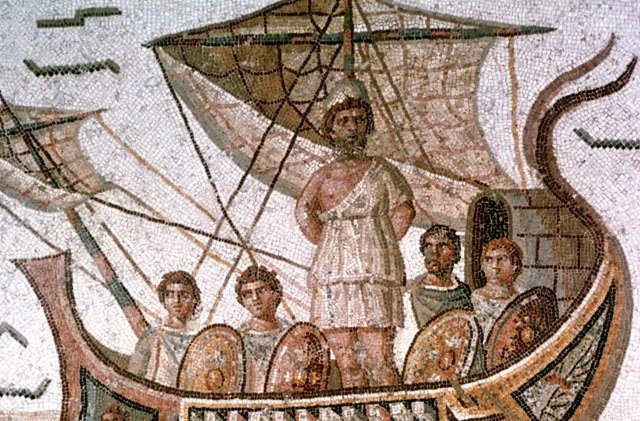
As technological innovation continues to reshape societies and globalization transforms economies, one of Germany’s leading newspapers has turned its attention to an unlikely source for understanding the present: Homer’s Odyssey. In an essay published by Die Zeit under the title “Wir Irrfahrer,” the ancient Greek epic becomes the central lens through which the publication examines the political narratives surrounding figures including Vladimir Putin, Donald Trump and Europe’s nationalist right.
The article argues that despite living in an age defined by scientific progress, digital connectivity and modern institutions, contemporary political discourse is increasingly populated by references to ancient heroes, imperial imagery and tragic myths. Rather than presenting antiquity as a distant historical period, the essay portrays it as an enduring framework that continues to shape political imagination across different ideological movements.
According to Die Zeit, the modern world appears to have completed the work of rationalization that once promised to leave superstition and mythology behind. Yet the publication suggests that classical imagery has returned with renewed prominence. From technological ambitions to nationalist rhetoric, political and cultural actors are described as drawing upon narratives rooted in antiquity to interpret present-day uncertainty and project visions of the future.
The article highlights the influence of classical symbolism within parts of the American technology sector, pointing to imagery associated with Elon Musk’s long-term ambitions for human settlements on Mars. These futuristic visions, it notes, have at times been presented through architectural forms reminiscent of Roman villas, blending technological aspirations with symbols drawn from the ancient world.
The essay then turns to Donald Trump, describing his political message as one that frames the United States as completing a long historical journey before returning to a perceived national homeland. Die Zeit compares this narrative to Odysseus’ return to Ithaca after years of wandering, suggesting that the slogan of restoring America evokes an imagined past that supporters associate with stability, hierarchy and prosperity. Within this interpretation, the publication identifies the late nineteenth-century Gilded Age as a symbolic destination rather than simply a historical reference point.
A similar literary parallel is applied to Russian President Vladimir Putin. Die Zeit argues that Putin’s political narrative places the medieval state of Kyivan Rus at the center of a broader historical vision connecting Russia, Ukraine and Belarus. The publication states that this interpretation of history informs the Kremlin’s understanding of contemporary conflict and territorial claims. Within the Odyssey metaphor developed throughout the essay, Ukraine becomes the contested homeland where competing claims over identity and legitimacy continue to unfold.
The feature also examines the appeal of historical symbolism among Europe’s nationalist and ethnonationalist movements. According to Die Zeit, many of these groups invoke visions of an idealized national past, whether through references to mythic origins or memories of the decades of economic expansion that followed the Second World War. The publication argues that such narratives frequently present contemporary globalization, migration and European integration as departures from an earlier period of perceived order and cohesion.
Throughout the essay, Homer’s Odyssey serves not as a historical account but as an expansive metaphor for the trajectory of modern civilization. Die Zeit suggests that the age of globalization increasingly resembles the end of an extended voyage rather than the beginning of an open future. After decades marked by economic integration, technological transformation and international cooperation, the publication describes societies confronting persistent wars, economic inequality, geopolitical rivalry and climate-related instability. Against this backdrop, political movements promising a return to familiar identities and national borders have gained renewed visibility.
The article broadens its historical perspective by connecting Homer’s epic to the intellectual development of the modern West. It references Renaissance philosopher Francis Bacon, whose vision of scientific and geographical expansion symbolized Europe’s movement beyond the boundaries of the ancient world. Die Zeit presents this historical trajectory as part of a centuries-long journey that included exploration, colonial expansion and globalization before arriving at what it characterizes as a contemporary search for national refuge.
To deepen its examination, the essay introduces several influential twentieth-century thinkers whose work explored the relationship between modernity, power and myth. Sociologist Max Weber is cited for his observation that old gods can reappear as impersonal forces shaping modern life, while philosophers Theodor W. Adorno and Max Horkheimer are presented as arguing that enlightenment and rationality can themselves produce new systems of domination. The article also references theologian Romano Guardini, whose reflections after the Second World War questioned whether technological progress alone could eliminate violence and conflict.
The discussion extends beyond European intellectual history to contemporary political thought in the United States. Die Zeit notes statements by entrepreneur Elon Musk criticizing Christian traditions of compassion as a source of civilizational weakness, contrasting those views with admiration for the moral ambiguity found in classical hero stories. The publication also examines comments by U.S. Secretary of State Marco Rubio regarding liberal democracy and international order, arguing that his language reflects assumptions about enduring patterns of conflict rooted in historical interpretations of human nature.
Across these examples, the essay contends that references to antiquity increasingly function as political narratives rather than literary allusions. Ancient epics, heroic figures and classical empires become symbolic resources through which leaders and movements explain present crises, justify strategic choices and define national identity. Homer’s Odyssey, in this reading, is transformed from an ancient poem into a contemporary political metaphor.
The feature concludes by returning to its central image of Odysseus’ journey. While acknowledging the enduring influence of classical literature, Die Zeit ultimately frames the challenges confronting modern societies as products of human political choices rather than inevitable repetitions of ancient tragedy. The publication closes by observing that even in Homer’s epic, lasting peace required intervention beyond the ambitions of competing warriors. In today’s world, it notes, societies continue to navigate their own uncertain voyage without such mythical guidance, leaving the tensions between cooperation, conflict and competing visions of the past unresolved.