For months of war stretching across Gaza, Lebanon, and beyond, Israel’s skies have been crowded not with pilots, but with machines. According to internal documents obtained by Haaretz, the Israel Defense Forces’ drone fleet has operated continuously as what officials describe as a “highly effective target and intel generator,” reshaping the way intelligence is gathered, processed, and acted upon in real time.
The documents outline a military ecosystem in which unmanned aircraft are no longer passive observers but active participants in a tightly integrated digital network. Since the outbreak of war following the October 7, 2023 attacks, Israel’s fleet of surveillance and strike drones has been deployed at an unprecedented scale, tracking vast areas of Gaza and southern Lebanon while feeding artificial intelligence systems that help identify targets and coordinate strikes across multiple branches of the military.
At the center of this system, according to the documents and interviews cited by Haaretz, is a process described by defense contractors and officials as the “algorithmicization” of aerial warfare. Long in development but rapidly expanded during the current conflict, this shift has brought together sensors, communications systems, and AI tools into a unified operational chain that processes enormous streams of battlefield data. Testimonies from soldiers and defense sources, including accounts collected by the group Breaking the Silence, describe a growing reliance on automated analysis to support decisions in combat environments that are constantly shifting.
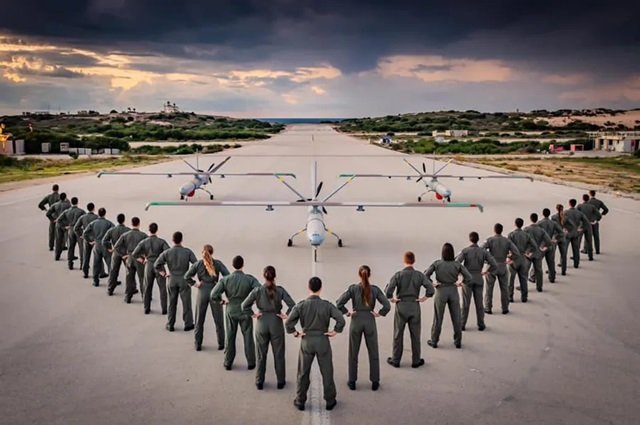
The backbone of this aerial network is built on two main platforms manufactured by Elbit Systems: the Hermes 450, known in Hebrew as Zik, and the Hermes 900, or Kochav. According to the documents, both platforms were deployed at unprecedented scale in the early months of the war, with flight hours increasing fivefold. Together, they have provided near-continuous aerial coverage over Gaza, monitoring movement, detecting threats, and identifying potential targets, including hostile drones.
The Hermes 450, in service for more than two decades, and the larger Hermes 900, operational for over a decade, have evolved from reconnaissance tools into multi-role systems capable of both surveillance and strike missions. With extended endurance, advanced sensors, and payload capacities that include cameras, radar, and electronic intelligence systems, the drones have become central to what the IDF describes in internal documentation as “360-degree force protection” and close air support in densely populated combat zones.
A key element of this transformation is a system referred to in the documents as “Server in the Sky” (SITS). Installed onboard drones, the system functions as an embedded computing platform that processes data directly in flight. Rather than merely transmitting raw imagery and sensor readings back to ground stations, the system analyzes information in real time, using algorithms to detect and classify objects and determine whether they should be tracked or flagged for further action.
According to the documents, Server in the Sky supports what are described as “AI-based recommendations and decisions,” feeding information to command centers, air force pilots, and ground troops. While human operators remain involved, the system is designed to handle vast quantities of battlefield data simultaneously, generating structured outputs and narrative-style analytics intended to assist operational decisions.
The architecture also enables a form of autonomous task management across the drone fleet. As one aircraft completes a surveillance pass or is forced to reposition due to weather or threat conditions, another drone can automatically assume coverage of the same area. In practice, this creates a continuous aerial presence over designated combat zones, maintaining what the documents describe as uninterrupted visibility even under changing battlefield conditions.
Another system detailed in the documents is Wide Area Persistent Surveillance (WAPS), which allows a single drone to monitor up to 80 square kilometers at once through an array of ten electro-optical cameras. The system provides simultaneous real-time tracking across multiple points within a wide operational space, effectively turning a single aircraft into a distributed surveillance platform capable of covering large sections of territory, including areas spanning nearly a quarter of the Gaza Strip.
Beyond live monitoring, WAPS also generates what the documents describe as “intelligence forensics,” enabling analysts to replay events in real time or retrospectively reconstruct movements across different vantage points. This capability allows operators to trace activity backward through time, linking events and movements across a continuous visual record. According to the documents, this dual function has made the system a particularly effective tool for both target identification and post-event analysis in Gaza and Lebanon.
The data produced by these systems feeds into broader intelligence frameworks that include automated classification and filtering mechanisms, sometimes described in the documents as “gatekeepers.” These systems help determine which information is escalated for human review and which is used directly in operational workflows. Earlier investigations cited by Haaretz have linked similar AI-driven processes to the creation of large-scale targeting databases used by the military during the war.
The integration of these technologies extends beyond Gaza. The documents describe how AI systems and drone networks have been incorporated into what the IDF calls its Operational Data and AI Factory, a military-wide infrastructure that links intelligence, surveillance, and strike capabilities across different theaters of operation. By March, according to the IDF, this infrastructure had been fully operational across the military, extending its reach into Lebanon, Iran, and other regions.
Within this system, drone-generated intelligence is combined with signals intelligence, electronic warfare data, and computer vision analysis to identify and classify targets. The process forms what the documents describe as an end-to-end cycle: collection, identification, target generation, and attack. In some cases, drone surveillance has been used to guide airstrikes in close proximity to ground forces, with officials telling Haaretz that such coordination has reduced friendly-fire risks and improved precision in densely populated environments.
The IDF, in a statement to Haaretz, emphasized that artificial intelligence tools serve only as auxiliary systems and do not replace human judgment. According to the statement, every strike undergoes individual assessment by authorized personnel, including evaluations of military necessity and potential collateral impact, in accordance with international law.
The documents also describe developments in counter-drone warfare. As Hezbollah and other actors expanded their use of aerial systems, Israel adapted its drone fleet to detect incoming hostile aircraft. A system known as Spectro, mounted on Hermes 900 drones, was integrated with onboard analytics to identify and track hostile drones in flight, extending the role of surveillance aircraft into active aerial defense.
This evolution reflects a broader shift in military aviation in which drones increasingly operate not only as reconnaissance and strike platforms but also as nodes in a wider automated detection and response network. The loss of earlier ground-based systems, such as the Sky Dew radar blimp deployed in northern Israel, further pushed reliance onto airborne platforms for continuous monitoring of low-altitude threats.
The technological ecosystem described in the Haaretz documents also extends into the global defense market. Elbit Systems’ Hermes drones and related systems are exported or jointly produced in more than 20 countries, with customers including joint ventures in India and purchases by states and organizations involved in border surveillance and security operations. Israeli defense exports reached record levels in the past year, with drones and quadcopters accounting for a significant share of sales.