
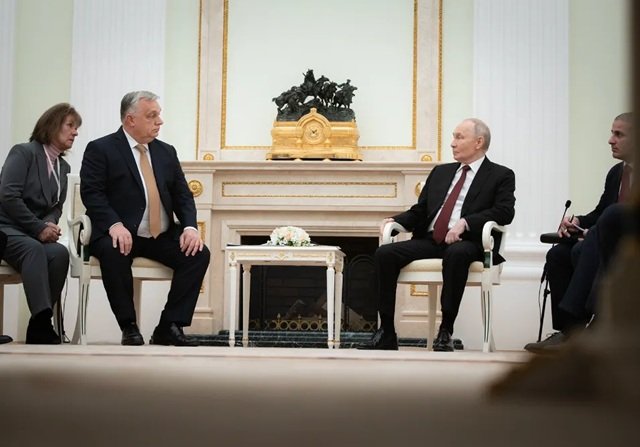
We are just days away from Hungary’s nail-biting election, and one of Russia’s most familiar tactics is playing out again, the same one seen so many times in Ukraine, Moldova, the U.S., across Europe, and wherever Moscow looks to shape election outcomes. What appears to be domestic political messaging is in fact part of a coordinated influence operation meant to shape how voters think, tap into their fears, and ultimately influence how they vote, and if this sounds familiar, it is because this is exactly what Russia has done, multiple times, in the U.S.
New research shows that a large share of pro-Orbán content circulating on Telegram in the final stretch of the campaign is part of a coordinated network pushing identical phrases, narratives, and warnings across thousands of channels, often in synchronized waves. The messaging is consistent: Hungary faces catastrophe if Orbán loses, foreign forces are trying to drag the country into war, and the election could be manipulated to deny him victory—narratives that closely track both Orbán’s own rhetoric and broader Kremlin propaganda.
What matters is not just the content but how it is being spread. These narratives are first created or amplified within Russian and Russia-aligned ecosystems, in this case through state media Rossiya Segodnya, before being pushed into Telegram networks that act as coordination hubs, where messaging is aligned, translated, and replicated at scale. Researchers found Russian-origin content translated directly into Hungarian and distributed across tens of thousands of groups, creating the appearance of widespread grassroots support.
From there, the operation does not stay confined to Telegram. The same narratives move rapidly onto Facebook, TikTok, and X, where they reappear as domestic political messaging while maintaining identical framing and language. In this case, Telegram is being used as the staging ground, with coordinated amplification pushing the same messaging across platforms, a tactic that has also been used in other operations, including in the United States, through mainstream social media.
Much of the infrastructure behind these operations has shifted in recent years. After the decline of the Internet Research Agency following the fallout around Yevgeny Prigozhin, who was allegedly killed in 2023, large parts of Russia’s influence operations moved more directly under the Kremlin, with activity increasingly tied to the presidential administration and projects linked to organizations like the Social Design Agency. Officials, including Sergey Kiriyenko, oversee these broader efforts, which run through a mix of state media, proxy platforms, contractors, and distributed networks that generate content, seed narratives, and push them across social media platforms. This makes them more integrated with Russia’s state policy, more scalable across regions, and harder to trace.
This is only one part of a much broader effort. Russian operatives are not just active online but present on the ground in Hungary, with reporting indicating that a GRU-linked team of political technologists and social media specialists was deployed to Budapest to support Orbán’s re-election campaign, operating under diplomatic cover. Meanwhile, separate reporting shows that nearly half of the staff at Russia’s embassy in Hungary are tied to intelligence services, including at least fifteen confirmed intelligence officials and several more suspected.
The information campaign is also running alongside more traditional pressure tactics. Reports point to widespread vote-buying efforts in rural Hungary, where local officials linked to Viktor Orbán’s party are accused of distributing cash, food, medicine, and other incentives to vulnerable populations. They are also using dependency, intimidation, and control over local services to influence how people vote, tactics that mirror methods used in other Russian-influenced elections, including recent operations in Moldova.
Hungary is not the first country to see this kind of multi-faceted operation, nor is Orbán the first leader to coordinate with the Kremlin. Ukraine was one of the main testing grounds, where Russia built long-term networks of media, political proxies, and influence channels to shape public perception and weaken pro-Western governments, while fusing disinformation with economic pressure, political manipulation, and covert support for aligned actors. The same approach appeared, a decade later, in the 2016 U.S. election through coordinated online networks, and has since been used across Europe through support for fringe extremist parties, amplification of anti-EU messaging, efforts to break support for Ukraine, and broader attempts to undermine trust in democratic institutions.
Hungary is the latest place this is playing out, and that is not by accident. Orbán has long been one of the Kremlin’s most reliable puppets inside the European Union and NATO, pushing against sanctions, echoing familiar talking points, and, as recent leaks have shown, passing information to Moscow, all while helping create divisions over Ukraine, which makes keeping him in power a strategic priority for the Kremlin.
What stands out is how brazen Russia has become compared to some of its earlier election interference operations. It also shows how comfortable Moscow feels operating inside Hungary after years of capture.
Despite all of this, and even as the U.S. and Russia run joint operations for Orbán, polls suggest momentum for the opposition ahead of Sunday’s vote. In the end, the outcome ultimately will come down to the voters, and it will be the people who decide the future of their country.