Humanoid robots are approaching a point where they could become commercially useful, according to Chinese and U.S. companies that have unveiled plans in recent months to produce them at scale. As reported by Nature, industry leaders and researchers say rapid improvements in artificial intelligence, battery technology and hardware design have driven a step change in humanoid capabilities over the past five years, bringing long-promised applications closer to reality.
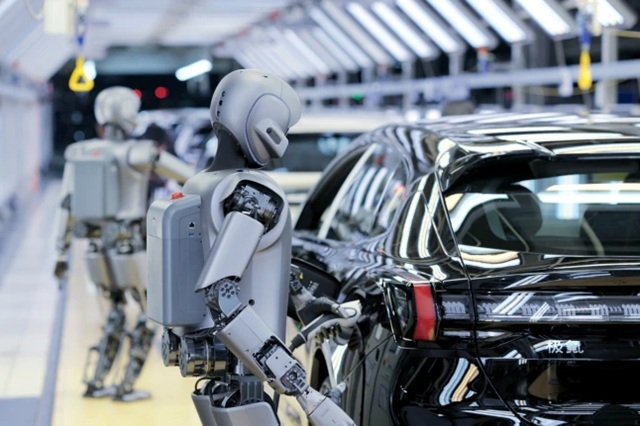
Chinese robotics firm UBTECH announced in November that it had completed what it described as the world’s first mass delivery of humanoid robots. More than 1,000 units of its Walker S2 model were shipped to factories in 2025, according to Yu Zheng, a roboticist and vice-dean of the UBTECH Research Institute in Shenzhen. The silver-white humanoid can walk autonomously, maintain balance and manipulate objects, though Zheng said deployment remains at an early stage and the robots are still far from replacing human workers.
Despite the progress, it is not yet clear whether humanoids are delivering tangible gains in efficiency or cost savings. Battery life remains limited to hours, and many tasks still require human oversight. In practice, operators often remotely control the robots, using them as data-gathering tools to train future autonomous systems. Researchers quoted by Nature warn that technical and safety constraints mean humanoid robots are not ready for general-purpose roles in homes, offices or unstructured public environments.
“They can do maybe one or two things autonomously, or semi-autonomously,” said Esyin Chew, a roboticist at Cardiff Metropolitan University, who is overseeing trials involving more than 80 robots in service and healthcare settings. She noted that while progress is evident, humanoids still lack the ability to respond flexibly to unexpected real-world situations in the way humans can.
The idea of humanoid robots has long been fueled by science fiction, but many roboticists point out that the human form is inherently complex and unstable compared with static industrial machines or quadruped robots. Oskar Palinko, a roboticist at the University of Southern Denmark, told Nature that a humanoid’s reliance on balance makes it vulnerable, noting that it would fall if it lost power. Yet he added that humanoids have a unique advantage: they are designed to operate in environments built for people, potentially allowing them to act as a “universal tool” capable of performing a wide range of tasks.
According to Palinko, recent advances have brought humanoids much closer to this vision. Denser batteries now allow robots to operate for hours instead of minutes, actuators have become cheaper and more precise, and AI-driven control systems enable better perception and learning. Developers are increasingly incorporating generative AI models that allow robots to reason about their surroundings and acquire new skills without being explicitly programmed.
Automotive manufacturing is emerging as a likely first proving ground. U.S. developers such as Boston Dynamics and Tesla are already piloting humanoid robots in their own factories. Carolina Parada, who leads the robotics team at Google DeepMind, said car plants offer an ideal environment, combining complex tasks with semi-structured settings that are already adapted for automation. Google DeepMind last week announced a partnership with Boston Dynamics to accelerate such efforts.
Companies are betting that robots will improve through experience. At UBTECH, when a Walker S2 fails during autonomous operation, a remote human operator steps in to complete the task, generating data that feeds back into system training. Similar approaches are being used by Boston Dynamics, with large data-collection centers dedicated to teaching humanoids new skills through human demonstration.
While China and the United States are leading development, China appears particularly open to real-world experimentation. Zheng said Chinese factories have been willing to host early trials, even knowing that current humanoids may not yet match human productivity. A UBTECH spokesperson said customers view the deployments as a starting point rather than a finished solution, reflecting a broader willingness to invest in long-term gains.
As Nature notes, humanoid robots are no longer a distant concept but a rapidly evolving technology. Whether they can move beyond carefully managed factory pilots to become reliable, autonomous workers remains an open question, but the pace of progress suggests their role in industry will continue to expand.