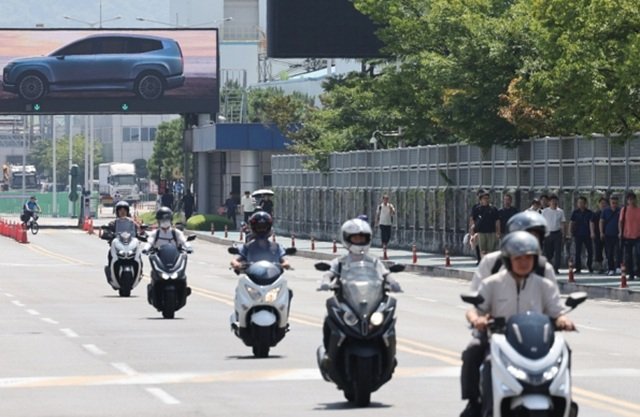
Hyundai Motor’s South Korean union staged its first full strike in a decade on Friday after wage negotiations stalled, escalating a labour dispute centred not only on pay but also on retirement and the future of jobs threatened by artificial intelligence and automation.
Around 40,000 Hyundai Motor union members were expected to join the one-day walkout, while striking workers from Hyundai Motor, affiliate Kia Corp and their suppliers were due to rally outside Hyundai Motor’s headquarters in Seoul at 2 p.m. (0500 GMT), according to the Korea Metal Workers Union (KMWU), the umbrella union representing the workers.
A union official said around 1,200 to 1,300 union members were expected to attend the Seoul rally. Members of other unions and the umbrella union were also expected to participate, taking total expected attendance at the capital’s rally to about 3,000.
The strike represents a significant escalation after a series of partial walkouts that began in late July. Those actions have disrupted production of 55,200 vehicles worth over 2.3 trillion won ($1.67 billion), according to estimates from Yonhap News Agency.
The latest labour action also comes at a difficult moment for Hyundai. In July, the automaker said it expected to miss its global sales target for the year, as it faces growing competition from Chinese manufacturers in Europe and falling sales in South Korea.
At the centre of the dispute is a broader question about how South Korea’s ageing workforce will adapt to rapid technological change. Hyundai’s union is demanding that the mandatory retirement age be raised from the current 60, in line with President Lee Jae Myung’s pledge to gradually increase the limit in one of the world’s fastest-ageing countries.
Workers are also seeking higher bonuses, demanding an increase to 800% of monthly base salary from 750%. But the dispute extends beyond wages. The union has demanded guarantees to protect jobs as Hyundai adopts artificial intelligence and automation across its operations.
The issue has particular significance for Hyundai because of its investment in advanced robotics. The company owns humanoid robot maker Boston Dynamics and has said it plans to deploy humanoid robots at its U.S. plant in Georgia from 2028, with the aim of expanding their use across its production sites.
Hyundai Motor union spokesperson Kim Jin-wook said the two sides remained apart over the retirement age and bonuses, among other issues. He said the union remained open to resuming wage talks but would discuss further strike plans if management failed to produce “forward-looking proposals.”
The dispute comes amid growing labour unrest in South Korea following the election of pro-labour liberal President Lee Jae Myung last year. For Hyundai, however, the immediate challenge is balancing demands from workers with the pressures of global competition and a rapid transition towards automated production.
Hyundai Motor said it remained committed to finding solutions through dialogue. “Strike action can impact our customers, partners and operations. We are at a critical time when both sides must work together to successfully navigate the global transition to future mobility,” the company said in a statement.
The strike therefore places Hyundai at the intersection of two forces reshaping the global automobile industry: pressure from workers seeking greater security and technological change that could fundamentally alter how cars are built. For the company and its workforce, negotiations now extend well beyond the traditional question of wages.