by Our Correspondent in New Delhi
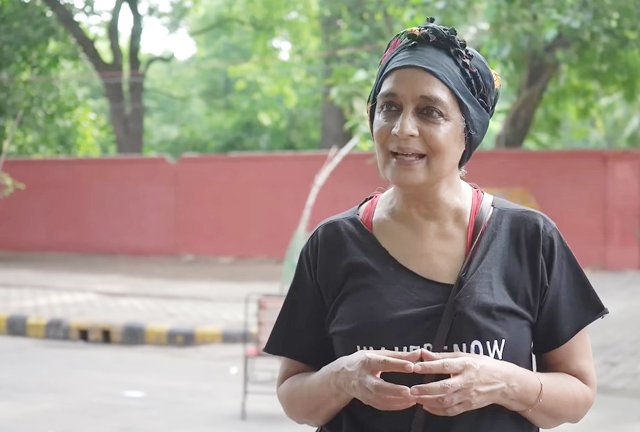
The morning after India’s education minister resigned, Arundhati Roy returned to Jantar Mantar, where, only days earlier, one of the most remarkable protest movements in recent memory had reached its climax. Accompanied by Scroll Executive Editor Supriya Sharma, Roy walked through a place that had, until recently, reverberated with chants, songs, satire and youthful defiance. The crowds had dispersed, the graffiti had largely been painted over, and the authorities were eager to restore what they called “normalcy.” Yet, as Roy observed, the silence itself seemed unsettling. “It’s a bit chilling now,” she reflected. “The silence, like it never happened or something.” During their conversation, police officers interrupted them, insisting they leave the public space. After a brief exchange, the discussion resumed elsewhere, becoming itself a quiet reminder that even after a protest formally ends, the contest over public memory and public space continues.
For Roy, the significance of the movement extended far beyond its immediate political objective. Although the resignation of the education minister represented a tangible victory, she insisted that the protest’s deeper achievement lay elsewhere. It had exposed the vulnerability of a political order that, for years, had appeared almost untouchable. More remarkably, it had done so not through violence or solemn rhetoric but through ridicule, humour and irreverence.
Roy confessed that she had initially approached the movement with caution. Having witnessed earlier protest mobilisations that she believed had been appropriated by right-wing politics, she deliberately maintained a distance. She worried that her own more radical political writings might become attached to a movement whose demands were, at least publicly, relatively narrow. “I was careful,” she explained, “about not allowing me to be pinned on to it.” Instead, she watched patiently, paying attention to its slogans, symbols and political language.
What ultimately persuaded her was not a single demand but the character of the protest itself. She recognised, in its language and humour, a willingness to confront the dominant currents of Hindu nationalist rhetoric rather than accommodate them. That shift convinced her that something genuinely new was emerging.
The atmosphere she encountered astonished her. “It was delightfully profane,” she laughed. For Roy, humour was never merely entertainment. “Humour is the distillation of politics,” she observed, describing it as politics in its most concentrated and sophisticated form. The jokes, memes, chants and irreverent slogans did not trivialise politics; they distilled years of accumulated frustration into a language that was instantly understood.
After decades spent criticising Prime Minister Narendra Modi and warning about the direction of Indian politics, Roy admitted that she had never imagined witnessing such a public rupture. “It’s been twenty-four years that he’s been in my crosshairs,” she said. “I thought I would die before you saw something like this happen.” The experience was, in her words, profoundly “cathartic.”
One of Roy’s most striking arguments concerns the political power of ridicule. Elections, she suggested, might remove governments, but they do not necessarily dismantle carefully manufactured political mythology. This movement, however, had accomplished something altogether different.
For more than two decades, she argued, Modi’s public persona had been meticulously cultivated through media management, carefully choreographed appearances and relentless political messaging. Here, however, that carefully constructed image encountered something it could neither anticipate nor easily suppress: spontaneous laughter.
“The greatest achievement of this movement,” Roy argued, “is that a person who confected his image so carefully over literally twenty-four years… suddenly gets stripped bare in two weeks by these kids.” She struggled to recall any comparable moment in modern political history. “I do not believe that any human being, let alone a head of state, has been derided and mocked so much in the history of time.”
Social media undoubtedly accelerated the process, but Roy insisted the transformation ran much deeper than digital culture. Old speeches resurfaced, official slogans became punchlines, carefully scripted performances became objects of parody, and an image of unquestioned authority rapidly dissolved into comic material.
“So how is he going to come out and face people and say those stupid things all over again?” she asked.
For Roy, this symbolic dismantling represented a political victory that exceeded electoral arithmetic. “In some ways,” she argued, “that’s bigger than winning an election.” Much commentary has focused on the role of artificial intelligence, memes and online humour in sustaining the protests. Roy acknowledged their novelty but resisted reducing the movement to technology alone. Instead, she argued that propaganda itself had begun collapsing under the weight of lived experience.
“The propaganda is not sophisticated,” she remarked. “It is so dumb that even someone with an average IQ can see through it.” For years, she suggested, many had assumed younger generations had absorbed official narratives unquestioningly. The protests demonstrated precisely the opposite. Reality, she argued, had finally begun colliding with propaganda.
Families that once embraced official narratives were confronting shrinking economic opportunities, unemployment and growing insecurity. Students protested examination paper leaks, but beyond those immediate grievances lay a broader crisis of privatised education, exclusion and declining public institutions. Even successful graduates increasingly faced futures without meaningful employment. “The propaganda has a shelf life,” Roy observed.
She broadened the argument still further. Communities displaced from forests, farmers confronting economic distress and small businesses squeezed by increasing economic concentration had long experienced these realities. Now, she believed, similar pressures had reached India’s expanding middle classes.
“The rot is everywhere,” she declared.
Statistics, official narratives and triumphalist slogans increasingly collided with everyday experience. “Even the statistics are lies,” she argued, adding that governments eventually begin believing “their own propaganda.” Roy was particularly fascinated by the apparent isolation surrounding political leadership itself. Invoking Vasily Grossman’s Stalingrad, she recalled the episode of a German general unable to tell Hitler uncomfortable truths because he had become overwhelmed by the dictator’s aura. Roy wondered whether something similar now surrounded India’s own leadership.
“Is there nobody telling this man that something has turned?” she asked. “Not just domestically but internationally?”
For Roy, the question was not simply whether power could survive criticism but whether power had insulated itself so completely that it no longer recognised reality when confronted by it. International ridicule, domestic satire and collapsing public deference had together punctured an image once presented as almost invincible. Whether those in power fully understood that transformation remained, in her view, an open question.
The encounter with the police midway through the interview became an unintended metaphor for the very themes Roy had been discussing. Officers politely but firmly insisted that the conversation end because order had to be maintained in the public space. The exchange was brief, yet revealing. Later, reflecting on the interruption, Roy remarked that many officials themselves were likely sympathetic to the students. “They also have these kids of people,” she observed. “Privately very sympathetic to the protest.” But sympathy, she implied, mattered little when institutions were organised around enforcing authority rather than accommodating dissent. Drawing a line between Delhi and Kashmir, she recalled an essay she had written years earlier predicting that “India was going to become an integral part of Kashmir.” The methods first normalised in Kashmir, she argued, had gradually travelled elsewhere. “The pellet guns have come from Srinagar to here.” Even the language of governance sounded familiar. Authorities repeatedly spoke of restoring “normalcy”, a word Roy said Kashmiris had heard for decades. “Remember in Kashmir they declare normalcy,” she said. “It’s always a declaration.” Once the protesters departed, walls were repainted, graffiti erased and visible traces removed. “Blood stains are removed, walls are painted over,” she reflected, “but you can almost hear the slogans still. You can almost see those lovely faces still.”
Yet Roy repeatedly cautioned against confusing symbolic victory with structural change. The resignation of one minister, she argued, did not alter the machinery beneath. “A little symbol sitting on a bloody mountain was flicked off and another one has been put there,” she remarked, insisting that the “mountain” remained. Education itself, she argued, continued to suffer from privatisation, exclusion, examination scandals and ideological rewriting of curricula. The government’s response, meanwhile, demonstrated no willingness to acknowledge responsibility. Instead, the departing minister received praise as though he had “martyred himself to the cause of students and not been shamed and forced to step down.” The real contest, Roy believed, was only beginning.
Nor was she convinced that India’s political opposition had risen to the moment. While acknowledging isolated gestures of solidarity, Roy lamented what she considered an inability to match the courage and imagination displayed by the students. “These kids did what the opposition could not do,” she said. Instead of embracing the movement with confidence, opposition parties appeared hesitant, fragmented and preoccupied with internal rivalries. Facing what she described as “an existential threat”, they nevertheless continued “squabbling” and “jockeying for position”. Roy’s frustration was captured in one memorable observation: “Every time it suffers some setbacks this BJP goes to work hard, whereas the opposition goes to bed.”
Her concern extended beyond parliamentary politics to the broader architecture of power. Elections, she argued, were increasingly shaped by advantages unavailable to ordinary competitors, while much of India’s television media had abandoned even the pretence of independence. It was no longer merely a question of censorship. “It is not even a group of people worrying about censorship,” she argued. “It’s a group of people enthusiastically amplifying this fascist nationalist message.” Against that backdrop, the students’ ability to puncture official narratives through humour appeared even more extraordinary.
Throughout the conversation Roy returned to a recurring theme: laughter as political resistance. The defining emotion of the protest, she insisted, was not the absence of anger but anger transformed into wit. “I don’t think there is such a huge brick wall between rage and humour,” she explained. “Humour is the distillation of politics.” The crowds laughed because they had found a collective language capable of expressing what many individuals had long felt unable to articulate. “Sometimes they said the quiet part out loud,” she reflected. Alone, people remained cautious; together, they discovered unexpected freedom.
That freedom, however, remained unevenly distributed. Roy worried deeply about reports that Muslim participants were being detained after the demonstrations ended. She referred to the arrests of volunteers who had helped feed protesters and spoke of large-scale detentions elsewhere. More fundamentally, she reminded listeners that state violence had historically fallen far more heavily upon communities already living at the margins. Had this uprising consisted primarily of Muslims, Sikhs, Christians, Dalits or Adivasis, she suggested, the state’s response would almost certainly have been harsher. “These are the children of his constituency,” she said, explaining why restraint had limits the authorities were unwilling to cross. Even amid celebration, she could not forget those who remained imprisoned or those whose suffering had disappeared from public attention. She invoked the names of Umar Khalid and Sharjeel Imam, reminding listeners that both had spent years in prison without trial. She recalled the anti-CAA protests, the deaths that followed, and the haunting image of Muslim youths beaten by police while being forced to sing the national anthem. “I cannot forget that,” she said. “That is burned into my mind.” Her anger, she admitted without apology, had accumulated over decades. “People tell me you’re angry. Yeah, I’m angry. I’ve been angry for a very, very long time. But I laugh with anger, as did those students.”
If anger supplied the emotional foundation, joy became the movement’s most unexpected political achievement. Roy confessed that, for years, she had felt ashamed by the public acceptance of intolerance and majoritarian violence. “For the first time in years it felt wonderful to be Indian,” she said. Watching young people reject fear through satire transformed not only her political outlook but also her emotional relationship with the country itself. “I swear I can die in peace now. I will die smiling. I didn’t think I’d see it in my lifetime.”
Roy resisted invitations to overanalyse the phenomenon while it was still unfolding. Politics, she observed, changes rapidly; victories rarely last forever. Yet she worried that the habit of immediate strategic calculation had left people unable simply to celebrate an extraordinary democratic moment. “I don’t want to analyse it,” she laughed. “I just want to enjoy it.” Asked how she had celebrated, her answer was disarmingly simple: “I came here and I just smile and smile and smile.”
Near the end of the conversation Roy reflected on how profoundly the previous weeks had affected her personally. Those who had recognised the dangers of majoritarian politics early, she noted, had often been ridiculed, dismissed or branded alarmists. Watching the wider public finally arrive at similar conclusions brought not triumph but relief. “I didn’t realise how guarded and weary as a person I had become until I was able to just let it go.” The change, she said, was almost physical. For years she had awakened each morning feeling as though she first had to remove “this block of concrete” from her chest before beginning the day. During the protests, that burden had not disappeared, but “the concrete block has been in the other room. It’s there, but it’s in the other room.”
That image perhaps captures the essence of Roy’s reflections more powerfully than any political slogan. She offered no prediction that authoritarianism had been defeated, no guarantee that the movement would reshape India’s future, and no illusion that humour alone could transform institutions. What she celebrated was something more elemental: the sudden rediscovery of public courage, the refusal of fear, and the capacity of ordinary young people to puncture a carefully cultivated mythology through laughter. The walls may have been repainted, the slogans erased and “normalcy” officially restored, but for Roy the most enduring legacy of those remarkable weeks was that millions had glimpsed, however briefly, a different emotional and political possibility. As she put it with characteristic simplicity, “We’ll live to fight another day.”