by Satchi
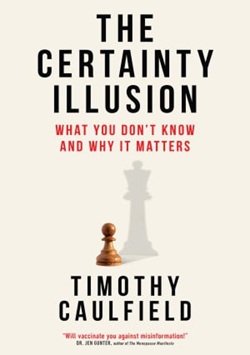
Timothy Caulfield’s The Certainty Illusion is a masterful, incendiary dissection of the modern knowledge crisis, a book that dares to claw at the bedrock of our cognitive complacency. With surgical precision, Caulfield reveals the grotesque paradox of the digital age: the more access we have to information, the more uncertain and polarised our beliefs become. At its heart, this is not merely a book about misinformation—it is a scathing indictment of society’s delusional hunger for certainty in an age fuelled by chaos and clickbait.
Caulfield’s voice bristles with urgency, opening with the provocative assertion that “our information environment… is completely and truly f*cked” (p. 7). Such bluntness is not gratuitous; rather, it serves as a clarion call, shaking readers from their intellectual stupor. The very platforms designed to enlighten us, Caulfield argues, have been hijacked by algorithms that prioritise outrage over accuracy, with the information economy driven not by truth but by the ruthless pursuit of attention (p. 45).
One of the book’s most chilling observations is how the illusion of scientific credibility is manipulated. Caulfield’s analysis of “scienceploitation”—the bastardisation of scientific rhetoric for commercial gain—is both scathing and deeply unsettling. The proliferation of pseudo-scientific garbage, from detox teas to anti-vax rhetoric, thrives because it masquerades as genuine science. As Caulfield grimly notes, “Science-y language injects a veneer of credibility and believability” (p. 112), turning what should be a bastion of rational inquiry into a playground for charlatans.
Perhaps the book’s most controversial argument lies in its assertion that the very institutions meant to uphold scientific integrity—academic journals, research bodies—are complicit in this farce. Caulfield exposes the rot within academia, with predatory journals and hype-driven research leading to a dilution of scientific credibility (p. 156). This is a bold, perhaps uncomfortable critique, particularly for those who still naively revere science as an unassailable fortress of objectivity.
Yet, The Certainty Illusion is not a nihilistic screed. Beneath the cynicism lies a profound faith in the process of science, albeit a process that Caulfield insists must be embraced with humility. He echoes Carl Sagan’s sentiment of science as “a candle in the dark” (p. 221), reminding us that the pursuit of knowledge should be grounded in scepticism and curiosity—not hubris.
Caulfield’s exploration of the goodness illusion—where moral posturing becomes a tool for manipulation—is equally biting. His critique of health halos, sustainability rhetoric, and virtue-signalling consumerism exposes a society more concerned with the performance of goodness than genuine ethical action (p. 274). The section on “clean beauty” and its pseudoscientific underpinnings is particularly damning, revealing how moral branding exploits consumer anxieties for profit (p. 287).
The book’s final section, The Opinion Illusion, might be its most disquieting. Here, Caulfield interrogates the modern obsession with online reviews and ratings—those seemingly innocuous five-star systems that, in reality, perpetuate a cycle of manipulation and deception (p. 332). He chillingly argues that “a shocking percentage of online reviews are fake or manipulated” (p. 341), contributing to a larger erosion of trust in public discourse.
The Certainty Illusion is a provocative, unrelenting exploration of the fractures in our epistemological foundations. Caulfield’s prose is sharp, his arguments meticulously researched, and his conclusions unsettlingly plausible. This book does not merely challenge readers to question what they know—it forces them to confront the uncomfortable possibility that certainty itself is a dangerous illusion. In a world where information has become a weapon, The Certainty Illusion is not just timely; it is essential.