
For more than six decades, the Indus Waters Treaty survived what diplomacy between India and Pakistan often could not: wars, military crises, diplomatic breakdowns and prolonged hostility. On August 31, that resilience faced one of its most consequential legal tests.
In an award specifically addressing the status of the treaty following India’s April 2025 decision to hold it “in abeyance,” the Court of Arbitration in The Hague ruled unanimously that the move neither terminated nor suspended the 1960 agreement. India, the court held, remains bound by the treaty and must continue observing its obligations, including those governing hydroelectric projects on the western rivers.
The decision goes beyond the immediate water dispute. It draws a line between sovereign political choices and treaty obligations at a time when New Delhi has sought to link continued implementation of the treaty to its security concerns regarding Pakistan.
India immediately rejected the ruling. Its Ministry of External Affairs maintained that the Court of Arbitration had “no jurisdiction whatsoever” over what it described as India’s sovereign decisions and insisted that its decision to place the treaty in abeyance remains in force.
India’s jurisdictional objection predates the latest ruling. New Delhi has long disputed the Court of Arbitration’s jurisdiction, arguing that technical questions surrounding the Kishenganga and Ratle hydroelectric projects properly belong before the treaty’s Neutral Expert mechanism. The Court of Arbitration, however, rejected India’s objections to its competence in 2023 and subsequently held that India’s 2025 decision to place the treaty in abeyance could not limit that competence.
The result is an unusual confrontation: the treaty remains legally operative according to the arbitral tribunal, while one of its two parties rejects the tribunal’s authority.
A treaty designed to survive crises
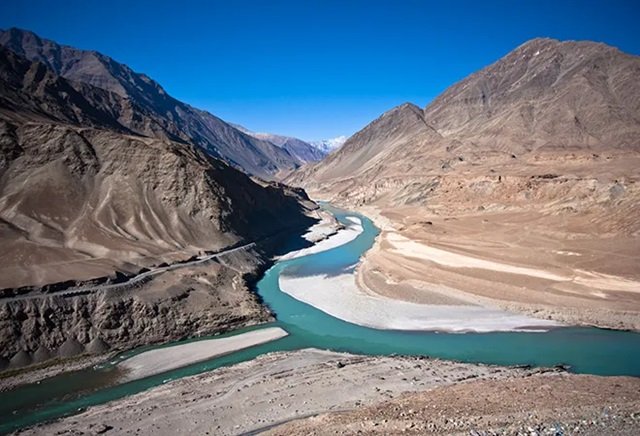
Signed in 1960 with World Bank involvement, the Indus Waters Treaty divided use of the Indus river system. The treaty allocated the eastern rivers Ravi, Beas and Sutlej– primarily to India, while Pakistan received rights over the western rivers Indus, Jhelum and Chenab– subject to specified Indian uses.
For Pakistan, the stakes are particularly high. The Indus system supports most of the country’s irrigated agriculture, making water flows inseparable from food security and economic stability.
Against the backdrop of historically unstable India-Pakistan relations, the treaty relies on rules, technical procedures and dispute-settlement mechanisms rather than political trust. It remained operational through repeated armed conflicts after 1960.
That distinction became critical after the April 2025 attack in Pahalgam in Indian-administered Kashmir, which killed 26 people. India blamed Pakistan for supporting cross-border terrorism and announced that the treaty would be held in abeyance until Islamabad “credibly and irrevocably” ended such support. Pakistan denied involvement.
The award directly addressed whether such considerations could provide a legal basis for suspending the treaty. The court concluded that they did not.
Sovereignty does not erase treaty obligations
The most significant part of the decision concerns the limits of unilateral action.
The treaty itself contains no provision allowing either India or Pakistan independently to suspend it or place it in “abeyance.” Instead, it provides that the agreement remains in force unless both states modify or terminate it through another treaty.
The tribunal then examined whether wider international law offered India another route.
It considered potential grounds including material breach, fundamental change of circumstances, armed conflict and countermeasures. None, it concluded, justified suspension or termination.
Most importantly, it rejected sovereignty itself as sufficient justification, finding that it does not give states a general right to discard treaty commitments unilaterally.
The court applied the international-law principle of pacta sunt servanda: agreements must be kept.
India’s terrorism argument also encountered a structural problem. Even assuming its allegations against Pakistan were true, the tribunal found that they would not constitute a material breach of the Indus Waters Treaty because the agreement regulates rights and obligations concerning the Indus river system; it does not regulate terrorism or the use of force.
The tribunal also considered arguments involving demographic pressures, clean-energy requirements, advances in dam technology and climate change. None met the demanding legal threshold required to establish a fundamental change of circumstances sufficient to suspend the treaty.
Ratle puts the ruling to a practical test
A separate order issued alongside the award gives the dispute immediate practical significance.
Pakistan had sought interim measures concerning India’s Ratle Hydro-Electric Plant on the Chenab River. The project, together with Kishenganga, is also being examined by a World Bank-appointed Neutral Expert, whose final decision is expected around July 2027.
The court prohibited India from concreting the Ratle dam wall and power-intake structure beyond specified levels until 90 days after the Neutral Expert delivers that decision. The order also requires India to notify the Court, the Neutral Expert and Pakistan of changes to the project’s construction schedule.
If construction continued and disputed components were subsequently found incompatible with treaty requirements, reversing completed reinforced-concrete works could be extraordinarily difficult and costly.
The order therefore attempts to preserve the effectiveness of the dispute-settlement process before physical construction creates irreversible facts on the ground.
The larger test comes after the ruling
Pakistan has welcomed the decision. Foreign Minister Ishaq Dar described it as vindication of Islamabad’s position that a binding international treaty cannot simply be suspended unilaterally.
But Pakistan’s legal success does not by itself resolve the dispute. India’s categorical rejection exposes the gap between international adjudication and implementation: a tribunal can define legal obligations, but securing compliance is a separate political challenge. That could make the next phase more consequential than the award itself.
The dispute is no longer simply about how much engineering flexibility India possesses in designing hydroelectric projects on the western rivers. It is increasingly about whether the institutional architecture that has insulated Indus water cooperation from broader India-Pakistan confrontation can survive when one party rejects both the treaty’s continued operation and the authority of one of its dispute-settlement mechanisms.
For decades, the Indus Waters Treaty demonstrated that even bitter rivals could isolate an existential resource from their broader conflict.
The Hague ruling has reaffirmed that principle in law. The harder test is whether the treaty’s institutions can continue to constrain state behavior when political and security confrontation threatens to overwhelm them.