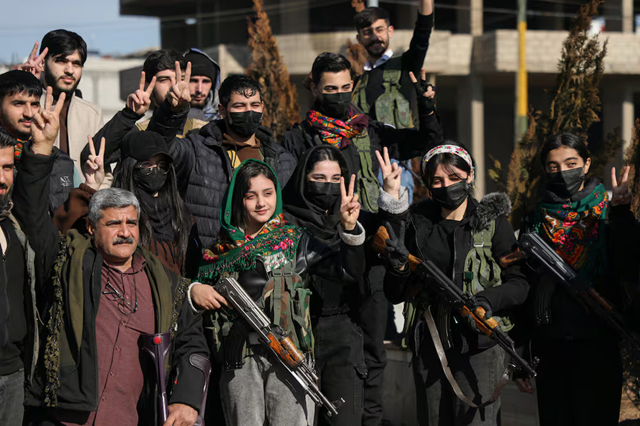
A decade ago, Kurdish movements across the Middle East appeared to be gaining ground. In Syria, Kurdish militias advanced against the self-proclaimed Islamic State caliphate, their resistance against the jihadists responsible for attacks in Europe winning international public support. In Iraq, Kurdish peshmerga used the fight against Islamic State to bring new cities under the control of the Kurdistan Regional Government while Baghdad struggled to contain the crisis. A year later, the Kurdish authorities held a controversial independence referendum.
In Turkey, the Kurdistan Workers’ Party, or PKK, sought to emulate its Syrian allies by taking the conflict into cities in an attempt to establish liberated zones. In Iran, forces belonging to Kurdish groups operating in exile began a new phase of their border guerrilla war.
Ten years later, the direction has changed dramatically. The Kurdish dream of territorial autonomy has been pushed aside by the realities of a region in which central governments have regained strength and the balance of power has shifted away from the armed movements that appeared ascendant after 2011.
“The dream of Kurdish territorial autonomy has been put on hold across the region in the medium term,” says Ezgi Basaran, a professor at the University of Oxford and author of several books on Turkish politics and the Kurdish question. The opportunity that emerged after 2011, she argues, has disappeared. The collapse of the Syrian state and the war against ISIS led Western countries to provide weapons to Kurdish forces, creating a combination of circumstances that no longer exists.
Instead, the regional order has consolidated around centralised nation-states, a structure that Basaran says is desired by Turkey and regarded by Washington as easier to manage.
Yet the retreat from territorial autonomy has not necessarily meant the disappearance of Kurdish political aspirations. Basaran stresses that the shift has also been a decision made by Kurdish movements themselves. Autonomy continues to have support among Kurdish populations, she says, and the demand could immediately return if states in the region fragment again.
The Kurdish population, estimated at between 30 and 35 million people across Turkey, Iran, Iraq and Syria, is commonly described as one of the world’s largest stateless peoples. But the notion of a single, unified Kurdish political movement conceals substantial differences. Family and commercial ties cross the borders separating the four countries, yet Kurdish communities have developed distinct historical, ideological and linguistic identities. Kurmanyi predominates in Syria and Turkey, alongside Zazaki, while Sorani is spoken mainly in Iraq and Iran.
The emerging political strategy is therefore increasingly centred not on establishing autonomous territories but on securing rights within existing states. In Syria and Turkey, Kurdish movements are being encouraged to pursue their rights as citizens rather than as an autonomous bloc.
Basaran points to the movement associated with Abdullah Öcalan, the leader of the PKK, and Mazlum Abdi, his disciple, as examples of this transformation. Öcalan is negotiating a disarmament process with the Turkish Government, while Abdi announced this week the dissolution of the Syrian Democratic Forces as the culmination of a process to integrate Kurdish militias and their autonomous administration into the Syrian state.
The change represents a move away from a military strategy towards political and legal mechanisms. For Kurdish movements, Basaran argues, the military paradigm was becoming increasingly difficult to sustain, while the political and legal route offers better long-term prospects.
In Syria, however, the limits of territorial autonomy were particularly stark. Roj Girasun, director of the Rawest research centre in Diyarbakir, the unofficial capital of Turkey’s Kurds, argues that the small size and geographical dispersal of Syria’s Kurdish population made conventional territorial autonomy unviable.
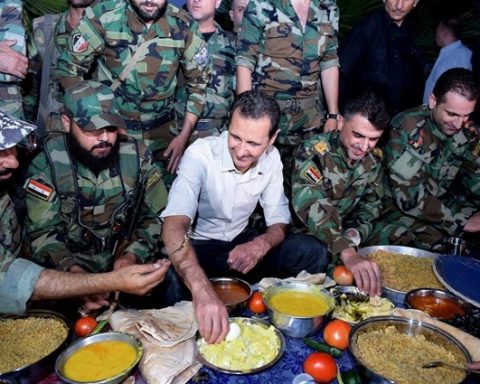
The decisive moment came after the overthrow of Bashar al-Assad in 2024. Girasun argues that Syrian Kurds failed to understand the change in the regional balance of power. Had they reached an agreement with Damascus earlier, he says, they might have retained some degree of autonomy or special status. Instead, they were forced to negotiate following a military defeat in January.
Negotiations in Syria and Turkey are progressing in parallel, reflecting the links between the two Kurdish movements and the central governments. But their immediate results differ. Syrian Kurds have secured recognition of rights including official status for their language and education in their mother tongue. In Turkey, the principal agreement so far has been a partial amnesty for PKK combatants.
For Kurdish society in Turkey, Girasun says, the process is not viewed as a solution to the Kurdish question but as its removal from armed conflict. Decades of fighting had exhausted Kurdish society, he argues, and there is now a desire for the issue to be decided through politics. The end of the armed struggle is significant because Kurdish demands had previously been treated through the prism of terrorism.
The experience of Iraqi Kurdistan offers another warning. The Kurdistan Regional Government, which emerged from the US invasion of Iraq in 2003 and the establishment of a federal state after Saddam Hussein’s overthrow, had served as a model for Kurdish nationalist movements elsewhere. But the failed 2017 independence referendum, whose results were recognised only by Israel, was followed by political paralysis.
Parliamentary elections held in 2024, two years late, produced a deeply divided regional parliament. The rivalry between the two dominant blocs, the Kurdistan Democratic Party of the Barzani clan and the Patriotic Union of Kurdistan of the Talabani family, has since prevented the formation of a government.
Dlawar Aladdin, director of the Middle East Research Institute in Erbil, says the divisions have limited the regional government’s negotiating capacity. Baghdad, he argues, has used that weakness to restrict self-government, particularly by weakening fiscal autonomy and through Federal Supreme Court rulings on oil exports, which are now controlled by the Iraqi Government.
Iraqi Kurdistan has also resisted attempts by Kurdish-Iranian armed groups based there to use its territory for attacks against Iran, fearing retaliation from Tehran. When Israeli-US attacks on Iran began in February, those groups expressed willingness to participate in a ground invasion. The plan, promoted by the Israeli Government, was ultimately abandoned by US President Donald Trump following pressure from Turkey and other regional allies.
The episode illustrates another longstanding dilemma: the dangers of relying on foreign powers.
For decades, outside support has repeatedly opened possibilities for Kurdish autonomy while ultimately proving unreliable. Israel’s role is particularly revealing. Tel Aviv supplied intelligence and military equipment to Turkey during its struggle against the PKK in the 1990s. In more recent years, Israel has courted Kurdish movements as part of efforts to weaken states across the region. During the past two years, Benjamin Netanyahu’s Government urged Syrian Kurdish militias to resist Damascus. They ultimately rejected the support.
The historical precedent is even older. The Republic of Mahabad, established in January 1946, survived only until December that year after its Soviet sponsors withdrew from Iran. Its collapse became an enduring example of the vulnerability of Kurdish political projects dependent upon an external patron.
“The external sponsors have proved to be as reliable as their own interests,” Basaran says. The United States supported the Syrian Democratic Forces against ISIS before abandoning them when they sought to govern Syria from Damascus. Israel supported Iranian Kurds, she says, before Trump withdrew that backing.
For Kurdish movements across the region, the lesson is stark. External powers may provide weapons, intelligence or political support when their interests coincide with Kurdish ambitions, but those alliances can disappear when regional priorities change.
“The lesson, which the Kurds have already learned three or four times, is that an autonomy that depends on a foreign air force lasts exactly as long as the foreign power’s interest in it. Not a day longer,” Basaran says.
The Kurdish political project has therefore entered a different phase. Territorial autonomy, once strengthened by the collapse of states and the international campaign against Islamic State, has given way to negotiations over rights, citizenship, disarmament and integration. The aspiration has not necessarily disappeared. But for now, the armed struggle for autonomous territory has yielded to the harder politics of survival within states whose authority has once again become the dominant force in the Middle East.