Lebanon has become a central arena in the intensifying struggle between two competing visions for the Middle East. On one side is a United States-led strategy aimed at integrating the region more closely with Western partners while encouraging normalisation between Israel and its Arab neighbours. On the other is Iran’s “resistance ideology”, built around confronting Israel, the United States and the wider West through a network of allied non-state groups, foremost among them Lebanese Hezbollah. According to The Soufan Center, the outcome of this contest could significantly influence both the regional security architecture and the future of Iran’s strategic influence.
The competing agendas came into sharp focus during Lebanese President Joseph Aoun’s visit to Washington, the first by a Lebanese president in 17 years. Aoun sought support from US President Donald Trump to achieve two objectives that have become increasingly intertwined: disarming Hezbollah and securing an Israeli withdrawal from southern Lebanon. His visit coincided with the launch of a new pilot programme under which the Lebanese Armed Forces (LAF) will gradually assume control of positions in southern Lebanon that were previously held by Hezbollah before being captured and later vacated by Israeli forces.
The developments illustrate the extent to which Lebanon has become central to the broader confrontation between Washington and Tehran. Beyond ideological differences, the dispute revolves around Iran’s long-standing strategy of projecting regional influence through the training, financing and arming of allied organisations across the Middle East. Hezbollah remains the most prominent of these groups and occupies a critical position in Iran’s regional security calculations. Tehran considers efforts to dismantle Hezbollah’s military structure or reduce its political influence in Lebanon as measures that would inflict a potentially severe strategic setback on the Iranian state itself.
The significance Iran attaches to Hezbollah’s survival was reflected during negotiations over the June US-Iran Memorandum of Understanding. Iranian negotiators insisted that the agreement include a commitment by the United States to secure a ceasefire on “all fronts” throughout the region. While this provision implicitly required Washington to pressure Israel to halt military operations against Hezbollah, it did not specifically require an Israeli withdrawal from the buffer zone established in southern Lebanon.
Although the Trump administration successfully encouraged Israel to reduce the intensity of its offensive against Hezbollah, Iran later cited the signing of a “Trilateral Framework Agreement” involving Israel, Lebanon and the United States as a violation of the Memorandum of Understanding. According to Tehran, the agreement allowed Israel sufficient latitude to continue military operations against Hezbollah, contributing to the collapse of the broader accord.
The trilateral framework extends beyond immediate security concerns. It establishes a roadmap for disarming Hezbollah while creating conditions for an eventual Israeli withdrawal from southern Lebanon. It also outlines a longer-term pathway towards a formal peace treaty and eventual normalisation of relations between Israel and Lebanon, an outcome that would support Washington’s broader effort to assemble a regional coalition of Arab states at peace with Israel to counter Iran’s regional influence.
Joseph Aoun’s visit to Washington reflected Beirut’s willingness to engage with that vision, while also highlighting the limits of political consensus inside Lebanon. During his meeting with President Trump, Aoun thanked the US administration for helping establish a framework intended to end hostilities between Lebanon and Israel “forever”, telling Trump, “This will be your legacy.” The visit marked the culmination of five months of US-mediated direct negotiations involving Israel and the Lebanese government.
At the same time, Aoun firmly rejected suggestions that he should hold a direct meeting with Israeli Prime Minister Benjamin Netanyahu. He maintained that such a summit could only take place after hostilities between Israel and Hezbollah had ended and Israeli forces had fully withdrawn from Lebanese territory. His position reflects Lebanon’s effort to balance engagement with US diplomacy while maintaining domestic political consensus.
Despite increasing agreement among many Lebanese political leaders that Hezbollah should ultimately relinquish its weapons, considerable doubts remain over whether that objective can be achieved. Hezbollah is deeply rooted within Lebanese society, particularly among the country’s Shia community, where decades of Iranian financial assistance, military support and religious ties have reinforced its influence. After Hezbollah entered Iran’s defence effort in March, Israeli forces crossed into Lebanon and established a buffer zone along the border.
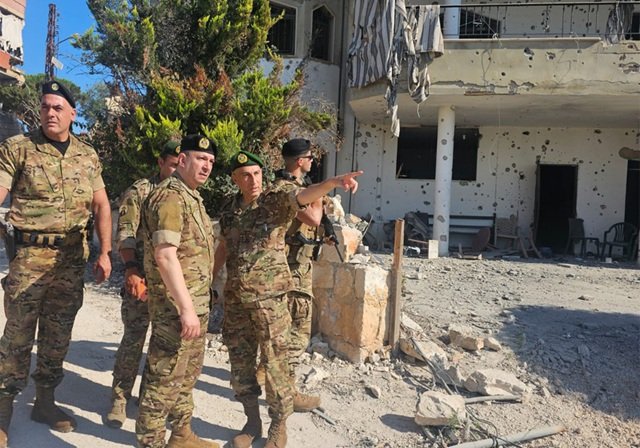
Following six rounds of negotiations, including the Trilateral Framework Agreement and subsequent meetings in Rome, Israel, Lebanon and the United States developed a mechanism for implementing Beirut’s objective of disarming Hezbollah. The pilot programme initially covers two locations before expanding further, allowing the Lebanese Armed Forces gradually to assume responsibility for positions formerly occupied by Hezbollah. Coinciding with Aoun’s visit, the US State Department announced that implementation had begun, stating that operations were underway in the villages of Froun, Srifa and Zawtar Al-Gharbiya under the auspices of the Military Coordination Group for Lebanon.
Even as implementation began, scepticism remained widespread. During his discussions in Washington, Aoun acknowledged concerns among Lebanon’s Shia population that the plan might fail to secure a complete Israeli withdrawal from southern Lebanon. Referring to comments by Lebanese Parliament Speaker Nabi Berrih, Aoun told journalists at the White House: “I think the Speaker of the Parliament also wants to see the end of this war. He’s from the South, and he knows he did his best to rebuild the South. But unfortunately, the South is being destroyed in front of his eyes. So he’s actually supportive of what we are doing, but we need to be careful.”
That caution reflects fears that any attempt to disarm Hezbollah through force could trigger renewed communal conflict reminiscent of Lebanon’s 1976-1989 civil war. To strengthen the state’s capacity, Aoun used his Washington visit to seek additional military assistance and financial support for the Lebanese Armed Forces. Reports also suggest that the United States, Israel and Lebanon are advancing plans to train and vet elite LAF units capable of disarming Hezbollah by force if necessary. However, LAF commander Rodolphe Haykal has publicly warned that direct military confrontation with Hezbollah could fracture the armed forces, as occurred during Lebanon’s civil war. Those concerns were reinforced when Israeli forces reportedly fired upon LAF units approaching positions within Israel’s self-declared buffer zone shortly before the Trump-Aoun meeting.
The search for alternatives has also extended beyond Lebanon. President Trump has proposed involving Syria’s new government under Ahmed al-Sharaa in efforts to weaken Hezbollah. Although Sharaa has redirected Syria away from Iran after decades of Assad family alignment with Tehran, Syrian officials have rejected suggestions of military involvement in Lebanon as unrealistic and destabilising. Nevertheless, Damascus has demonstrated willingness to cooperate with Washington and Beirut in limiting Iranian influence. Syrian authorities recently intercepted an Iranian shipment reportedly destined for Hezbollah, prompting Iran to announce an attack on the al-Tanf base in eastern Syria as a warning against interference. While US and Syrian officials denied that an actual attack had occurred, the episode illustrated the increasingly regional dimensions of the contest surrounding Lebanon.
Recognising President Aoun’s central role in reducing Iranian influence within Lebanon, President Trump concluded the visit by announcing that US airlines would once again be permitted to operate direct flights to Lebanon, ending a suspension that has remained in place for more than four decades following the 1985 hijacking of TWA Flight 847 by Hezbollah militants and the killing of US Navy diver Robert Stethem. Trump wrote on social media that he was directing his administration to restore direct services after meeting Aoun, describing him as having “done a remarkable job working to transform his Country”. The move offers the prospect of economic relief for Lebanon, whose economy relies heavily on the US dollar. According to The Soufan Center, however, the broader benefits are likely to remain limited unless the conflict between Israel and Hezbollah comes to a lasting end, underscoring how closely Lebanon’s recovery remains tied to the wider struggle between Washington and Tehran.